
Ready to Grow Your Social Media?
Join thousands of creators and businesses using NLO SMM Panel
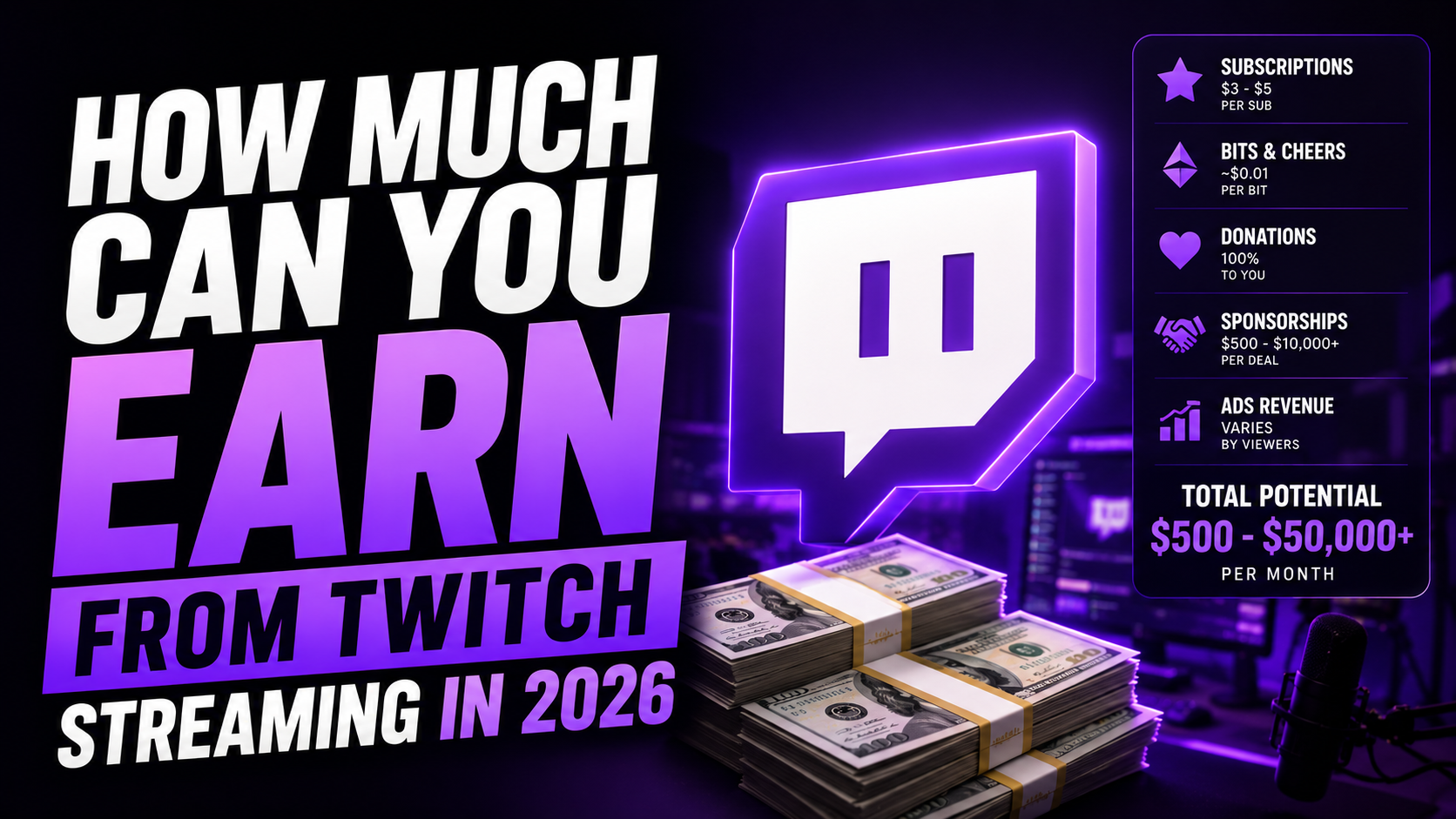
Twitch streamer earnings are legitimately hard to pin down because the revenue stack combines multiple different payment mechanisms, each with its own rules, splits, and eligibility requirements. Subscriptions, Bits, ad revenue, sponsor deals, donations, merchandise, and games storefront affiliate revenue all contribute to what a streamer actually takes home. The answer to "how much does Twitch pay" ranges from zero dollars (most streamers, most months, because they never crossed the Affiliate threshold) to seven-figure monthly income (top-tier streamers combining subs, sponsors, and diversified revenue streams). Between those extremes lies the honest middle where realistic streamer income actually accumulates. In this specific breakdown, we cover the real earning ranges by concurrent viewer tier, the subscription split economics that produce most working streamer income, how Bits and cheering compare to donations, the ad revenue and Ads Incentive Program mechanics, sponsor deal pricing for streamers, realistic monthly income tiers, and how targeted amplification through the buy twitch followers tier accelerates the Affiliate qualification timeline that keeps most new streamers locked out of platform monetization for their first 6 to 18 months.
Our team has tracked earning data across dozens of Twitch channels spanning multiple content categories including gaming, IRL (in real life), Just Chatting, creative, music, and podcast streams. The numbers in this article are drawn from actual streamer disclosures, tracked payout reports, and cross-referenced against public earnings data where streamers shared them. Not marketing hype. Not one-off screenshots. The realistic income ranges Twitch streamers actually earn in 2026, plus the full NLO SMM services catalog that supports both cold-start amplification for new streamers and ongoing viewer growth for established streamers optimizing their subscription pipeline.
Why Twitch Monetization Is Different From TikTok and YouTube
Twitch operates on a fundamentally different creator economics model than short-form platforms. Understanding these differences matters because strategies that produce meaningful income on TikTok or YouTube often fail on Twitch, and streamers expecting Twitch to pay like YouTube consistently underestimate the subscription-driven reality of the platform's actual monetization structure.
Live Streaming Requires Different Content Economics
Unlike TikTok or YouTube where a single successful piece of content can generate views and income for months, Twitch content is fundamentally ephemeral. A stream happens live, viewers watch in real time, and the value creation window largely closes when the stream ends. VOD (Video On Demand) archived streams generate secondary views, but the primary economics revolve around live audience presence. This live-first structure produces creator economics that reward consistent scheduling more than viral individual content.
The practical implication is that streamers cannot rely on one viral moment to sustain earnings. Monthly income depends on consistent weekly stream hours, sustained viewer counts across streams, and subscriber retention across months rather than one-hit viral spikes. This structural difference explains why Twitch streamers often work 20 to 40 hours weekly to sustain income levels that TikTok creators might reach with 8 to 10 hours of content production per week.
In my experience across tracked streamers, this economic model produces a specific pattern. Streamers who treat Twitch as a supplementary discovery channel while primarily building audience through other platforms often plateau at low income levels. Streamers who commit to Twitch-first scheduling and audience cultivation reach meaningful income tiers within 12 to 24 months because the live-relationship economics reward the sustained presence commitment.
Subscription-Driven Economics as the Primary Model
Twitch subscriptions produce roughly 50 to 70 percent of income for established streamers. This is different from YouTube where ad revenue produces the baseline income for most channels. On Twitch, monthly recurring subscriptions from viewers are the primary revenue foundation, with ads, Bits, sponsors, and donations supplementing that channel. Understanding this subscription-primary model changes how streamers approach growth strategy.
Subscription revenue is recurring by design. A viewer subscribing at Tier 1 (4.99 dollars monthly) continues paying monthly unless they explicitly cancel. This produces predictable monthly income for streamers with retained subscriber bases, unlike the deal-by-deal volatility that dominates Instagram creator economics. The trade-off is that subscribers require sustained content quality and community engagement to retain, otherwise they cancel and reduce baseline income.
The recurring revenue model produces specific strategic implications. Streamers who focus on subscriber retention through community building often earn more than streamers focused on maximizing peak concurrent viewers. A channel with 300 loyal subs producing 1,500 dollars monthly in reliable subscription revenue often outperforms a channel with occasional 3,000 concurrent viewer spikes that fail to convert to sustained subscriber base.
The Subscription Economy: The Real Revenue Engine
Twitch subscriptions are the single most important revenue mechanism for the majority of monetized streamers. Understanding subscription splits, tier economics, and retention dynamics is essential for realistic income planning because this channel produces the majority of what streamers actually take home each month.
The Three Subscription Tiers and Splits
Twitch offers three subscription tiers. Tier 1 costs viewers 4.99 dollars monthly and is the most common subscription type. Tier 2 costs 9.99 dollars monthly and includes additional exclusive benefits. Tier 3 costs 24.99 dollars monthly and represents premium fan support. Roughly 85 to 92 percent of subscriptions across the platform are Tier 1, with Tier 2 accounting for 5 to 10 percent and Tier 3 taking the remainder.
The creator revenue split depends on the streamer's Twitch tier status. Standard Affiliates receive 50 percent of subscription revenue (with the platform taking 50 percent). Partners historically received 50 percent by default with negotiated splits reaching 60 to 70 percent for larger channels. Twitch's Partner Plus program launched in 2023 offers 70 percent split to Partners meeting specific criteria including subscriber count minimums and stream frequency requirements.
Prime Gaming subscriptions (free monthly subscriptions for Amazon Prime members) pay creators the same as paid Tier 1 subs, though Twitch applies specific accounting for how these are calculated in payouts. Prime subs are meaningful income for smaller streamers because they lower the barrier for viewers to support the channel, expanding subscriber base without requiring viewers to pay directly.
Subscription Retention and Predictable Monthly Income
Sub retention rates vary enormously by streamer engagement quality. Streamers with strong community engagement typically retain 60 to 80 percent of subs month over month. Streamers with weak engagement retain 30 to 50 percent. This retention differential compounds dramatically over time. A streamer gaining 100 new subs monthly with 75 percent retention builds to roughly 400 subs baseline over six months. Same growth rate with 40 percent retention builds only to about 160 baseline subs.
Understanding retention dynamics changes what streamers optimize for. Chasing viral one-time sub spikes without engagement follow-through produces short-term revenue that collapses. Building community engagement that retains subs across months produces the compounding baseline that eventually reaches career-sustainable income levels. Streamers focused on retention metrics consistently outperform streamers focused only on sub acquisition volume.
Community-building tactics that lift retention include remembering regular viewer names, engaging chat throughout streams rather than ignoring it, hosting subscriber-only events like game nights or Q&A sessions, and creating consistent stream rituals that give subs specific reasons to renew each month. These tactics feel like extra effort but produce material retention improvements that compound across months into meaningful income differences.
Bits, Cheering, and Direct Fan Support
Beyond subscriptions, Bits and Cheering produce meaningful supplementary revenue for streamers with active real-time engagement. Understanding how Bits work clarifies where this channel fits in the overall earning stack.
How Bits Actually Generate Revenue
Bits are Twitch's virtual currency that viewers purchase with real money then use to cheer during streams. Each Bit generates 1 cent (0.01 dollars) of revenue for the streamer, with Twitch taking the remainder of the retail Bit price. Viewers cheer Bits by typing specific commands in chat, triggering animated notifications that highlight the cheer in the stream and chat feed.
Bit revenue depends heavily on stream personality and viewer engagement pattern. Personality-driven streamers with strong parasocial audiences produce substantially higher Bit revenue per viewer than gaming-focused streamers whose viewers are there primarily for gameplay. Comedy streamers, IRL streamers, and Just Chatting streamers typically generate the highest per-viewer Bit revenue because the audience relationship is more emotional and viewers actively want to signal support through cheering.
Consistent stream scheduling meaningfully lifts Bit revenue potential. Streaming at predictable times trains audiences to show up when streams happen, producing larger concurrent viewer counts that convert to higher Bit volumes. Streamers who broadcast 4 to 5 sessions weekly at consistent hours often earn substantially more Bits than streamers streaming sporadically to similar-size audiences.
Bits vs Direct Donations
Many streamers receive donations directly through third-party platforms (Streamlabs, StreamElements) rather than through Bits. Direct donations bypass Twitch's revenue split entirely, giving streamers 100 percent of donation amounts minus payment processing fees (typically 3 to 5 percent). This produces materially better economics for the streamer per donated dollar compared to Bits where Twitch takes a significant cut.
The trade-off is friction. Bits work seamlessly within the Twitch interface and produce visible on-stream celebration animations that viewers enjoy. Direct donations require viewers to leave the stream, use an external donation page, and complete separate payment flow. This friction reduces donation volume compared to Bits despite the better per-donation economics. Most streamers accept both channels and let viewers choose based on their preference.
Alert widgets that display donation and Bit notifications on stream create positive reinforcement patterns for future viewer support. When viewers see other viewers cheering or donating and getting on-stream acknowledgment, they become more likely to do the same. Configuring engaging donation alerts is a small technical setup that produces measurable revenue lift for streamers who take the time to design memorable on-stream celebration moments.
Ad Revenue and the Ads Incentive Program
Twitch runs ads during streams and pays streamers a portion of the ad revenue. Understanding how ad revenue works, and specifically how the Ads Incentive Program pays streamers who accept scheduled ad breaks, helps clarify what portion of income actually comes from advertising versus other channels.
Standard Ad Revenue Mechanics
Twitch runs pre-roll ads before viewers enter a stream and mid-roll ads that streamers can trigger manually or that Twitch triggers automatically for streamers who allow automatic ad breaks. Standard ad revenue splits pay streamers approximately 55 percent of ad CPM, similar to YouTube's split. CPMs vary widely by streamer size, audience geography, and viewer demographic.
Typical Twitch ad RPMs (revenue per 1000 ad impressions) fall in the 3 to 10 dollar range for USA-focused streamers depending on category and audience quality. Emerging market audiences produce substantially lower RPMs (0.30 to 1.50 dollars per 1000). Ad revenue is meaningful but rarely the primary income for streamers focused on Twitch monetization. Most streamers earn 10 to 25 percent of their total Twitch income from ads with the remainder coming from subs, Bits, and sponsors.
The Ads Incentive Program
Twitch's Ads Incentive Program (AIP) pays streamers who commit to running specific numbers of ad minutes per streamed hour. AIP pays a flat rate per streamed hour with ads, typically 100 to 500 dollars per hour depending on streamer tier and month. This program has become one of the more attractive Twitch revenue mechanisms because it pays predictable rates regardless of viewer count or ad performance.
Enrollment in AIP is invite-based and depends on streamer performance history. Established streamers with consistent viewer counts qualify for higher AIP tiers. New streamers below the Affiliate threshold cannot access AIP. Understanding when your channel qualifies for AIP participation and what tier you can access helps calibrate expectations about the ad revenue portion of your income stack.
Ad break placement affects viewer experience meaningfully. Running ad breaks during natural content pauses (character loading screens in games, transitional moments in Just Chatting) reduces viewer disruption compared to ad breaks that interrupt exciting gameplay moments. Streamers who thoughtfully schedule ad breaks retain viewers better than streamers who let ads run automatically during peak engagement moments, which produces higher long-term earnings even at lower per-hour ad rates.
Sponsorships and Brand Deals for Streamers
Sponsorships represent the highest single-deal payout mechanism for established streamers, often exceeding what subscription revenue produces monthly. Understanding sponsor economics for streamers helps clarify where the actual money lives once streamers reach meaningful scale.
Sponsor Deal Pricing Structure
Streamer sponsor pricing typically follows a formula based on average concurrent viewers rather than follower or subscriber count. Rough benchmarks in 2026 place sponsor rates at approximately 5 to 20 dollars per average concurrent viewer per hour of sponsored content. A streamer averaging 500 concurrent viewers running a 3-hour sponsored gaming session might charge 7,500 to 30,000 dollars for the sponsored session.
The concurrent viewer metric matters more than follower count for streamers because live viewership is what sponsors actually reach with their promotional content. A streamer with 100,000 followers but only 200 concurrent viewers has much less sponsor value than a streamer with 30,000 followers but 800 concurrent viewers. Building strong live viewer count is what unlocks meaningful sponsor income at each tier.
Deal Types and Long-Term Partnerships
Sponsor deals come in several structures. Single sponsored streams paying flat fees for one dedicated broadcast. Multi-stream campaign packages spread across weeks with total campaign values in the 10,000 to 500,000 dollar range for established streamers. Long-term ambassador deals producing monthly retainer income for consistent brand promotion across ongoing streams. Ambassador deals stabilize income against the volatility of single-stream sponsor revenue.
Endemic gaming sponsors (peripherals, chairs, energy drinks, game publishers) produce the most predictable pipeline for gaming streamers. Non-endemic sponsors (consumer brands, financial services, tech products) enter the market for streamers with broader audiences beyond pure gaming demographics. Building audience diversity beyond core gaming attracts non-endemic sponsors that often pay higher rates than saturated endemic categories.
Sponsor deal negotiation for streamers benefits significantly from understanding the value of usage rights, exclusivity, and post-stream content repurposing. Sponsors often want to clip highlights from sponsored streams for their own marketing, request exclusivity within a product category for a defined period, or require follow-up content beyond the sponsored stream itself. Charging appropriately for these extensions consistently produces materially better final deal value than accepting first offers that include everything in the base rate.
Realistic Earnings by Concurrent Viewer Tier
The most useful way to think about Twitch earnings is by average concurrent viewer count. Each tier has typical income ranges that combine subscriptions, Bits, ads, and sponsors into realistic monthly income projections.
Pre-Affiliate Tier: 0 to 50 Concurrent Viewers
Streamers below the Twitch Affiliate threshold earn nothing from platform payouts. Zero subscription revenue, no Bits, no ads. The channel serves purely as a marketing surface for external revenue streams like direct donations, personal brand building toward off-platform monetization, or funnel-building toward owned products. This tier is where most streamers quit before reaching viable income levels.
The strategic focus during this phase is crossing the Affiliate threshold as fast as possible, not extracting revenue from a channel that structurally cannot produce it yet. Affiliate requirements are 50 followers, 500 total minutes broadcast, 7 unique broadcast days, and average of 3 concurrent viewers over a 30-day period. These are achievable but require sustained streaming effort during the pre-monetization phase.
Affiliate Tier: 50 to 500 Concurrent Viewers
Affiliate streamers start earning from subscriptions, Bits, and ads once they cross the threshold. Total monthly income at this tier typically ranges from 50 to 3,000 dollars. Subscriber counts at 20 to 200 subs produce 100 to 800 dollars monthly. Bits and ads add another 50 to 500 dollars monthly. This is where Twitch starts producing supplementary income but rarely enough to justify full-time streaming without other revenue streams.
Sponsor deals become available at this tier but remain limited. Small endemic sponsors (peripheral brands, indie games, energy drink micro-brands) may offer 200 to 2,000 dollar sponsored streams. One or two sponsor deals monthly can effectively double or triple platform income at this tier. Total tier income including sponsors typically lands in the 200 to 6,000 dollar monthly range.
Building sponsor pipeline habits early helps even at this modest viewer count. Setting up a professional email address, maintaining a basic media kit, and practicing outreach on smaller brands teaches negotiation skills that pay off enormously once concurrent viewer count reaches sponsor-viable scale. Most streamers who reach top tiers built these habits during the Affiliate phase.
Mid Tier: 500 to 5,000 Concurrent Viewers
Mid-tier streamers generate meaningful primary income from Twitch. Subscription revenue typically produces 3,000 to 30,000 dollars monthly for streamers with 500 to 3,000 active subscribers. Bits and ads add another 1,000 to 5,000 monthly. Sponsor deals scale meaningfully at this tier, with individual sponsored streams paying 2,500 to 30,000 dollars each.
Total mid-tier income typically lands in the 8,000 to 100,000 dollar monthly range depending on category, sponsor pipeline management, and Ads Incentive Program participation. This is where Twitch becomes viable primary income for many streamers. Ambassador deals producing 5,000 to 40,000 monthly retainers stabilize income against the volatility that pure single-deal sponsorship revenue would produce.
Partner Tier: 5,000 to 50,000 Concurrent Viewers
Partner-tier streamers generate income scaling into six-figure monthly ranges. Subscription revenue produces 30,000 to 500,000 dollars monthly for streamers with active subscriber bases of 5,000 to 50,000. Bits, ads, and sponsors add another 20,000 to 300,000 dollars monthly. Total monthly income at this tier typically ranges from 60,000 to 1,000,000+ dollars for streamers fully monetizing across all channels.
Partner Plus qualification unlocks 70 percent subscription splits that meaningfully affect income at this tier. A streamer with 5,000 active Tier 1 subs earning 50 percent splits produces 12,475 monthly gross. Same streamer at 70 percent splits produces 17,465 monthly gross. The additional 5,000 dollars monthly compounds across the year to 60,000+ dollars in additional income purely from the split improvement.
Top Tier: 50,000+ Concurrent Viewers
Top-tier streamers generate seven-figure monthly income routinely. Individual sponsor deals reach 100,000 to 2 million dollars per major campaign. Subscription bases of 20,000 to 100,000+ active subs produce 100,000 to 700,000 dollars monthly at Partner Plus splits. At this tier, streaming operations resemble media companies with dedicated teams supporting content production, sponsor sales, and community management.
The gap between Partner tier and Top tier is often bigger than streamers expect. Reaching 50,000 concurrent viewers requires either exceptional viral events or years of consistent audience compounding beyond what most Partner-tier streamers achieve. Most streamers at 10,000 concurrent viewers take 24 to 48 additional months to reach 50,000, and many never cross that threshold despite steady growth. Treating Partner tier as career-viable rather than chasing top-tier metrics is often the pragmatic choice.
Concurrent Viewers Drive Income
Subscriptions convert from concurrent viewers who become fans. Sponsors pay based on average concurrent viewership. Bits and Cheering scale with active audience presence. Growing concurrent viewer count is the meta-metric that unlocks every other Twitch revenue channel.
Affiliate vs Partner: The Critical Distinction
Understanding the difference between Twitch Affiliate and Partner status is essential because the two tiers unlock different monetization capabilities and split economics.
What Each Tier Actually Unlocks
Twitch Affiliate is the entry monetization tier available to streamers meeting minimum broadcasting criteria. Affiliates can accept subscriptions, receive Bits, run ads through basic ad breaks, and participate in some sponsored programs. Standard subscription split is 50 percent. Ad revenue splits at 55 percent creator share. Affiliate is straightforward to reach and represents the transition from unpaid streaming to platform monetization.
Twitch Partner is the elevated tier available to streamers who apply and meet stricter performance criteria. Partners unlock enhanced features including custom emote slots (increasing from Affiliate's basic slots to Partner's expanded slot count), better sub badge customization, priority customer support, exclusive Partner-only events and promotions, and access to negotiated subscription splits above the standard 50 percent.
Partner Plus is a further elevated tier within the Partner program launched in 2023. Partner Plus streamers who meet specific criteria (typically 350 recurring paid subscriptions maintained for 3 consecutive months plus other performance requirements) unlock 70 percent subscription splits on the first 100,000 dollars of monthly gross subscription revenue. This meaningfully improves subscription economics for streamers at the qualifying threshold.
The Timeline From Affiliate to Partner
Reaching Twitch Partner typically takes 12 to 36 months of consistent streaming after reaching Affiliate. Requirements are not fully public but rough patterns show that streamers with average concurrent viewers of 75 to 500 across their most-recent 30 days can apply successfully with strong stream frequency and community engagement metrics. Some streamers reach Partner faster through breakthrough moments or viral clips that dramatically lift viewership.
Understanding this timeline changes how streamers should think about growth. The Affiliate-to-Partner phase produces meaningful income even without Partner status, so the tier upgrade primarily affects growth ceiling rather than baseline income. Streamers should focus on sustained community building during this phase rather than obsessing over Partner qualification specifically.
Partner Plus qualification requires maintaining 350 recurring paid subscriptions for 3 consecutive months (as of the current program terms). Streamers approaching this threshold should track their sub count month over month and identify what content or community activities correlate with subscriber growth. Small changes in engagement approach that push sub count past the 350 threshold unlock the 70 percent split that produces substantially better economics indefinitely.
How Amplification Accelerates the Affiliate Threshold
The cold-start problem for new Twitch streamers centers on reaching the Affiliate threshold that unlocks all platform monetization. Reaching the minimum requirements (50 followers, average 3 concurrent viewers, 500 total broadcast minutes, 7 unique broadcast days) typically takes new streamers 3 to 8 months of consistent streaming during which the channel produces zero platform revenue.
Why the Affiliate Threshold Is So Difficult
The 50-follower requirement sounds easy but is genuinely challenging for new streamers. Twitch's discovery mechanics distribute new-channel streams conservatively because the algorithm has no historical data to base confidence on. Small stream audiences produce weak signal that limits distribution expansion. This limited distribution produces slow follower growth, extending the timeline to Affiliate eligibility.
The 3 concurrent viewers requirement compounds the challenge. Solo streaming to an empty channel is discouraging and rarely produces the sustained streaming effort needed to accumulate broadcast minutes. Many streamers give up during this phase before the algorithm has any chance to compound their content because the visible progress feels disproportionate to the effort invested.
How Targeted Amplification Breaks Through
Targeted amplification through viewer amplification combined with follower growth accelerates the Affiliate qualification timeline meaningfully. Adding proportional followers plus concurrent viewers during streams triggers the algorithmic trust score elevation that produces organic follower growth on subsequent streams.
Our team's data shows that streamers combining organic content strategy with targeted amplification reach Affiliate eligibility in 1 to 3 months rather than the organic-only 3 to 8 months. The compressed timeline converts the pre-monetization phase from a 6+ month zero-revenue slog into a shorter 2 to 3 month period with subscription income arriving at the end.
The amplification is not a shortcut around content quality. Poor streams that receive amplification still stall after the initial boost because organic viewers do not continue engagement. Quality streams amplified past the Affiliate threshold continue generating organic viewer growth because the algorithm's trust score elevation persists as long as content quality holds up under expanded distribution.
Case Study: Streamer Path From Zero to 4,800 Dollars Monthly
Real numbers make the abstract concrete. This case walks through the actual 12-month timeline of a gaming streamer client we tracked, showing how the earning math translates into practical monthly income when strategies are applied consistently.
Months 1 to 3: Foundation and Affiliate Push
The account started as a new variety gaming streamer focused on indie and roguelike games. Zero followers, no prior streaming history. Content plan was 4 streams per week at 3 to 4 hours each, plus recorded VODs uploaded to YouTube for secondary discovery. The streamer handled all production personally with a mid-tier microphone and basic webcam setup.
Months 1 and 2 produced typical cold-start results. Average concurrent viewers hovered around 1 to 2. Follower count reached 34 by end of Month 2. Zero platform revenue because the channel was well below Affiliate threshold. In Month 3, the streamer added targeted amplification through paid viewer and follower services to accelerate the Affiliate qualification path.
Month 3 saw the Affiliate threshold reached. Follower count crossed 60 (organic plus amplification). Average concurrent viewers reached 4 during peak streaming windows. Broadcasting minutes accumulated to well above 500 across 12 stream days. Affiliate application submitted and approved by end of Month 3, unlocking subscription monetization.
Months 4 to 8: Monetization Ramp
Month 4 through 8 saw steady growth. Subscriber count climbed from initial 8 (Month 4) to approximately 85 (Month 8). Subscription revenue climbed from 40 dollars in Month 4 to 425 dollars in Month 8. Bits and ads added another 100 to 300 dollars monthly. Average concurrent viewers reached 60 to 120 by end of Month 8.
Month 6 brought the first small sponsor opportunity from a peripheral brand at 400 dollars for a single sponsored stream. Month 7 added another 500 dollar sponsor deal. These small sponsor deals meaningfully lifted monthly income above pure subscription baseline. Month 8 total income reached approximately 1,600 dollars combining subs, Bits, ads, and sponsors.
Months 9 to 12: Approaching Partner Territory
By Month 10, subscriber count reached 240. Average concurrent viewers stabilized around 180 to 250 during peak streams. Subscription revenue reached 1,200 monthly. Ads Incentive Program invitation arrived in Month 10 adding another 400 monthly in AIP payments.
Month 12 saw the account approach Partner-eligible metrics. Subscribers reached 380 active. Average concurrent viewers stabilized around 320. Total Month 12 income reached 4,800 dollars combining subscription revenue (1,900), Bits and ads (450), AIP payments (500), and three sponsor deals (1,950).
Total 12-month journey. Approximately 500 dollars invested in amplification during Months 3 through 5 to accelerate Affiliate qualification and initial viewer momentum. Total cumulative income across 12 months reached approximately 18,000 dollars. Return on amplification investment: roughly 36 times the initial spend. Partner application projected for Month 15 to 16 as the account continues its trajectory.
From Zero to 4,800 Monthly in 12 Months
Real streamers hitting real numbers when strategic amplification aligns with quality streaming. Twitch monetization is not theoretical. The paths are documented, the timelines are shorter than most expect once Affiliate gets crossed, and the compounding continues as viewer counts grow into Partner territory.
Frequently Asked Questions About Twitch Streamer Earnings in 2026
How much does Twitch pay streamers per viewer?
Twitch does not pay per viewer directly. Revenue comes from subscriptions (streamer receives 50-70% split), Bits (streamer gets 1 cent per Bit cheered), ads (55% streamer share of CPM), and sponsors (variable rates typically 5-20 dollars per average concurrent viewer per sponsored hour). Total per-viewer earnings vary enormously based on category and audience quality.
How much does a Twitch subscription pay the streamer?
Standard Affiliates and Partners receive 50 percent of subscription revenue. Tier 1 (4.99 dollar) subs pay the streamer 2.50 dollars. Tier 2 (9.99) pays 5.00. Tier 3 (24.99) pays 12.50. Partner Plus streamers receive 70 percent splits, producing 3.50 per Tier 1 sub. Prime Gaming subs pay the same as paid Tier 1.
What are the requirements to become a Twitch Affiliate?
Twitch Affiliate requirements are 50 followers, 500 total minutes broadcast, 7 unique broadcast days, and average of 3 concurrent viewers over a 30-day period. These metrics must be met before Twitch offers the Affiliate agreement that unlocks subscriptions, Bits, and ad revenue.
How long does it take to make 1000 dollars monthly on Twitch?
Organic-only growth typically takes 12 to 24 months to reach consistent 1,000 dollar monthly income. Amplified growth using targeted viewer and follower acceleration can compress this to 6 to 10 months. Timeline varies by category, streaming schedule consistency, and personality-driven audience building capability.
What is the difference between Affiliate and Partner?
Affiliate is entry-tier monetization with 50 percent standard subscription split and basic feature access. Partner is elevated tier requiring application with stricter criteria, offering enhanced features, expanded emote slots, priority support, and access to negotiated splits reaching 70 percent through Partner Plus program for qualifying streamers.
How much do sponsored streams pay?
Sponsored stream rates follow rough formula of 5 to 20 dollars per average concurrent viewer per sponsored content hour. A 500-viewer streamer running 3-hour sponsored stream might charge 7,500 to 30,000. Larger streamers unlock major-brand sponsor categories with per-campaign values reaching 100,000 to 2 million dollars.
What is the Twitch Ads Incentive Program?
AIP pays streamers who commit to running specific numbers of ad minutes per streamed hour. Payments are flat rates per streamed hour with ads, typically 100 to 500 dollars per hour depending on tier and month. Enrollment is invite-based and depends on streamer performance history. Not accessible below Affiliate tier.
Do Twitch streamers make more money from subs or sponsors?
Subscriptions produce roughly 50 to 70 percent of income for established streamers. Sponsors produce 15 to 40 percent for streamers with active pipeline management. Bits, ads, and other channels fill the remainder. The exact mix varies by category and streamer specialization, but subscriptions typically form the baseline recurring income.
Which Twitch categories earn the most?
Just Chatting produces the highest per-viewer revenue for personality-driven streamers. Popular game categories (League of Legends, Valorant, Fortnite) attract large audiences that convert to substantial subscription volumes. Music, IRL streams, and podcasting formats produce strong income for streamers with dedicated communities.
Does buying viewers help Twitch channel growth?
Quality viewer services delivered within safe parameters help by breaking cold-start barriers and accelerating Affiliate qualification. Cheap services with obvious bot patterns can trigger platform enforcement that restricts monetization or bans accounts. Service quality determines whether amplification helps or hurts.
Can I earn on Twitch streaming games I do not own?
Yes, though Twitch community guidelines require respecting DMCA and copyright rules. Most game publishers explicitly permit streaming their games. Some publishers require specific attribution or restrictions on monetization from their content. Reviewing publisher streaming policies before building around specific games prevents monetization issues later.
Final Thoughts
Twitch monetization in 2026 is real, meaningful, and achievable for streamers willing to commit to sustained streaming schedules and community-building effort. The economics are structurally different from short-form platforms because Twitch rewards recurring subscription retention rather than viral individual content. Subscriptions produce the majority of income for established streamers. Bits, ads, sponsors, and donations supplement the subscription baseline.
The barrier that kills most streamer monetization attempts is the pre-Affiliate phase where new channels produce zero revenue for 3 to 8 months while reaching the minimum threshold requirements. This is where targeted amplification becomes strategically valuable. Compressing the 3 to 8 month organic-only Affiliate path into a 1 to 3 month accelerated timeline converts the zero-revenue period into a short sprint with subscription income arriving at the end.
The NLO SMM Twitch services stack provides every component of the amplification strategy that supports Affiliate qualification acceleration and the ongoing viewer growth that scales streamer earnings across the Affiliate-to-Partner path. Combined with consistent streaming schedules and quality content production, deliberate Twitch monetization becomes an operational system that produces predictable outcomes. The streamers earning meaningful monthly income from Twitch in 2026 are executing specific playbooks, and this article documented the earning math those playbooks produce.
Ready to Boost Your Social Media Presence?
Join thousands of satisfied customers who trust NLO SMM Panel for their social media growth.