Best Time to Post on Facebook in 2026 (Day-by-Day Data-Backed Guide)
Ready to Grow Your Social Media?
Join thousands of creators and businesses using NLO SMM Panel
Best time to post on Facebook in 2026 matters for one mechanical reason: the ranking system weighs your post's first 60-120 minutes of engagement disproportionately, and posting when your audience is actually online decides how strong those first signals can possibly be. Miss your audience's active window and the algorithm evaluates your post against a half-empty room, producing weak velocity that caps distribution before the content gets a fair read. Hit the window and identical content compounds through progressively wider distribution rings across the following days. But is timing more important than content quality? No. Content quality is the ceiling. Timing is the floor. And Pages building their audience foundation through consistent posting paired with quality Facebook Page likes support still need timing discipline underneath, because even a strong follower base produces weak velocity when posts land while it sleeps. This guide covers exact optimal windows Monday through Sunday, format-specific timing for Reels versus Feed posts, niche patterns for local business, ecommerce, and creator Pages, posting frequency strategy, and how to replace generic advice with your own Insights data.
Our team tracks posting timestamps against 28-day reach outcomes across dozens of managed Facebook Pages spanning local business, ecommerce, creator, and media niches, and every window recommended here comes from that correlation work rather than recycled infographics. For the ranking mechanics underneath these recommendations, cross-reference the NLO SMM Facebook algorithm deep dive covering the full four-stage pipeline, and our Instagram posting time breakdown for how Meta's other major surface compares.
Why Posting Time Still Matters on Facebook in 2026
A recommendation-driven Feed sounds like timing should be dead. It is not, and the reason sits in how the algorithm decides which posts deserve recommendation distribution in the first place.
Early Velocity and the Evaluation Window
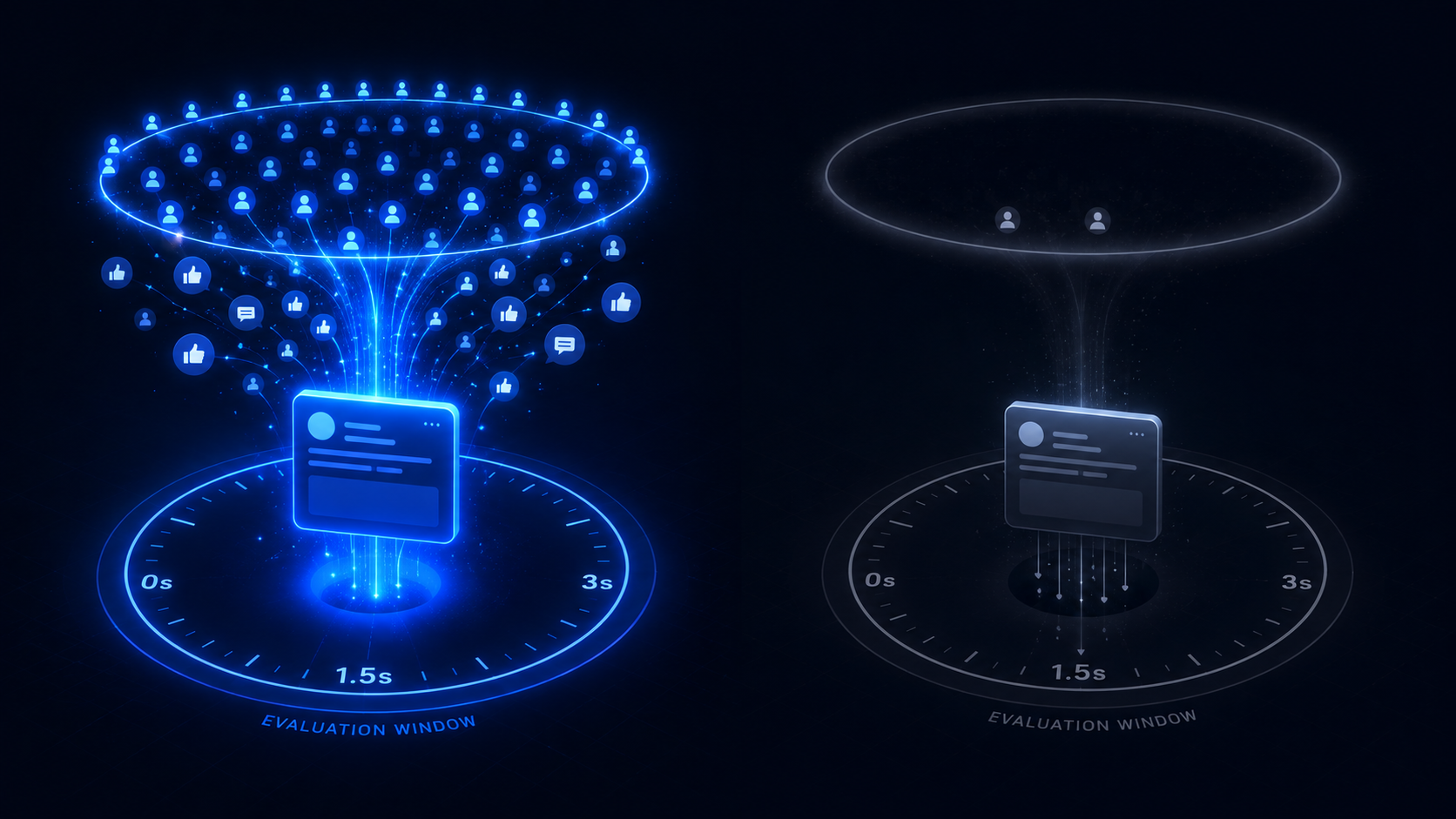
Facebook shapes a post's distribution ceiling from signal accumulation in the first 60-120 minutes after publishing. Comments, shares, reactions, and dwell behavior arriving fast from credible accounts tell the prediction model the post generates action, which expands the next test ring. A post that stalls in hour one rarely recovers regardless of how good it looks in hour twelve.
Posting time is the single biggest lever on that early window. The same post published at 11 AM Wednesday, when your audience checks Facebook during a break, and at 2 AM Saturday faces two completely different evaluation audiences. One produces velocity, the other produces silence, and the algorithm cannot tell the difference between content nobody wanted and content nobody saw.
In my experience auditing Page analytics, timing misalignment is the most common fixable reach problem after penalty flags. Owners post when they finish work, usually late evening, while their audience's measured active hours peaked at midday. The content was fine... the evaluation room was empty.
Timing Is the Floor, Content Is the Ceiling
No posting window rescues weak content, because velocity without second-ring engagement teaches the model the post does not convert beyond its first audience. Timing optimization raises the floor under every post by guaranteeing the evaluation happens against a full room. What happens after that depends on the content itself.
The two multiply rather than add. Strong content at a dead hour underperforms because evaluation signals never accumulate. Weak content at peak hour underperforms because the full room ignores it. Strong content at peak hour is where outsized reach lives, and our tracked Pages show 2-4x reach differences between peak-window and dead-hour publishing of comparable posts.
That multiplier also compounds at Page level. Consistent peak-window posting builds the baseline trust that sets each new post's starting test audience, so timing discipline pays forward across every future post, not just the one you scheduled correctly today.
How the Facebook Algorithm Uses Posting Time
Facebook has no explicit "posted at a good hour" ranking factor. Timing works through indirect mechanics, and understanding them separates meaningful optimization from superstition.
Predicted Interactions and Active-Hour Alignment
The ranking system predicts, per viewer, the probability of comment, share, and dwell actions on each candidate post. Those predictions lean heavily on fresh engagement evidence. Publishing into your audience's active hours front-loads that evidence when recency weighting is strongest, which lifts the relevance scores your post carries into wider distribution rounds.
Active-hour alignment also changes who engages, not just how many. Break-time and evening audiences interact more fully: longer dwell, more substantive comments, more Messenger shares. Dead-hour audiences skim. Since signal quality is weighted by depth and account credibility, peak windows improve both the volume and the weight of your first-hour signals simultaneously.
Does this mean a great post at a bad time is doomed? Mostly, yes, on connected distribution. Reels get partial rescue because recommendation surfaces keep testing them across days, but standard Feed posts live and die on early velocity almost entirely.
Page Baseline and Consistency Signals
Beneath per-post evaluation sits the Page-level baseline: accumulated evidence of how audiences respond to your content over time. Pages that publish on a stable schedule feed the prediction model a continuous calibration stream, and our team's data suggests stable-cadence Pages outperform burst-and-silence Pages at identical content quality.
Consistency interacts with timing directly. A Page that posts every weekday at 11 AM trains both the model and the audience; regular fans learn when fresh content lands and become the early-velocity engine each post needs. Erratic timing wastes that training even when individual windows are chosen well.
And the baseline decays. Two or three weeks of scattered posting drags the calibration back toward cold-start behavior, which is why timing strategy is a schedule commitment rather than a per-post decision.
The Algorithm Cannot Rank a Post Nobody Saw
Facebook decides a post's distribution ceiling from its first 60-120 minutes of signals. Publishing while your audience is offline means the evaluation runs against an empty room, and the algorithm reads silence as low quality. Posting time is the one lever that guarantees a full room for every evaluation.
Best Time to Post on Facebook Monday Through Wednesday
Early week on Facebook builds from a slow Monday start into the strongest sustained window of the week at midweek. The three days reward different content types at different hours.
Monday Windows
Monday 7-9 AM captures commute and coffee browsing as audiences ease into the week, a strong slot for local business updates, service announcements, and practical content. Monday midday (12-2 PM) performs moderately, while Monday evening (7-9 PM) recovers well for Reels and entertainment content as audiences decompress.
Monday is also a lower-competition day. Many Pages skip it entirely after weekend breaks, which means Monday morning slots face thinner competition for Feed placement than midweek mornings. Our tracked local business Pages consistently see Monday 8 AM posts outperform their own Tuesday 8 AM posts on reach-per-follower, purely on competition dynamics.
What Monday punishes is heavy promotional content. Audiences in week-start mode hide sales posts at higher rates than midweek, and hides are weighted heavily as negative feedback. Save promotion for Thursday-Friday and spend Monday on utility.
Tuesday and Wednesday: The Midweek Peak
Tuesday through Wednesday 11 AM-1 PM is the strongest general-purpose Facebook window of the week across our tracked niches. Lunch-break browsing produces full-attention audiences with time to read, comment, and share, exactly the signal profile the evaluation window rewards. Wednesday in particular ranks as the top overall posting day on most Pages we monitor.
Morning windows (7-9 AM) both days perform strongly for business and news-style content, and evening windows (7-9 PM) lead for Reels. The midweek pattern is remarkably stable year over year... audience routines anchor to the workweek, and workweek structure does not trend.
My tracked Pages show midweek midday posts producing 30-50% higher average reach than identical-format posts published on weekend afternoons. If a Page posts only three times weekly, Tuesday midday, Wednesday midday, and Thursday evening capture the most value per post of any three-slot combination we have tested.

Best Time to Post on Facebook Thursday Through Saturday
Late week shifts Facebook's audience from work-break browsing toward leisure browsing, and the optimal windows migrate later in the day as that happens.
Thursday Windows
Thursday holds the midweek midday strength (11 AM-1 PM) while adding the week's first strong late-evening window as weekend anticipation builds. Thursday 7-9 PM is the best early slot for promotional and event content because audiences begin planning their weekends, and event responses cluster heavily in this window on our tracked Pages.
Thursday posts also enjoy favorable runway. Distribution momentum built Thursday carries into Friday-Sunday browsing, extending the post's productive life across the week's highest-leisure days. Pages launching important posts get more from Thursday than from Sunday for this reason alone, and pairing key launches with first-hour engagement support like Facebook post likes services during the evaluation window reinforces the velocity that decides whether that runway ever opens.
Friday Windows
Friday mornings (8-11 AM) perform surprisingly well as work focus loosens and browsing rises during the wind-down. Lifestyle, entertainment, and casual content peak here. Friday midday holds steady, but Friday 5-8 PM turns volatile: part of your audience is out socially, part is decompressing at home, and which segment dominates depends entirely on your Page's demographics.
Friday late evening (9-11 PM) works for entertainment Reels aimed at younger audiences and fails for business content almost universally. Test it once against your own Insights before making it a habit. And avoid publishing anything strategically important Friday after 3 PM if your audience skews professional; the workweek attention that powers B2B engagement is simply gone.
Saturday Windows
Saturday 9-11 AM is the weekend's best slot, catching relaxed morning browsing over coffee when audiences have attention to spare. Community content, longer text posts, and photo posts earn their best weekend dwell times here. Saturday morning also faces reduced Page competition, since business Pages disproportionately go silent on weekends.
Saturday evening (7-9 PM) performs well for Reels and entertainment while staying mediocre for anything requiring focus. Saturday midday is the weekend's dead zone, with audiences out at errands and events, and posts published 12-4 PM Saturday consistently record the weakest first-hour velocity of any daytime slot on our tracked Pages.
Best Time to Post on Facebook Sunday
Sunday behaves unlike any other day. It contains one genuinely strong window, one mediocre stretch, and the single worst posting window of the entire week, all inside twelve hours.
The Sunday Morning Community Window
Sunday 9 AM-12 PM captures unhurried browsing when audiences give content more dwell than any weekday allows. Reflective posts, community spotlights, weekly recaps, and story-driven text posts perform their weekly best in this window. Group activity also peaks Sunday morning, making it the prime slot for discussion posts inside owned Groups.
Competition is thin, too. Most Pages have abandoned Sunday entirely, so credible content published Sunday morning competes against a shallow inventory pool for connected placements. Our tracked community-focused Pages regularly see Sunday morning posts outperform their weekday average, a pattern that surprises owners who assumed weekends were dead across the board.
The Sunday Evening Slowdown
Sunday from late afternoon onward tightens steadily as audiences shift into week-preparation mode. Sunday 6-8 PM performs below every weekday evening, and Sunday after 9 PM is the weakest window of the week. First-hour audiences are minimal, dwell is short, and the post's momentum then has to survive Monday, itself a modest browsing day.
Is there any content that justifies Sunday night publishing? Practically none. A post finished Sunday evening loses nothing by being scheduled for Monday 8 AM, and gains a full commute-hour evaluation audience. Scheduling exists precisely for this gap between when content is ready and when audiences are.
Best Posting Times by Format: Reels, Text, Photos, and Links
Facebook's surfaces evaluate formats differently, and each format's optimal window follows its consumption mode. Treating all posts as timing-identical wastes the biggest known performance gaps.
Facebook Reels Timing
Reels peak in evening leisure windows, 7-9 PM on weekdays and slightly later on Friday-Saturday, when short-video browsing dominates platform behavior. The Reels evaluation runs on completion and rewatch behavior against a test audience, so publishing into high-consumption hours gives the test its best possible sample. Full format tactics live in the NLO SMM guide to getting views on Facebook Reels; the timing layer here multiplies everything in it.
Reels forgive timing errors more than Feed posts because recommendation surfaces keep testing them across days. They do not forgive them completely. Our tracked Pages see evening-published Reels open with materially stronger first-day view accumulation than morning-published Reels, and that early momentum shapes how aggressively distribution expands. Creators supporting launch-window watch volume with Facebook views services get the most from that support inside the same evening windows, when organic completion data is accumulating alongside it.
One caution: do not stack a Reel and a Feed post inside the same hour. They split your active audience's attention during both evaluations, and both open weaker than either would alone. Space formats at least 3-4 hours apart.
Text, Photo, and Link Post Timing
Native text and photo posts earn distribution through dwell and conversation, which makes them midday formats: 11 AM-1 PM weekdays and Saturday-Sunday mornings, when audiences have reading attention. A story-driven text post published into a lunch window gets the 20-40 second dwell reads that expand distribution; the same post at 10 PM gets skimmed.
Link posts carry a ranking discount everywhere, so give them the strongest possible slot when you must publish them: Tuesday-Thursday mornings for professional audiences, midday otherwise. Never spend your week's best window on a link post, and never publish links on weekends, where their already-reduced reach drops further on our tracked Pages.
Photo carousels and multi-image posts behave like text posts with a longer dwell ceiling, rewarding the same midday and weekend-morning windows. The swipe-through behavior they generate reads as strong engaged-time signal, and it accumulates best when audiences are unhurried.
Match the Format to the Hour, Not Just the Day
Reels win evenings when short-video browsing peaks. Text and photo posts win midday and weekend mornings when audiences have reading attention. Link posts need the strongest weekday-morning slot you can spare. The day-level advice everyone repeats misses where the real gaps live: format-to-hour alignment.
Niche-Specific Facebook Timing Patterns
Generic windows average across audiences that behave nothing alike. Layering niche patterns over the baseline windows is where tracked Pages separate from guesswork.
Local Business and Service Pages
Local business audiences browse in commute and lunch rhythms, making weekday 7-9 AM and 12-2 PM the core windows. Posts announcing hours, offers, or availability peak Monday-Wednesday mornings when weekly planning happens. Restaurant and hospitality Pages add a strong Thursday-Friday 4-6 PM window as audiences plan evenings out.
Weekend behavior splits by business type. Service businesses see Saturday morning engagement from audiences handling household decisions; nightlife and events Pages see Friday-Saturday afternoon peaks as plans form. The consistent rule across local niches: post before the decision moment, not during it, because Facebook browsing precedes the outing rather than accompanying it.
Ecommerce and Creator Pages
Ecommerce Pages peak in evening browse windows (7-9 PM) when purchase-adjacent scrolling happens, with Thursday-Friday evenings strongest as weekend discretionary spending approaches. Midday product posts underperform evening product posts consistently on our tracked stores, inverting the general-content pattern, because shopping mode is a leisure mode.
Creator and entertainment Pages live in the same evening windows plus weekend mornings, tracking leisure attention throughout. For both niches, the wider growth stack matters alongside timing, and the NLO SMM guide to the best SMM panel for Facebook in 2026 covers how amplification services layer onto a posting schedule that already hits the right hours. Timing multiplies support exactly as it multiplies content.
Posting Frequency and Scheduling Strategy
Window selection answers when. Frequency and scheduling answer how often and how sustainably, and both feed the consistency signals the baseline is built from.
The 4-7 Weekly Posts Sweet Spot
Our tracked Pages perform best at 4-7 Feed posts weekly plus near-daily Reels, published on a stable schedule. Below that cadence the calibration stream thins and the audience habit never forms. Above roughly ten weekly Feed posts, per-post reach declines as posts begin competing with each other for the same audience's limited attention.
Spacing matters as much as count. Posts published 4-6 hours apart each get a clean evaluation window; posts stacked an hour apart cannibalize each other's velocity. A Page posting twice daily does best pairing a midday Feed post with an evening Reel, covering both attention modes without overlap.
But sustainability beats ambition every time. A schedule you hold for ninety days builds more baseline than a heavier schedule abandoned in week three, because the model rewards the pattern, not the burst. Choose the cadence your production capacity survives.
Scheduling With Meta Business Suite
Meta Business Suite's Planner schedules Feed posts, Reels, and Stories natively, and scheduled posts carry no ranking penalty against live-published posts. This severs production time from publishing time completely: batch content whenever convenient, publish at the windows your data selects.
Planner also surfaces suggested times built from your Page's own activity data, a reasonable starting point worth checking against the Insights analysis below. Treat the suggestions as hypotheses rather than answers... they optimize for general activity, not for your format mix or content goals.
How to Find Your Page's Personal Best Times
Every window above is a starting point. Your audience's measured behavior outranks any general recommendation, and Facebook hands you the measurement tools for free.
Reading Insights Active Hours
Meta Business Suite Insights shows when your followers are online by day and hour. The peak hours chart is the single most valuable timing input you have, because it reflects your actual audience rather than platform averages. Pages with international followings or unusual demographics routinely discover peaks nowhere near the generic windows.
Read it with one correction: post slightly before the peak, not at it. Publishing 30-60 minutes ahead of your audience's peak hour lets the post sit at the top of candidate inventory as the wave arrives, capturing the full peak inside the evaluation window rather than the tail of it.
Recheck monthly. Audience composition shifts as a Page grows, and our team's data suggests Pages crossing follower milestones often develop measurably different active-hour profiles within a quarter, especially when Reels bring in demographically distinct new followers.

Correlating Post Times With 28-Day Reach
Insights shows when followers are online; your post-level data shows what actually converts. Export or log your last 30-40 posts with publishing day, hour, format, and 28-day reach, then look for the pattern. Thirty posts is roughly the minimum before signal separates from noise, so resist rewriting strategy off five data points.
Hunt the outliers in both directions. A strong post at a supposedly weak hour is a hypothesis worth retesting; a weak post at your best hour usually indicts the content, not the clock. Within a few monthly cycles this log becomes a personal timing map that beats every generic guide, this one included.
Your Insights Data Outranks Every Generic Guide
Generic windows exist to stop you from posting into an empty room. Your Page's Insights active hours and a 30-post timing log tell you where your specific audience actually lives. Post 30-60 minutes before your measured peak and let the wave arrive while the evaluation window is still open.
Common Facebook Timing Mistakes That Cost Reach
The same timing errors surface across nearly every Page audit we run. Posting at creator convenience instead of audience hours, usually late evening after work, when the audience peaked at midday. Stacking multiple posts inside one hour and splitting the evaluation audience across all of them. Publishing for the creator's timezone while Insights shows the audience concentrated somewhere else entirely.
Strategy-level mistakes compound the tactical ones. Abandoning a schedule after two quiet weeks, exactly when baseline calibration was starting to form. Spending the week's best window on a link post that carries a ranking discount no window can offset. Copying another niche's timing chart because it was presented confidently, when niche behavior differences of 30-60% dwarf the precision of any chart.
And the quietest mistake: never testing at all. Pages that run the same inherited schedule for years miss audience shifts that Insights records in plain sight. A monthly fifteen-minute review of active hours and post-level outcomes is the entire maintenance cost of staying aligned.
Frequently Asked Questions About Facebook Posting Times in 2026
What is the best time to post on Facebook in 2026?
Tuesday through Thursday 11 AM-1 PM produces the strongest general-purpose engagement across most tracked niches, with 7-9 PM the top window for Reels and entertainment content. Adjust against your own audience's active hours in Meta Business Suite Insights, which outrank any generic recommendation.
What is the best day to post on Facebook?
Wednesday ranks as the strongest overall day across most Pages we track, with Tuesday and Thursday close behind. Saturday and Sunday mornings outperform their reputation for community and lifestyle content, while Sunday evening is the weakest slot of the week.
What is the worst time to post on Facebook?
Sunday after 9 PM and late night hours (11 PM-5 AM local audience time) consistently produce the weakest first-hour velocity, and Saturday 12-4 PM is the weakest daytime stretch. Posts published in these windows face empty evaluation audiences that cap distribution regardless of content quality.
How often should I post on Facebook in 2026?
4-7 Feed posts weekly plus near-daily Reels on a stable schedule performs best across tracked Pages. Beyond roughly ten weekly Feed posts, per-post reach declines as posts compete for the same audience attention. Consistency at a sustainable cadence beats volume in bursts.
Does posting time matter for Facebook Reels?
Yes, though less severely than for Feed posts. Evening windows (7-9 PM weekdays, slightly later Friday-Saturday) give Reels their strongest first-day view accumulation because short-video browsing peaks then. Recommendation surfaces keep testing Reels across days, softening but not erasing timing errors.
How do I find my Page's best posting time?
Meta Business Suite Insights shows your followers' active hours by day and hour. Post 30-60 minutes before your measured peak, then log 30-40 posts with publishing time, format, and 28-day reach to find the windows that actually convert for your specific audience.
Should I schedule Facebook posts or publish live?
Scheduling through Meta Business Suite Planner carries no ranking penalty, and scheduled posts timed to audience peaks outperform live posts published at creator convenience. Batch production whenever suits you, publish when your Insights data says your audience is present.
Is it bad to post multiple times a day on Facebook?
Not if posts are spaced 4-6 hours apart so each gets a clean evaluation window. Posts stacked inside the same hour split your active audience's attention and both open weaker. Pairing a midday Feed post with an evening Reel covers both attention modes without overlap.
Do weekend posts perform well on Facebook?
Saturday and Sunday 9 AM-12 PM perform well, especially for community, lifestyle, and story-driven content, and face reduced Page competition. Saturday midday and Sunday evening underperform consistently. Link posts and heavy promotion do worst on weekends across tracked Pages.
Should I post for my timezone or my audience's timezone?
Always the audience's. Meta Business Suite Insights shows follower geography and active hours; align publishing with the timezone where your audience concentrates. US-focused Pages typically anchor on Eastern Time, capturing overlap across all US timezones within the standard windows.
Final Thoughts
Best time to post on Facebook in 2026 reduces to one mechanical truth and one discipline. The truth: the algorithm sets your post's ceiling from its first 60-120 minutes, so the window you choose decides the audience your evaluation runs against. The discipline: midweek midday for Feed posts, evenings for Reels, weekend mornings for community content, then replace all of it with your own Insights data as soon as thirty posts of evidence accumulate.
Timing is also the cheapest optimization a Page can make. It costs a scheduling habit, not a production budget, and the gain applies to every post published from that point forward. Combined with the ranking mechanics covered across the NLO SMM guides, a timed schedule becomes an operating system rather than a series of guesses. Ready to pair timing discipline with launch-window support across 2,000+ active services? Register your NLO SMM account and put both levers behind every post you publish.