

Facebook / 18 MIN READ
Facebook/24 MIN READ/4,793 WORDS
How the Facebook Algorithm Works in 2026 (Deep Dive)
NLO SMM TeamMAIN PROVIDER SINCE 2019SHARE
Ready to Grow Your Social Media?
Join thousands of creators and businesses using NLO SMM Panel
Facebook's algorithm in 2026 is not one system. It is a stack of ranking layers that scores every eligible post against thousands of personal signals before your Feed loads, and most Page reach problems trace back to misreading which layer is suppressing you. This deep dive covers the full ranking pipeline: inventory, signals, predictions, relevance scoring, the Reels distribution engine, penalty triggers that quietly cap reach, and the trust baseline that decides your default distribution before a post is even evaluated.
The stakes are structural. A Page that understands signal hierarchy compounds reach with every post, while a Page guessing at it burns content into a capped audience. Creators building followings through consistent posting paired with foundation support like quality Facebook followers during early growth phases still need the algorithmic mechanics underneath, because no follower count rescues content the ranking system has scored as low-value.
Our team tracks distribution outcomes across dozens of managed Facebook Pages spanning ecommerce, local business, creator, and media niches. Every claim here comes from correlating post-level metrics with 28-day reach outcomes on those Pages rather than repeating Meta's press releases. For the Reels-specific view, cross-reference the NLO SMM breakdown of getting views on Facebook Reels, which covers format tactics this article treats at the ranking-system level.
Why Facebook's Algorithm Confuses More Creators Than Any Other Platform
Facebook runs more surface types than any competing platform. Feed, Reels, Stories, Groups, Video tab, Marketplace, and search all rank content with separate models that share signals but weigh them differently. Creators port TikTok or Instagram assumptions onto Facebook and misdiagnose their reach problems, because advice that holds on a single-surface platform breaks on a seven-surface one.
And the platform's audience behavior is older and slower. Facebook sessions skew longer than TikTok sessions but interaction rates per item are lower, which pushes the ranking system to lean harder on predicted interactions rather than raw engagement volume. The algorithm is guessing what you would do... not just counting what everyone did. That prediction layer is the part most reach advice skips entirely.
In my experience auditing underperforming Pages, roughly seven in ten reach collapses are penalty-layer problems (engagement bait flags, unoriginal content demotion, link-heavy posting) rather than content quality problems. The owners were optimizing captions while a suppression flag capped everything they posted. Diagnosing the correct layer first is the entire game.
The Four-Stage Ranking Pipeline Facebook Actually Runs
Meta has publicly described Feed ranking as a four-stage process: inventory, signals, predictions, and relevance score. The framework is old but still accurate in 2026, with the major change being how much unconnected content now enters the inventory stage. Understanding each stage tells you exactly where your posts win or die.
Inventory: What Content Even Qualifies for Your Feed
Inventory is every post eligible to appear in a given user's Feed at load time. In 2026 that pool includes posts from friends, followed Pages, joined Groups, and a large slice of AI-recommended content from accounts the user never followed. Meta's shift toward a discovery engine means your posts compete against the best unconnected content on the platform, not just against other Pages your fans follow.
This changed the math for Pages in both directions. Reach to your own followers got harder because recommended content crowds the Feed. But reach beyond your followers got dramatically easier, because strong posts now enter recommendation inventory for millions of unconnected users. Our tracked Pages regularly see 60-80% of Reels reach coming from non-followers, a distribution profile that did not exist on Facebook five years ago.
Eligibility itself has rules. Content that violates Community Standards is removed, but content that merely approaches the line gets demoted inside inventory, which we cover in the penalty section. A post can be live, visible on your Page, and effectively absent from ranked inventory at the same time. That invisible middle state explains most "my reach died overnight" complaints.
Signals: The Data Points Attached to Every Post
Signals are the measurable facts about a post and its early audience response. Who posted it, what format it uses, when it went live, how fast comments arrived, how long viewers dwelled on it, whether shares happened in Messenger or on timelines. Facebook processes thousands of these per post. Format, recency, and early engagement velocity carry the heaviest practical weight for Page operators.
Signal quality beats signal volume. Fifty comments of substance from accounts with real interaction history outweigh two hundred one-word comments from thin accounts, because each signal is weighted by the credibility of the account producing it. This is why engagement-pod tactics decayed so badly... the algorithm discounts reciprocal engagement circles it has already mapped.
Recency works differently than creators assume. Facebook does not rank purely chronologically, but signal accumulation in the first 60-120 minutes shapes the prediction stage disproportionately. A post that stalls early rarely recovers, while a post with fast, credible interaction gets test distribution to progressively wider rings of users.
Predictions and the Relevance Score
For each user and each candidate post, the system predicts the probability of specific actions: comment, share, dwell, hide, report. These predictions are personalized. The same post carries a different predicted-action profile for every viewer, built from that viewer's entire interaction history. Negative predictions subtract; a high predicted-hide probability can bury a post that engagement metrics say is winning.
All predictions collapse into a single relevance score per post per user, and the Feed is assembled from the highest scores with some diversity rules layered on so users do not see five Reels in a row. There is no global "good post" rating anywhere in the system. Your post has millions of relevance scores simultaneously, which is why identical content performs differently across Pages with different audience compositions.
The practical takeaway: you are optimizing predicted interactions for your specific audience, not chasing a universal engagement formula. But how do you influence a prediction model you cannot see? By feeding it consistent evidence. The trust-baseline section below covers exactly that mechanism.
Your Post Has Millions of Scores, Not One
Facebook computes a separate relevance score for every viewer and every post. Reach strategy means shifting the predicted-action profile of your audience over weeks of consistent signals, not gaming a single metric on a single post. Pages that understand this stop chasing viral one-offs and start compounding.
How the 2026 Feed Differs From the Old News Feed
Facebook retired the News Feed name in 2022, and by 2026 the product underneath has diverged even further from the friends-and-family feed people remember. Two shifts matter operationally for anyone publishing content: the dominance of AI-recommended distribution and the Reels-first surface allocation.
AI Recommendations Now Outweigh Friend Content
Meta has steadily raised the share of Feed impressions coming from unconnected recommendations, and on our tracked accounts the recommended slice of consumption keeps growing year over year. The Feed behaves like a discovery engine with a social layer, not a social network with discovery bolted on. For Pages this means follower count is a floor, not a ceiling.
Recommendation eligibility has its own standards, stricter than basic Community Standards. Content that is sensationalist, health-misleading, watermarked from other apps, or recycled without transformation stays visible to followers but gets excluded from recommendation inventory. Losing recommendation eligibility silently is the single most expensive penalty on 2026 Facebook, because it removes the majority of your potential reach while your Page analytics still look alive.
Our team's data suggests Pages maintaining full recommendation eligibility average 3-5x the 28-day reach of equivalent-quality Pages that tripped an eligibility filter. Meta exposes some of this in the Page's Professional Dashboard under content restrictions... check it before assuming your content got worse.
The Reels-First Surface Shift
Reels receive privileged placement across Feed slots, the dedicated Reels tab, and cross-surface distribution into search and Video. Static formats still work for connected audiences, but Reels is where unconnected reach concentrates. A Page posting zero Reels in 2026 is voluntarily forfeiting the platform's largest distribution channel.
The interplay with Instagram matters here. Meta's short-video ranking systems share architecture across both apps, so mechanics from the Instagram Reels algorithm deep dive transfer heavily: completion rate dominance, original audio preference, watermark demotion. Facebook Reels adds one twist, an older median audience that rewards clarity and slower pacing over trend-chasing edits.
Cross-posting from Instagram to Facebook works, with a caveat. Reels cross-posted with visible third-party watermarks (TikTok logos especially) get demoted in recommendations. Clean exports preserve full distribution. Small detail, large reach consequence.
The Engagement Signal Hierarchy in 2026
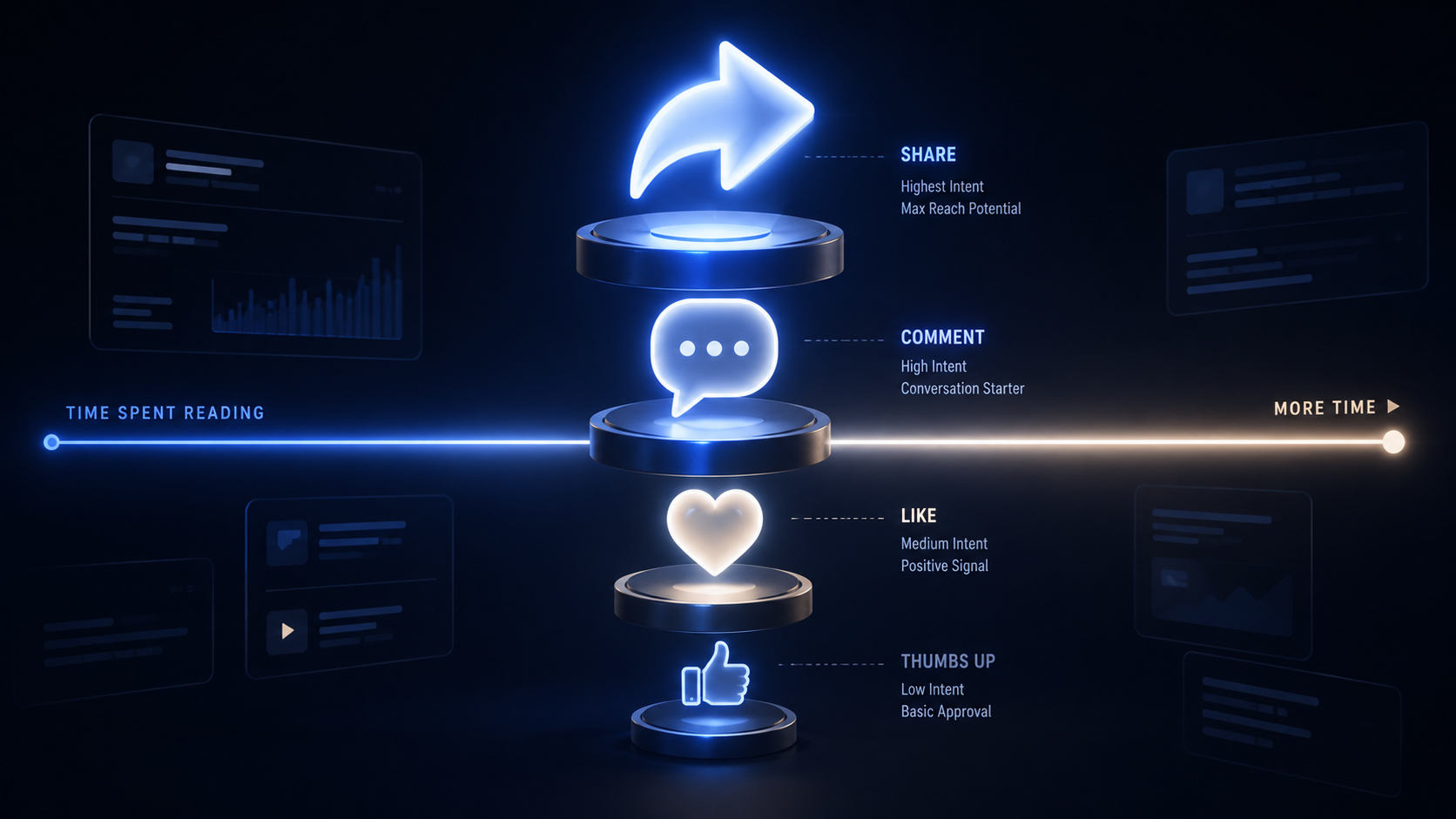
Not all engagement is equal, and Facebook's weighting has been explicit since the meaningful social interactions update: actions that create conversation between people outrank passive consumption signals. The 2026 hierarchy on our tracked Pages, from heaviest to lightest: shares, substantive comments, reactions, likes, clicks. Dwell time operates as a parallel signal across all of them.
Shares and Comments: The Conversation Signals
Shares carry the most weight per action because a share is a distribution decision made by a user, staking their own feed presence on your content. Messenger shares count and are enormous in 2026; private sharing has outgrown public sharing for most content types, and Facebook counts both. Content engineered to be sent to one specific person ("tag someone who...", done implicitly rather than as bait) consistently outperforms content engineered for public reaction.
Comments are weighted by depth and reciprocity. A 15+ word comment that receives a reply from the Page author generates a conversation loop the algorithm explicitly rewards. Replying to comments within the first hour is not community management theater; it is signal engineering. Pages that reply fast in our tracking see measurably wider next-ring distribution on the same posts.
And this is where amplification strategy fits legitimately. Creators pairing strong conversational content with Facebook shares services during launch windows are reinforcing the heaviest-weighted signal at the moment the prediction model is most sensitive to it. Support works when it amplifies real content quality, never as a substitute for it.
Reactions, Likes, and the Dwell Time Undercurrent
Reactions outweigh plain likes because they cost the user marginally more effort and carry emotional information the prediction model uses. Love and care reactions correlate with positive downstream behavior; angry reactions are a mixed signal that Meta has publicly de-weighted for divisive content. Chasing outrage engagement is a 2019 tactic that 2026 ranking actively punishes.
Dwell time is the silent workhorse. Facebook measures how long users pause on your post even without interacting, and long-dwell posts get expanded distribution on the strength of that alone. This rewards native text posts with substance, multi-photo posts users swipe through, and videos that hold attention. It quietly punishes thin image macros that users scroll past in under a second.
Is dwell time why long text posts sometimes outperform polished graphics? Yes. A 150-word story a user actually reads generates 20-40 seconds of dwell, which beats a two-second glance at a beautiful design every single time in the ranking math.
Shares Are the Heaviest Signal You Can Earn
One share outweighs dozens of likes in Feed ranking because it is a distribution decision, not a reaction. Build posts someone would send to one specific person in Messenger. Private sends count fully, and in 2026 they are the majority of sharing behavior on the platform.
Pages, Profiles, and Groups Rank Differently
The same content posted from a profile, a Page, and inside a Group receives three different distribution treatments. Operators who understand the differences route content to the surface where it ranks best instead of publishing identically everywhere.
Page Distribution Mechanics
Pages start with the weakest connected distribution of the three. Organic Page reach to followers has declined for a decade because Page inventory competes against friend content, Group content, and recommendations simultaneously. The compensation is that Pages have the strongest recommendation access: professional content is what the discovery engine prefers to push to unconnected users.
Follower quality shapes Page predictions directly. A follower base that never interacts teaches the model your content generates no action, dragging predicted-engagement scores down for everyone including future followers. This is why bought-then-abandoned audiences from low-quality providers damage Pages, and why growth services matter only when follower quality is real enough to sustain interaction rates. Slow organic growth with engaged followers beats fast growth with dead weight in every ranking scenario we have measured.
Page size changes almost nothing about per-post evaluation. A 2,000-follower Page with 8% interaction rates will out-distribute a 200,000-follower Page at 0.2% on recommendation surfaces. The algorithm ranks posts, not Pages, and the Page-level baseline only sets the starting test audience.
Why Groups Get Priority Placement
Group content receives elevated Feed placement for members because Groups are Meta's strongest retention product and membership is an explicit interest declaration. Posts inside an active Group routinely reach 30-60% of members organically, numbers no Page achieves with followers. For niche businesses, running a Group alongside a Page is the highest-leverage organic structure available on 2026 Facebook.
The mechanics reward discussion density. Groups where members answer each other generate conversation loops that lift every post's ranking inside member Feeds. Admin behavior matters too; Groups with consistent moderation and low spam rates receive better default distribution, while Groups that accumulate violations get unlisted from Group recommendations entirely.
But Groups are not a broadcast channel. Promotional posting inside Groups generates hide-and-report signals that suppress both the post and the Page behind it. The working pattern is value-first participation with the Page as an occasional, contextual destination.
Facebook Reels Algorithm Mechanics
Reels ranking runs on a separate model closer to TikTok's architecture than to Feed ranking: candidate pool, fast evaluation on a small test audience, expansion or death based on completion behavior. Because Reels is where unconnected reach lives, its mechanics deserve their own operational understanding.
The Evaluation Window for New Reels
New Reels get tested against a small audience slice within the first hours of publishing, follower and non-follower mixed. Completion rate and rewatch rate dominate the evaluation; a 15-second Reel watched to the end by half its test audience expands aggressively, while a 60-second Reel with heavy 3-second drop-off dies in the test ring regardless of production quality. Short and complete beats long and abandoned.
Early velocity compounds here exactly as in Feed. Reels that accumulate credible engagement during evaluation get pushed to progressively larger rings, which is why launch timing against your audience's active hours still matters on a recommendation-driven surface. Our tracked Pages see the strongest Reels evaluation outcomes from evening posts, consistent with platform-wide attention patterns.
Creators strengthening evaluation-window signals sometimes pair launches with Facebook views services to reinforce watch volume while organic completion data accumulates. The supported metric has to match real behavior... view support on a Reel with terrible retention changes nothing, because completion rate, not raw view count, is the deciding signal.
Original Audio, Watermarks, and Recycled Content
Meta's 2025 crackdown on unoriginal content carried straight into 2026: Reels reposted from other accounts without meaningful transformation get reduced distribution, and repeat offenders lose recommendation eligibility Page-wide. Transformation means commentary, editing, or remixing that adds something, not a filter and a new caption. Aggregator Pages that thrived on stolen clips are structurally dead on current Facebook.
Watermark demotion is mechanical and blunt. Visible TikTok watermarks flag a Reel as recycled third-party content and suppress its recommendation distribution. Exporting clean versions before cross-posting is a five-minute habit worth multiples in reach. Original audio earns a modest preference as an originality proxy, though trending licensed audio remains viable for Pages using it natively.
The originality system evaluates Pages cumulatively, not just posts. A Page with a high ratio of original uploads builds an originality baseline that survives the occasional shared clip. A Page that mostly redistributes builds the opposite. Every upload is a vote on which Page you are.
What Suppresses Distribution: The Penalty Layer
Facebook removes little and demotes a lot. The demotion layer is where most unexplained reach loss actually happens, and Meta publishes the categories openly in its Content Distribution Guidelines while almost nobody reads them. Three penalty families matter most for legitimate operators.
Engagement Bait Detection
Posts that explicitly ask for likes, shares, comments, or tags ("LIKE if you agree", "tag a friend who...", vote-with-reactions gimmicks) get classifier-detected and demoted. The 2026 classifiers catch soft variants too, including comment-fishing questions with no substance behind them. There is a real difference between a genuine question your audience wants to answer and a mechanical prompt engineered to farm signals; the model has seen billions of both.
Repeated bait posting escalates from post-level demotion to Page-level distrust, which drags the baseline of everything you publish afterward. In my experience the bait habit is the most common self-inflicted wound on small business Pages, usually copied from outdated advice articles still recommending 2016 tactics.
The clean substitute is stakes-based questions: ask things your audience has real opinions about, in contexts where answering benefits them. Same comment volume, opposite algorithmic treatment, because reply depth and conversation loops distinguish real discussion from farmed responses.
Link Posts, Clickbait, and Outbound Traffic
Facebook wants users on Facebook. Posts whose primary function is pushing traffic off-platform receive lower predicted-value scores, and links to ad-heavy or low-quality destination pages get demoted explicitly. Withholding headlines ("you won't believe what happened next") and sensationalized claims trip dedicated clickbait classifiers that have been refined for nearly a decade.
Operators who need outbound traffic adapt the ratio rather than fighting the bias. Pages in our tracking that hold link posts under a quarter of output, wrapped in native-value posts that stand alone, retain healthy distribution on the link posts they do publish. Pages posting links daily as their primary format watch reach erode quarter over quarter.
And the first-comment link trick? Largely neutralized. The ranking system evaluates the post's function, and a caption that obviously exists to route users into a comment link performs like a link post anyway. Native value first, traffic second, is the only stable pattern.
Borderline and Low-Quality Content Demotion
Content approaching Community Standards lines without crossing them (borderline health claims, near-nudity, rage-farming political content) gets reduced distribution by design, and exclusion from recommendations entirely. Meta accepts the engagement cost deliberately. For ordinary Pages the trap is topical drift: chasing an outrage trend for one week of strong metrics can cost recommendation eligibility that takes months to rebuild.
Low-quality signals also include domain-level reputation for shared links, comment-section toxicity the Page tolerates, and audience feedback like hides and "show less" selections. Negative feedback is weighted heavily because it is rare and deliberate. A post generating 500 reactions and 40 hides can rank worse than one generating 200 reactions and 2 hides.
Check the Professional Dashboard's content and recommendation status monthly. It surfaces active restrictions that explain reach patterns no amount of content tweaking will fix, and the appeal flow occasionally reverses false positives... quietly, without notification.
Most Dead Pages Are Demoted, Not Boring
Facebook removes little and demotes a lot. Engagement bait, watermarked Reels, link-heavy posting, and borderline topics cap distribution silently while your Page looks perfectly healthy. Audit the penalty layer in your Professional Dashboard before rewriting a single caption.
How Pages Earn Algorithmic Trust Over Time
Beneath per-post ranking sits a Page-level baseline: the accumulated evidence of how audiences historically respond to your content. This baseline sets the size and composition of each new post's initial test audience, which is why identical content performs differently on a trusted Page versus a cold one. Trust is buildable, measurable in outcomes, and losable.
Consistency, Format Mix, and Feedback Loops
Posting consistency builds baseline faster than posting volume. Our team's data suggests Pages publishing 4-7 times weekly on a stable schedule outperform Pages dumping 15 posts in bursts and going silent, because steady cadence gives the prediction model a continuous signal stream to calibrate against. Format mix matters alongside cadence: Reels for unconnected reach, native text and photo posts for dwell and conversation, occasional links where needed.
Every strong post slightly raises the baseline for the next one, and negative feedback compounds the same way downward. This makes the first 90 days of a Page disproportionately important. Early audiences that interact build a virtuous calibration; early audiences that ignore you teach the model indifference. Foundational audience quality, whether grown organically or supported through services like Facebook Page likes from providers that deliver real-profile quality, decides which loop you enter.
Recovery from a damaged baseline is possible but slow. Pages in our tracking that cut penalty behaviors and posted consistently for 6-8 weeks recovered most prior reach; the model re-learns when the evidence changes. But it re-learns on its schedule, not yours. Expect weeks, not days.
Early Velocity: The First Two Hours
Because signal accumulation in the first 60-120 minutes shapes prediction disproportionately, early velocity is the highest-leverage window a Page controls. Practical velocity levers: post when your specific audience is measurably active (Insights in Meta Business Suite shows this per Page), reply to every early comment to double the conversation signals, and seed the post into an owned Group where discussion starts immediately.
Notification-driven fans matter here too. Followers who selected the favorites option for your Page see posts reliably and interact early, effectively becoming your velocity engine. Asking your most engaged fans, once, to favorite the Page is worth more than a month of caption optimization. Few Pages ever ask.
What velocity support cannot do is rescue weak content repeatedly. The prediction model reads patterns across posts, and a Page whose early signals never convert into second-ring engagement gets its test audiences shrunk regardless of how strong hour one looks. Velocity amplifies quality; it does not replace it.
A Practical 30-Day Plan for Working With the Algorithm
Mechanics without sequence produce nothing. Here is the 30-day structure we deploy on new and recovering Pages, compressed from the systems above. It assumes 30-60 minutes of daily operator time and works for business and creator Pages alike.
Weeks One and Two: Audit and Baseline
Days 1-3 are pure audit: Professional Dashboard for restrictions and recommendation eligibility, Insights for actual audience active hours, a content review flagging every bait-pattern and watermarked post from the last 90 days. Delete nothing yet; just map the penalty exposure. Most operators find at least one active suppression they never knew existed.
Days 4-14 establish cadence: one Reel daily or near-daily, clean exports only, 15-30 seconds, built for completion. Two native non-Reel posts weekly engineered for dwell or conversation. Zero engagement bait, links held to a minimum. Reply to every comment within the first hour where humanly possible. This fortnight is about feeding the model consistent, clean evidence, and the metrics will look unremarkable while calibration happens.
Weeks Three and Four: Amplify What the Data Selects
By day 15 you have enough post-level data to see patterns: which Reel lengths complete, which topics generate shares, which posting hours produce velocity. Double down ruthlessly on the top quintile and cut the formats your audience demonstrably ignores. This is also the window where selective amplification makes sense on proven posts, and where a wider growth stack, covered in the NLO SMM guide to the best SMM panel for Facebook in 2026, plugs into launches you already know convert.
Days 21-30 add the structural layer: start or revive a Group attached to your niche, seed discussions there, and route your velocity through it. Ask engaged fans to favorite the Page. If outbound traffic is a business requirement, reintroduce link posts at a controlled ratio and watch whether reach holds. By day 30, tracked Pages following this sequence typically show 40-90% higher average reach than their day-1 baseline... not from any single trick, but from removing suppression and compounding clean signals.
Mistakes That Keep Killing Facebook Reach in 2026
The same errors surface in nearly every Page audit we run. Posting identical content across all Meta surfaces with watermarks intact. Treating Facebook as a link-distribution channel for a blog or store. Copying engagement-bait templates from outdated advice. Buying bulk low-quality audiences that crater interaction rates, instead of pairing real content with quality-vetted support. Ignoring the Professional Dashboard for years at a stretch.
Strategy-level mistakes cost more than tactical ones. Chasing virality with off-niche trend content teaches the prediction model your Page has no coherent audience, fragmenting future distribution. Abandoning formats after one weak post ignores that single-post variance is enormous while format-level patterns need 5-10 posts to read. And quitting during the calibration weeks, when clean signals have not yet compounded, abandons the exact mechanism that produces the payoff. Platform-agnostic virality principles in this cross-platform viral growth guide apply to Facebook only after the suppression and baseline layers are handled first.
Frequently Asked Questions About the Facebook Algorithm in 2026
How does the Facebook algorithm work in simple terms?
Facebook scores every eligible post for every individual user through four stages: inventory (what qualifies), signals (data about the post and early response), predictions (how likely you are to interact), and a relevance score that assembles the Feed. Highest predicted-value content wins placement, personalized per viewer.
Why is my Facebook Page reach so low in 2026?
Check the penalty layer before blaming content. Engagement bait patterns, watermarked or recycled Reels, link-heavy posting, and recommendation-eligibility restrictions cap reach silently. Review your Professional Dashboard for active restrictions, then rebuild with consistent original posting; most demotion-driven reach loss recovers within 6-8 weeks of clean signals.
What is the strongest ranking signal on Facebook right now?
Shares, including private Messenger shares, carry the heaviest per-action weight because a share is a distribution decision by the user. Substantive comments with author replies rank second. Dwell time operates underneath everything as a passive signal that expands distribution for content users actually pause and read.
Does the Facebook algorithm favor Reels over regular posts?
For unconnected reach, yes. Reels receive privileged placement across Feed, the Reels tab, and recommendation surfaces, and most non-follower reach on active Pages now arrives through Reels. Native text and photo posts still perform well with connected audiences through dwell and conversation signals, so effective Pages run both.
How important are the first hours after posting on Facebook?
Critically important. Signal accumulation in the first 60-120 minutes disproportionately shapes the prediction stage, and posts that stall early rarely recover. Post during your audience's measured active hours, reply to early comments immediately, and use owned Groups to start discussion fast.
Do watermarked TikTok videos get less reach on Facebook?
Yes, mechanically. Visible third-party watermarks flag a Reel as recycled content and suppress its recommendation distribution, and repeated unoriginal uploads can cost Page-wide recommendation eligibility. Export clean versions before cross-posting; the five-minute habit preserves the majority of potential Reels reach.
Is engagement bait still penalized on Facebook?
Yes, and classifiers now catch soft variants too. Posts explicitly requesting likes, tags, shares, or comment votes get demoted, and repeat bait posting escalates to Page-level distrust. Replace mechanical prompts with stakes-based questions your audience genuinely wants to answer; conversation depth separates real discussion from farmed signals.
Does buying Facebook followers or likes affect the algorithm?
Quality decides the outcome. Low-quality bulk audiences that never interact drag predicted-engagement scores down for the entire Page. Real-profile support that sustains interaction rates works as foundation-building alongside strong content. The algorithm reads interaction ratios, not raw counts, so audience quality always outranks audience size.
How much does posting time matter on Facebook in 2026?
It matters through early velocity, not chronology. Facebook is not a chronological feed, but posting when your specific audience is active maximizes first-hour signal accumulation during the evaluation window. Meta Business Suite Insights shows per-Page audience active hours; evening windows perform strongest across most tracked niches.
Can a Page recover after losing reach to algorithm penalties?
Usually yes. Remove the penalty behaviors, verify restrictions in the Professional Dashboard, appeal false positives, and post consistently clean original content. Tracked Pages typically recover most prior reach within 6-8 weeks because the prediction model re-learns from new evidence, though the timeline stretches with violation severity.
The Bottom Line on Facebook's 2026 Algorithm
Facebook ranking in 2026 rewards operators who think in layers. Clear the penalty layer first, because demotion silently caps everything above it. Feed the signal layer with shares, real conversation, and dwell-worthy content. Respect the Reels evaluation window and originality rules where unconnected reach lives. Build Page-level trust through consistency, and let early velocity compound each post through the prediction stage.
None of it requires guessing. The mechanics are stable, the diagnostics are visible in your Professional Dashboard and Insights, and the compounding math favors Pages that execute the same clean pattern for weeks over Pages chasing weekly tactic rotations. Start with the audit, run the 30-day sequence, and create an account at NLO SMM when you are ready to pair the mechanics with launch-window support across 2,000+ active services.
NLO SMM TeamWe are not resellers, we are the main providers. Our team tracks campaign data across dozens of artist and creator profiles and writes up what actually moves the numbers.
KEEP READING
ALL ARTICLES