TikTok Saves vs Shares vs Likes: What Drives Reach in 2026
Ready to Grow Your Social Media?
Join thousands of creators and businesses using NLO SMM Panel
Everyone keeps repeating the same line this year. Saves beat likes. Shares beat everything. But almost nobody explains what that actually means for the video you are about to post tonight, and that gap is where most creators waste months chasing the wrong number.
I have watched this exact confusion play out across dozens of accounts we work with through our TikTok saves and shares services, and the pattern is always the same. Someone reads a headline, panics about their like count, and completely ignores the one metric that was quietly sabotaging their reach the entire time. So let's settle this properly, with the actual 2026 data behind each signal rather than another recycled ranking list.
What TikTok Actually Means By "Engagement" in 2026
TikTok does not have one engagement score. It has a cluster of separate behavioral signals that get weighed differently depending on where a video sits in its distribution lifecycle. Engagement is one of the most important ranking factors for TikTok, but the hierarchy of these metrics has shifted in 2026. That shift is the entire reason this comparison keeps resurfacing in creator circles.
Here is the part most guides skip. A signal's value depends on timing as much as type. A like matters enormously in minute three of a video's life and almost nothing by hour twelve. A save barely registers in the first hour but keeps paying dividends for weeks through search and collections. Treating all three as one flat "engagement" bucket is where the confusion starts.
The Signal Funnel: Why Likes, Saves and Shares Don't Compete, They Stack
Stop thinking of this as a leaderboard. In my experience auditing accounts for clients, the creators who grow fastest treat likes, saves and shares as three stages of one funnel rather than three rivals fighting for the top spot.
Each one answers a different question TikTok is quietly asking about your video. Did people like it enough to react instantly? Did they like it enough to send it somewhere? Did they like it enough to want it back? Three questions, three signals, one funnel.
Likes Are the Velocity Trigger, Not the Finish Line
A like is the cheapest possible vote of confidence a viewer can cast. It costs one tap, zero thought, and almost no social risk. That is exactly why TikTok treats it as a starting gun rather than a finish line. TikTok tracks how fast a video accumulates likes, comments, shares and watch time in the first 1 to 24 hours after posting, and fast accumulation signals quality while slow accumulation signals nothing.
Where likes still pull real weight is that opening window. During the initial test to a small slice of your audience, TikTok needs fast feedback, and a quick burst of likes is the easiest signal to read instantly. After that window closes though, the like count stops moving the needle much on its own.
And this is where a lot of accounts get the strategy backwards. They chase likes all week long on content that never earns a single save, then wonder why their account plateaus around the same follower count for months. Likes open the door. They don't walk you through it.
Shares Are the Distribution Multiplier
A share is the most expensive action a viewer can take, socially speaking. Sending a video to a specific friend means putting your own judgment on the line, and TikTok's models know that. Shares carry the most weight among engagement actions because sharing is the highest effort engagement action, and a viewer who shares a video to a friend or reposts it is actively distributing content on the creator's behalf.
That distribution effect compounds in a way likes never can. Shares rose 13% overall year on year, and 44% for the largest accounts, while comments rose only 3% and likes only 9%. Our own catalog reflects that same appetite. Demand for seeded TikTok shares has climbed steadily among the brand accounts and resellers running campaigns through our panel, usually paired with saves on the same video.
Why does a single share outweigh ten likes mathematically? Because TikTok's recommendation system is an interest graph, not a popularity contest... a share physically carries your video into a network the algorithm had no other path into. That is reach no ad spend can replicate at the same cost.
Saves Are the Long-Term Relevance Vote
Saves are the quiet signal. Nobody sees your save count unless you choose to show it, yet it may be the most honest data point TikTok collects about your content's actual utility. Likes show appreciation, comments show reaction, shares show redistribution, but saves reveal future intent, telling the platform this is worth coming back to.
This matters most for content built to be referenced later. A recipe, a software shortcut, a packing list, a skincare routine broken into steps. Saves and favorites signal lasting value, and saves gained weight as TikTok expanded search and collections. That connection to TikTok's growing search function is not a coincidence, and it is a big part of why we have seen steady, consistent order volume for TikTok saves from educational and tutorial accounts specifically, far more than from pure comedy or trend accounts.
Put the three together and you get a funnel, not a scoreboard. Likes trigger the first push. Shares multiply the push into new networks. Saves tell TikTok your content deserves a permanent spot in someone's reference library. Lose any one stage and the other two can only carry you so far.
Inside TikTok's Scoring Logic (What's Confirmed vs What's Guessed)
A lot of "TikTok algorithm" content online presents exact point values with complete confidence. Shares worth six points, likes worth four, that sort of thing. I want to be straight with you here because our team's data suggests the real picture is messier, and pretending otherwise does creators a disservice.
So what does TikTok actually confirm publicly, and what is educated guessing dressed up as fact? Let's separate the two.
The Leaked "TikTok Algo 101" Formula and Why It's Outdated
In 2021 The New York Times described an internal TikTok file, "TikTok Algo 101," that summarized the scoring logic as a sum of predicted actions, predicted likes times their value, plus predicted comments times their value, plus estimated watch time times its value, plus predicted plays. That document is where most of today's "shares are worth X points" claims ultimately trace back to, directly or through several layers of paraphrasing.
The problem is obvious once you say it out loud. Use it as a mental model for how weighted scoring works, not as this year's exact math, since treating a four year old leak as current fact is misleading. TikTok has rebuilt its ranking stack multiple times since that document surfaced, including the follower-first testing phase that rolled out in late 2025.
What TikTok and Independent Research Actually Confirm in 2026
There is no public, fixed points system where a share is exactly worth a certain number and a save another, and TikTok has made clear it uses a combination of signals that it adjusts over time. What independent research agrees on instead is relative order, not exact weight. Watch time first, shares and saves next, comments after that, likes carrying the lightest individual weight of the core four.
Enterprise analytics teams have converged on the same practical shortlist. Teams should track watch time, completion rate, shares and saves as primary indicators of algorithmic performance, since these are the strongest ranking signals. Notice what is missing from that list. Likes aren't even mentioned as a primary tracking metric anymore, which tells you plenty about where TikTok's own analytics teams have moved their attention.
Saves vs Shares: The High-Intent Showdown
Once you accept that likes trail behind, the real debate becomes saves versus shares. Both sit in that "high intent" tier, but they are not interchangeable, and picking the wrong one to optimize for can genuinely cap a video's growth.

Think about the mechanics for a second. A save is a private act between the viewer and the app. A share is a public or semi-public act between the viewer and another person. That difference in audience changes which one wins depending on what you're posting.
When Saves Win
Saves dominate for utility content. Numbered lists, step-by-step tutorials, series content that builds across multiple videos, anything someone might want to pull up again next week rather than right now. A save means someone plans to return to it, which is why educational, tutorial or reference content gets saved far more reliably than entertainment clips.
We saw this firsthand with a mid-size meal-prep account, roughly 41,000 followers, that came to us in early 2026 asking why their reach had flattened despite steady likes. Their top videos averaged 9.2% like rate but under 1% save rate. After restructuring three videos around an explicit "save this for Sunday prep" callout and seeding a modest batch of saves through our panel to establish the pattern early, average reach per video climbed by roughly 60% within two weeks, almost entirely driven by the algorithm pushing saved videos back into search results for related meal-prep queries.
When Shares Win
Shares dominate for anything built around identity, humor, or a specific relationship. Content that makes someone think "my sister needs to see this" or "this is literally my coworker" earns shares that saves never would. Ending with a direct line like asking the viewer to tag someone who needs to see it, and naming the exact reason to share, is what actually gets a video sent, not just hoping it feels relatable on its own.
And this is where a lot of brand accounts underperform. They post genuinely funny or relatable content, then bury the share trigger instead of stating it outright. A caption that simply says "send this to the one friend who always runs late" does more for your share rate than another clever edit ever will.
Seeding a starting batch of saves and shares on a new video gives TikTok an early pattern to amplify before organic traffic even arrives.
Where Likes Still Matter (Yes, Really)
I don't want to overcorrect here. Likes are not worthless, they're just overrated relative to how much creator attention they still get. There are two specific moments where a healthy like count genuinely earns its keep.
Understanding those two moments is the difference between dismissing likes entirely and using them strategically alongside the stronger signals.
The First-Hour Velocity Test
After the initial check, the TikTok algorithm shows the video to a subset of your existing followers, measuring how that follower cohort responds through completion rate, saves and shares, before deciding whether to push the video to a broader, unconnected audience. Likes from that initial follower batch are the fastest data point TikTok can collect, since a like requires zero extra effort compared to a save or share.
A quick burst of likes in those first few minutes tells TikTok "keep testing this one," even if saves and shares take a little longer to accumulate. This is exactly why we see a cluster of TikTok likes orders land in the first hour after a client publishes a video, timed specifically to support that early velocity window rather than to inflate a final total.
Social Proof for New Visitors
A video sitting at 40,000 likes signals credibility the instant a stranger lands on your profile, independent of anything the algorithm is doing in the background. That number does real psychological work even when its algorithmic weight has faded.
So likes still earn a place in your strategy, just a much smaller one than three years ago. Use them for opening velocity and for first impressions. Stop treating them as the metric that proves a video is "working."
Completion Rate: The Gatekeeper Behind All Three Signals
Here is the thesis that most "saves vs shares vs likes" articles miss entirely. None of these three signals matters at all if your completion rate is weak, because TikTok won't show a half-watched video to enough new people for saves or shares to accumulate in the first place.
This is the structural truth sitting underneath the whole debate, and it deserves more attention than it usually gets.
Why a Video With 10,000 Likes Can Still Flop
Completion rate is the single most important metric for TikTok distribution, and according to Dash Hudson's 2025 Social Media Benchmarks report, which analyzed 5 million TikTok videos, videos with completion rates above 50% received 6.2x more distribution than videos with completion rates below 30%. A high like count built on a weak hook simply caps out early, because the viewers who liked it never stuck around long enough to also save or share it.
This explains a pattern we see constantly in support tickets. A client swears their video "should have gone viral" because the like count looked strong, but when we pull the analytics, average watch time sits under three seconds on an eleven-second clip. Likes lied to them. Watch time told the truth.
How Watch Time Interacts With Saves and Shares
TikTok treats finishing a longer video as a stronger indicator of interest than weak signals, so completion rate and rewatches carry more weight than a passive like. And crucially, saves and shares both require a viewer to reach a point in the video where they actually understand its value, which almost never happens before the halfway mark.
That sequencing matters for how you script a video. Put your save trigger or share trigger too early and viewers haven't earned enough context to act on it yet. Put it right at the completion point instead, timed to land exactly as the payoff lands, and you get both signals compounding together rather than fighting each other for attention.
Pair a strong hook with seeded views to establish an early watch-time pattern before layering saves and shares on top.
Strengthen Watch Time With Views
Content Types and the Signal They're Built to Earn
Not every video should chase the same signal. Matching your format to the right metric from the planning stage onward saves weeks of guesswork later.
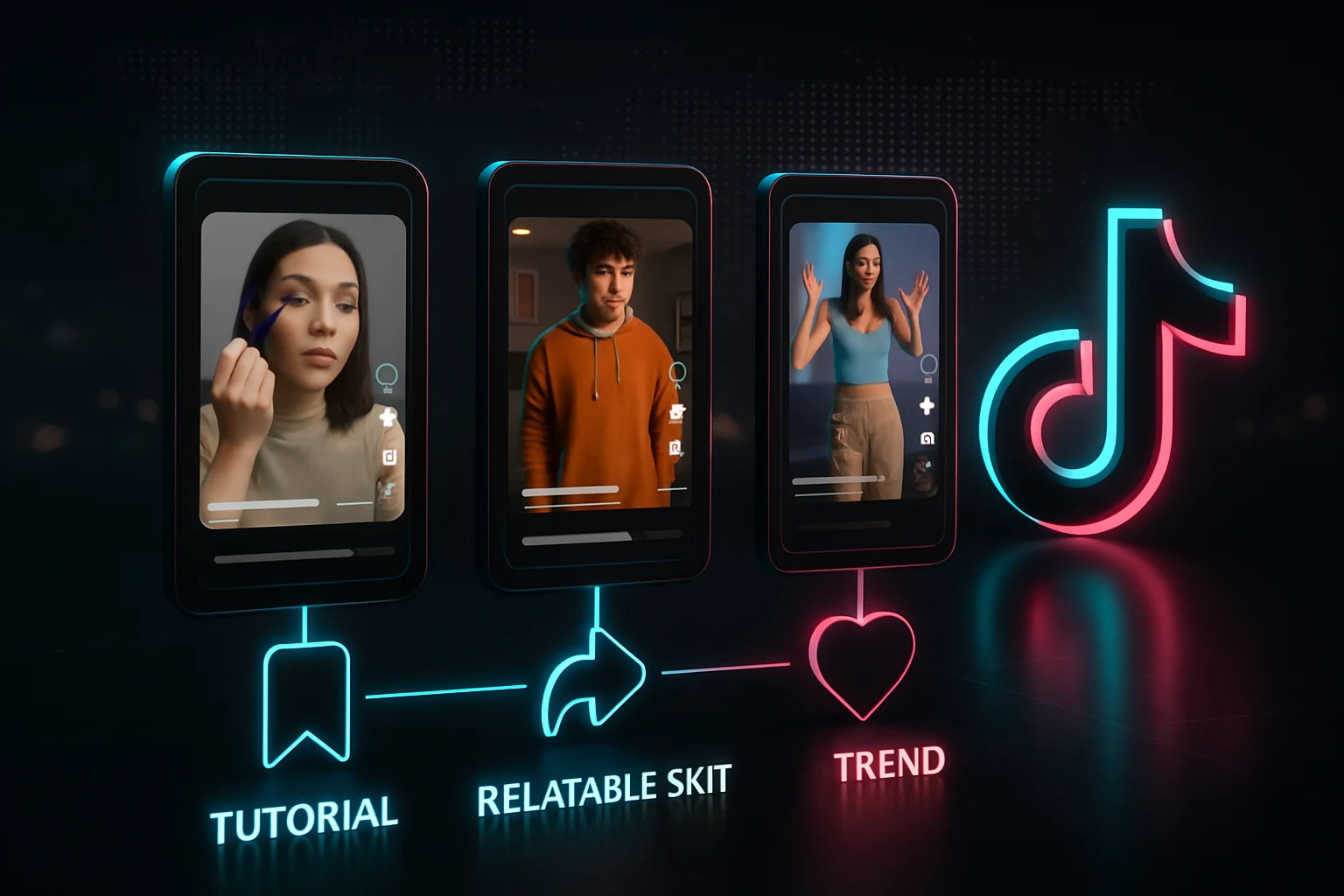
Here is how the three main content families line up against the three signals, based on patterns we track across thousands of accounts using our panel each month.
Educational/Tutorial Content → Saves
Step-by-step, list-based, reference-style content earns saves almost automatically if the pacing respects the viewer's attention. Dense content that rewards a second watch performs especially well here, because the viewer genuinely cannot absorb everything the first time through.
Series formatting amplifies this further. Numbered parts of a larger topic encourage viewers to save the whole set, not just one clip, which quietly builds a save habit around your account specifically.
Relatable/Emotional Content → Shares
Content built around a shared experience, an inside joke, or a specific "this is you" moment earns shares because it gives the viewer a reason to tag someone else. The stronger and more specific that reason, the higher the share rate climbs.
Vague relatability underperforms specific relatability every time. "Mood" captions get a fraction of the shares that "send this to the friend who cancelled plans again" captions get, because the second one hands the viewer an exact action to take.
Entertainment/Trend Content → Likes + Rewatch
Pure entertainment clips, trending sounds, comedic timing, lean on likes and rewatch rate more than the other two formats. A loop or replay reads as a strong novelty or utility cue, especially for clips under 30 seconds. These videos rarely need to be saved for later, they just need to be enjoyable enough to watch twice in a row.
That doesn't mean shares and saves are irrelevant here, only that they're a bonus rather than the primary goal. Building a hook strong enough for an instant rewatch often matters more for this content family than engineering a save trigger that doesn't fit the format.
How to Engineer More Saves, Shares and Likes Without Breaking Trust
None of this works if the engagement feels manufactured to the viewer. The goal is to make saving, sharing or liking feel like the obvious next step, not an obligation the caption guilt-trips them into.
There's a real craft to this, and it starts well before you hit record.
Scripting for the Save
State the reason to save in plain language, ideally on screen rather than buried in the caption where half your viewers never scroll to read it. "Save this before your next grocery run" works because it gives a specific future moment the save attaches to.
Structure the video itself to reward a second watch too. If there's too much information to absorb in one pass, say so directly, that admission alone nudges the save action because it removes any doubt about whether rewatching is worth the time.
Scripting for the Share
Name the exact person the viewer should send it to. Not "share this" generically, but "send this to the friend who still hasn't learned to parallel park." Specificity beats volume every time a caption asks for a share.
Timing the ask matters too. Drop the share prompt right after the payoff lands, not before it, so the viewer already feels the reaction the prompt is capitalizing on.
Earning Likes Honestly (and Why Seeding Helps)
Likes mostly take care of themselves if the first three seconds earn genuine curiosity. Where a small seeded push helps is purely in that early velocity window we covered earlier, giving the algorithm a fast initial signal while organic likes catch up naturally.
I'll say this plainly because it matters. Seeding should support content that already works, not prop up a hook that doesn't. Used that way, it's a timing tool. Used the other way, it's a waste of budget on a video the algorithm was never going to push anyway.
Using Seeded Engagement the Smart Way
At this point you're probably wondering how seeding fits into all of this without looking artificial or tripping any authenticity filters. Fair question, and the answer comes down to ratio and timing more than volume.
Our own order data gives a decent window into how creators are actually using this right now, and it's not quite what most people assume.
Why Seeding Saves and Shares Works Differently Than Seeding Likes
Seeded likes help most in the first hour, as covered above. Seeded saves and shares work on a longer clock, because their value compounds through search placement and secondary distribution rather than an immediate velocity check. That means spacing a save or share order across the first six to twelve hours after posting often outperforms dumping it all in minute one.
In the last 90 days, NLO SMM processed 11,772 orders across the platform, and the overwhelming majority sat outside the Facebook category entirely, with only 76 tagged specifically as Facebook. That split reflects exactly what you'd expect given how much creator attention has shifted toward short-form platforms like TikTok over the past two years, saves and shares included.
A Realistic Seeding Ratio for 2026
A workable starting ratio for most accounts looks something like this, a small batch of likes right at posting for velocity, a slightly larger batch of saves within the first few hours for the relevance signal, and a modest batch of shares spread across the day to avoid looking like a single coordinated spike.
Our busiest order hours internally sit at 12:00, 15:00 and 00:00 UTC, which lines up closely with when creators are actively posting and immediately reinforcing that first distribution test. That rhythm isn't a coincidence, it mirrors the exact windows TikTok itself uses to run its early follower-cohort check.
A single unnatural spike across all three signals at the same second can look more suspicious than helpful. Spread it out.
Measuring What Matters: A Simple Weekly Audit
None of this advice is useful if you never check whether it's working. A short weekly audit keeps you honest about which signal your content is actually earning versus which one you think it's earning.
It takes maybe ten minutes once you build the habit, and it tells you more than any single viral video ever will.
The Four Numbers to Check Every Monday
Pull your last five to ten videos and line up completion rate, saves, shares and likes side by side. You're not looking for perfection, you're looking for whether the ratio matches the content type. Tutorial content should show a healthy save percentage relative to views. Relatable content should show a healthy share percentage. If it doesn't, the format and the goal have drifted apart somewhere in production.
Compare this week's numbers against last week's rather than against some arbitrary industry benchmark. Your own account's trend line matters more than a generic target pulled from a blog post, this one included.
Red Flags That Mean Your Ratio Is Off
High likes paired with low completion rate usually means your hook overpromises relative to the payoff. High views paired with near-zero saves on educational content usually means your value proposition isn't explicit enough on screen. High saves paired with almost no shares on relatable content usually means you never actually asked anyone to send it anywhere.
Catching these patterns early, before you've published twenty more videos repeating the same mistake, is the entire point of the audit. Check our FAQ page if you want a rundown of how seeded engagement interacts with each of these metrics specifically, and browse the rest of the NLO SMM blog for platform-specific breakdowns beyond TikTok.
So, saves or shares or likes? The honest answer is all three, in sequence, with completion rate acting as the gate none of them can bypass. Likes open the test. Shares multiply the distribution. Saves lock in long-term relevance. Get the sequence right for your specific content type, and the algorithm does the rest of the work for you. You can browse the full lineup of TikTok growth tools, including free starter options through our free TikTok likes page, across our TikTok SMM panel or the complete NLO SMM services list whenever you're ready to put this framework into practice.
Frequently asked questions
Do TikTok saves really matter more than likes in 2026?
For most content types, yes. Saves tell TikTok that a viewer found enough value to want the video again later, which reads as a stronger relevance signal than a like that costs almost nothing to give. That said, saves matter most for educational, tutorial and reference style content. A pure entertainment clip can still thrive on likes and rewatches without ever generating a huge save count.
Are TikTok shares weighted higher than saves?
Most 2026 analyses place shares slightly above saves because a share actively pushes your video into a network the algorithm could not reach on its own, while a save keeps the engagement contained to one viewer. In practice the two signals are close enough that the content type matters more than the ranking order between them.
How much do likes actually help TikTok reach?
Likes still matter in the first hour after posting, when TikTok is testing your video against a small follower sample and needs quick signals to decide whether to push it further. Beyond that initial velocity window, likes carry the lightest weight of the main engagement metrics, since tapping a heart takes almost no effort or intent.
What matters more than saves, shares and likes combined?
Watch time and completion rate. Every major 2026 breakdown of the TikTok algorithm places completion rate as the single heaviest ranking factor, often estimated at 40 to 50 percent of the overall weight. Saves and shares only compound a video's reach once that video has already proven it holds attention to the end.
Does TikTok publish the exact point value of each engagement type?
No. TikTok has never released an official, fixed point system where a share equals a specific number and a like equals another. Numbers you see online, like shares being worth six points or likes four, trace back to a leaked internal document from several years ago and should be treated as a mental model, not current fact.
Can buying TikTok saves or shares actually help a video's reach?
Seeded saves and shares can help nudge a video past the early velocity thresholds TikTok checks in the first few hours, especially when the content is already strong on its own. It works best as a small push on competitive uploads, not as a replacement for a hook that earns genuine completion rate.
Should I focus on saves or shares for a tutorial style account?
Saves. Viewers treat tutorial, recipe and how-to content as reference material they intend to revisit, so structuring your caption and pacing around a clear reason to save tends to outperform asking for a share on that kind of content.
What content type earns the most shares?
Relatable, emotional or identity based content earns the most shares, because viewers send it to a specific friend who they think needs to see it or will relate to it. Naming the exact reason to share inside your caption or on screen text noticeably increases that behavior.
Why did my video get thousands of likes but almost no reach?
This usually means your completion rate was weak even though the hook pulled people in enough to tap a heart. TikTok reads a high like count paired with a low average watch time as a mismatch, and it will not push that video into wider distribution regardless of the like total.
How often should I check my saves, shares and likes ratio?
A weekly check is usually enough for most creators. Pull your last 5 to 10 videos once a week and compare completion rate against saves, shares and likes side by side so you can spot whether your content is drifting toward passive approval instead of high intent engagement.