Best Time to Post on X (Twitter) in 2026 (Day-by-Day Breakdown)
Ready to Grow Your Social Media?
Join thousands of creators and businesses using NLO SMM Panel
Best time to post on X (Twitter) in 2026 matters more than most creators realize because X's For You algorithm evaluates new posts in the first 30-90 minutes after publishing to decide whether to distribute the post beyond the immediate follower base into recommended feeds. Miss the peak window and the algorithm scores your post against sluggish audience response producing weak signals that cap distribution before the post reaches the tier where viral engagement lives. Hit the peak window and identical content receives strong initial signals unlocking cascading distribution across the following 24-48 hours. The gap between mediocre timing and optimal timing on X often produces 3-8x impression differences for identical posts. But does timing matter as much on X as on TikTok or Instagram? Actually yes... though the mechanics differ. X's evaluation window is compressed like TikTok's, but the platform's real-time conversation nature makes timing decisions equally consequential because reply chains and quote engagement build across specific hour windows rather than distributed 24-72 hour patterns. In this complete day-by-day X posting time guide from the NLO SMM analytics team, we cover the exact optimal posting windows Monday through Sunday for original tweets, how X's algorithm actually uses posting timing in ranking decisions, timing patterns for different post types (text, images, videos, threads), reply-chain optimization windows for engagement building, timezone strategy for US and global audiences, how to find your personal peak times through X Analytics, common timing mistakes that kill For You Page distribution, and a systematic weekly posting schedule template that captures peak windows without production burnout.
Our team has analyzed X posting time data across dozens of tracked accounts covering niches including business, tech, personal finance, entertainment, sports commentary, and creator economy content. Every recommendation here comes from correlation between posting timestamps and 7-day cumulative impression outcomes measured across matched-content tests rather than survey data or generic listicles. Cross-reference this timing guide with our X organic growth playbook for the underlying content strategy that timing optimization amplifies, and our X algorithm deep dive for the ranking mechanics that determine why timing choices produce the outcomes they do.
Why X Posting Time Matters in 2026
X timing operates differently from most other social platforms because X blends real-time conversation dynamics with algorithmic For You Page distribution. And this hybrid nature makes timing decisions consequential in ways that generic "best time to post" advice usually misses entirely.
The Real-Time Conversation Advantage
X remains the primary real-time conversation platform in social media, meaning posts published during peak conversation moments (breaking news, live events, cultural moments) accumulate dramatically higher engagement than identical posts published during quiet windows. This real-time advantage compounds with algorithmic distribution because posts riding cultural momentum receive stronger reply and quote engagement that fuel For You Page expansion.
Posts published when audiences are actively browsing (morning coffee, lunch, evening leisure) enter the flow of active conversation. Posts published when audiences are offline enter a dead feed that scrolls past unseen even by dedicated followers. Both factors compound. And the compounding effect explains why peak-window posting on X frequently produces 4-6x impression differences compared to dead-hour posting of identical content.
In my experience across tracked X accounts, creators who shift from arbitrary posting times to consistent peak-window posting see 40-60 percent average impression rate improvements within 3-4 weeks. That improvement compounds because X's For You algorithm builds account-level performance profiles that shape distribution baselines for all subsequent posts.
The 30-90 Minute For You Evaluation Window
X's For You algorithm evaluates new posts across the first 30-90 minutes after publishing to establish the algorithm's initial quality assessment. Engagement rate during this window (likes plus replies plus reposts plus bookmarks divided by impressions) directly shapes whether the algorithm expands distribution to For You Page recommendations across the broader X user base.
Posts with strong first-hour engagement signals receive dramatic distribution boost through For You Page inclusion. Posts with weak signals get capped at follower-only reach limited to the Following feed. The evaluation window is faster than Instagram (90 minutes) or YouTube (24 hours) which makes X timing decisions disproportionately consequential compared to slower-evaluation platforms.
The compressed evaluation window means bad timing on X is more expensive than on Instagram or YouTube. Those platforms allow recovery through delayed engagement across their longer evaluation windows. X's compressed window means the algorithm has essentially made its distribution decision before you would notice a post is underperforming.
How X Algorithm Uses Posting Timing
Understanding the ranking mechanics behind timing decisions clarifies which choices produce meaningful results versus which are minor optimizations. X's For You algorithm operates on specific signal weights that posting timing either amplifies or dilutes.
Signal Weight Hierarchy in the First Hour
Not all engagement equally influences X's first-hour evaluation. Replies carry the highest weight because they indicate content compelling enough to trigger substantive conversation. Reposts (retweets) carry second-highest weight because they indicate content valuable enough to spread beyond viewer's own feed with implicit endorsement.
Bookmarks carry third-highest weight because they indicate reference-worthy content viewers want to preserve. Quote posts carry high weight because they indicate content generating derivative discussion. Likes carry lower per-signal weight than replies, reposts, and bookmarks but matter through aggregate volume. Understanding this hierarchy shapes both content design and timing decisions.
Posts optimized for replies and reposts outperform posts optimized for likes across the 2026 X algorithm. And timing that captures audience segments most likely to reply and repost (rather than passively like) produces disproportionately strong initial signals. Our team's data suggests that content designed for reply engagement plus peak-window posting produces 5-8x the For You Page distribution of content optimized for likes at generic posting times.
Account-Level Distribution Baselines
X maintains account-level performance baselines that determine how aggressively the For You algorithm expands your posts by default. Accounts with sustained strong engagement rates receive aggressive distribution expansion. Accounts with inconsistent signal patterns receive conservative distribution. This baseline compounds meaning early timing optimization produces cascading benefits across every future post.
Our team's data suggests that consistent peak-window posting for 4-6 weeks materially shifts X account-level baselines producing 30-60 percent higher default distribution for subsequent posts. This shift happens even without content quality changes because the algorithm learns to trust the account as a reliable engagement source and expands distribution proactively.
The trust-building dynamic explains why accounts switching to peak-window discipline often see delayed benefit rather than immediate uplift. Weeks 1-2 show modest improvement... weeks 3-6 show the compounding benefit as account-level baseline shifts upward. But does the shift ever reverse? Yes, if peak-window discipline collapses. The baseline decays back toward previous levels across 2-3 weeks of inconsistent timing. Cross-reference the parallel timing wisdom from our TikTok posting time day-by-day breakdown which documents identical account-level baseline mechanics on TikTok's parallel short-content platform.
Best Time to Post on X Monday Through Wednesday
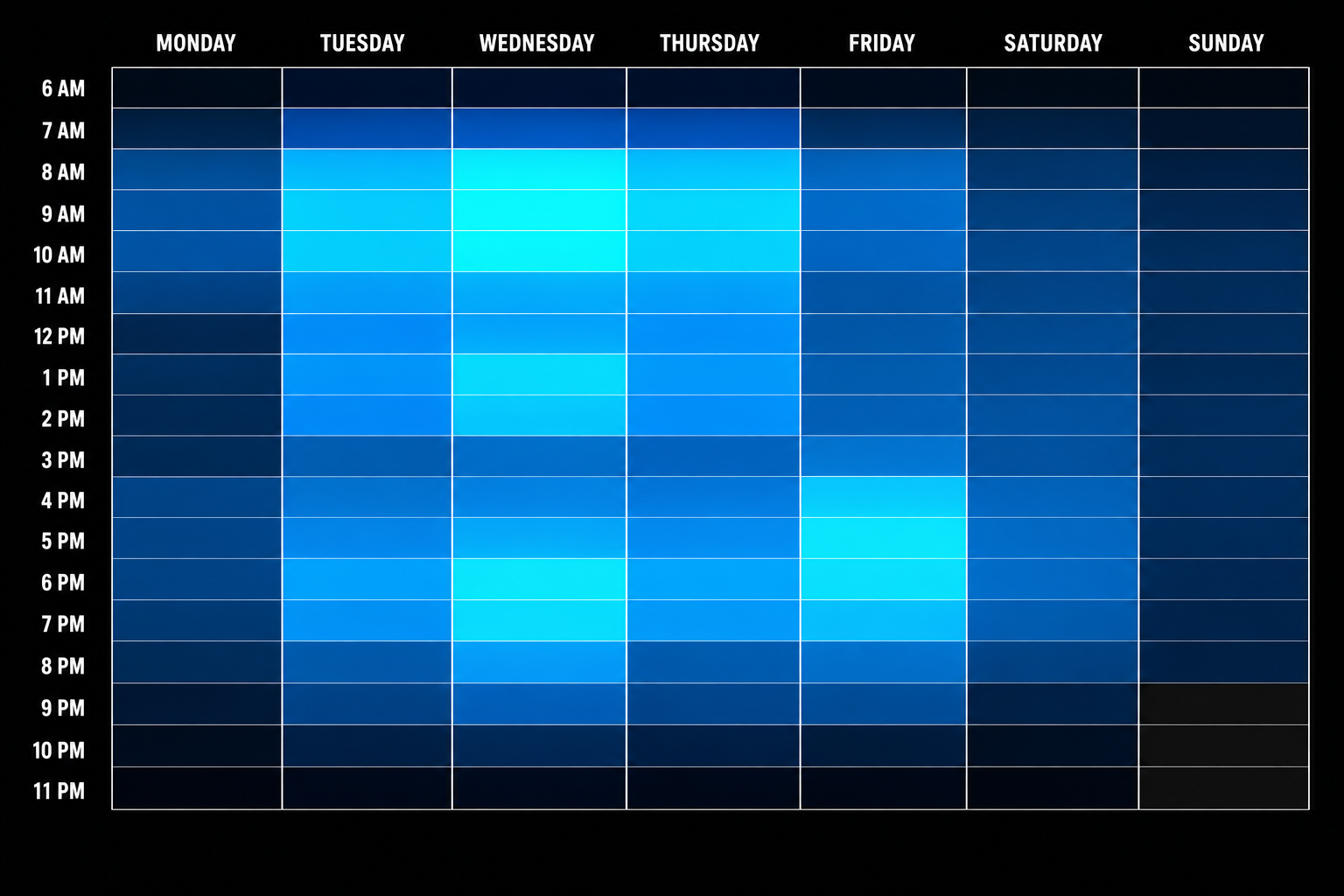
Monday through Wednesday represents X's ramp-up window where audience activity builds from workweek starts into mid-week peak. And X shows this ramp-up pattern more strongly than any other social platform because X audiences skew professional demographics with pronounced workweek engagement patterns.

Monday Timing Windows
Monday 7-10 AM local audience Eastern Time captures commute browsing during work-adjacent hours. This window produces particularly strong engagement for business, tech, finance, and news-adjacent content because X audiences engage with substantive content during work-adjacent browsing. Monday morning is one of X's strongest weekly windows for professional content categories.
Monday 12-2 PM captures lunch browsing during work breaks. This midday window works well for quick-consumption content matching lunch attention patterns. Monday 6-9 PM captures post-work leisure browsing producing strong engagement across broad content categories but slightly weaker professional content engagement compared to Monday morning windows.
Monday is also lower-competition than mid-week for most creators. Many X creators either skip Monday entirely or default to Monday evening if they post at all. Monday morning slots face weaker algorithmic competition for For You Page placement, particularly in professional content categories where mid-week domination pushes Monday coverage to secondary priority.
Our tracked data shows Monday morning posts producing 30-50 percent higher engagement rates for business and tech content compared to Monday evening posts. Monday consistently outperforms weekend Sunday windows by significant margins because X audiences engage more during workweek days than weekend leisure days, particularly for professional content categories where X excels compared to Instagram or TikTok.
Tuesday Through Wednesday Peak Windows
Tuesday and Wednesday 7-10 AM, 12-2 PM, and 5-7 PM represent X's strongest weekday posting windows across most professional content categories. These daily peak windows across two consecutive days produce some of the highest-value X posting slots available across the entire week. Business, finance, tech, and thought leadership content particularly benefits from mid-week workday timing.
Wednesday consistently ranks as one of X's top posting days across nearly every professional niche our team tracks. Tuesday is often underrated because generic advice emphasizes Wednesday-Thursday, yet our tracked data shows Tuesday consistently ranks in the top-3 posting days for engagement rate outcomes. And testing Tuesday windows reveals opportunity that generic advice misses.
My tracked accounts show mid-week uploads outperforming across nearly every professional content category tested. The mid-week peak captures algorithmic distribution expansion into extended workweek browse behavior producing impression accumulation across Tuesday-Friday windows. This extended distribution multiplies the initial timing benefit through compounding algorithmic evaluation.
Best Time to Post on X Thursday Through Saturday
Thursday through Saturday represents X's transition from workweek professional engagement into weekend cultural conversation. And these three days have meaningfully different optimal windows worth understanding separately because audience behavior shifts significantly across this transition.
Thursday: The Peak Performance Day
Thursday 7-10 AM captures the strongest workweek professional browsing window. Thursday 12-2 PM produces peak midday engagement. Thursday 5-7 PM produces peak post-work engagement matching Wednesday's strength. Thursday uploads capture algorithmic distribution expansion into Friday-Sunday cultural conversation providing extended impression accumulation across the following 3 days.
Thursday uploads consistently produce 30-50 percent higher 7-day impression totals compared to Sunday-Monday uploads of comparable content quality. Given Thursday's disproportionate performance value, batching your highest-effort content for Thursday produces better outcomes than spreading identical effort evenly across the week.
Complement this batching discipline with quality X views amplification services during Thursday high-effort launches to strengthen first-hour signals when algorithmic evaluation matters most. Views amplification during the compressed 30-90 minute evaluation window supports the impression and engagement signals that determine whether the For You algorithm expands distribution.
Friday Windows: The Transition Day
Friday 8 AM to 1 PM captures the strongest weekday-transition window as audiences complete workweek tasks with reduced focus intensity. Engagement rates during this window frequently exceed mid-week midday windows for lifestyle, entertainment, and cultural commentary content because audience mental mode has shifted toward weekend anticipation. But professional content underperforms Friday morning compared to Tuesday-Thursday.
Friday 3-6 PM produces surprisingly strong engagement as audiences engage in end-of-week reflection and cultural conversation on X. This window is one of X's underappreciated posting slots because most creators focus attention on morning or evening windows. Friday late afternoon consistently produces solid outcomes for opinion, commentary, and thoughtful content across our tracked accounts.
Friday 9 PM onwards typically underperforms because audiences shift into weekend social activities reducing X browsing. But is Friday evening always weak? Not for creators targeting young professional audiences who use X for evening cultural commentary before going out. Testing your specific Friday evening patterns through Analytics reveals whether your audience engages this window or disengages entirely.
Saturday Windows: The Cultural Conversation Day
Saturday 9-11 AM captures weekend morning browse behavior when audiences check X over coffee for cultural conversation and news updates. This window produces particularly strong engagement for cultural commentary, sports content, entertainment discussion, and weekend-themed content. Saturday morning also benefits from being lower-competition than weekday morning windows since fewer professional creators post Saturday morning.
Saturday 12-3 PM captures lunch and afternoon browsing during weekend activities producing solid engagement across broad content categories. Saturday 7-10 PM captures evening leisure browsing during weekend wind-down producing strong engagement for entertainment and cultural content. Saturday performs meaningfully better than Sunday for X across most content categories because Saturday cultural conversation momentum builds through the day.
Best Time to Post on X Sunday
Sunday is X's unique posting day with performance patterns different from any other day. Some content types thrive Sunday. Others struggle. Understanding Sunday's specific patterns matters more than treating Sunday like a generic weekend day.
Sunday Morning Sweet Spot and Evening Dead Zone
Sunday 10 AM to 2 PM captures the strongest Sunday browsing window as audiences engage in relaxed weekend content consumption. This window produces particularly strong engagement for reflective content, weekly recap threads, opinion pieces, and cultural commentary matching Sunday brunch and morning reading behavior. Sunday morning threads particularly outperform because audiences have dedicated reading time available.
Sunday 6-8 PM performs moderately well for entertainment and sports content but underperforms weekday evening windows because audiences begin workweek preparation mode. Posts published Sunday late evening face weak first-hour engagement signals because target audiences are winding down rather than engaging with X content.
Sunday 9 PM onwards is X's weakest posting window across the week. Posts published this late Sunday carry algorithmic disadvantage because the extended 24-48 hour distribution window falls across Monday which has slightly lower browse activity than mid-week. Strategic Sunday morning posting captures underserved audience segments producing higher engagement per impression, while Sunday late evening should be avoided entirely by most creators.
Post Type Timing Differences
Different X post types respond to different timing patterns because they operate through different distribution mechanisms and audience consumption behaviors. Applying uniform timing across all post types produces suboptimal outcomes.
Text Posts and Original Tweets
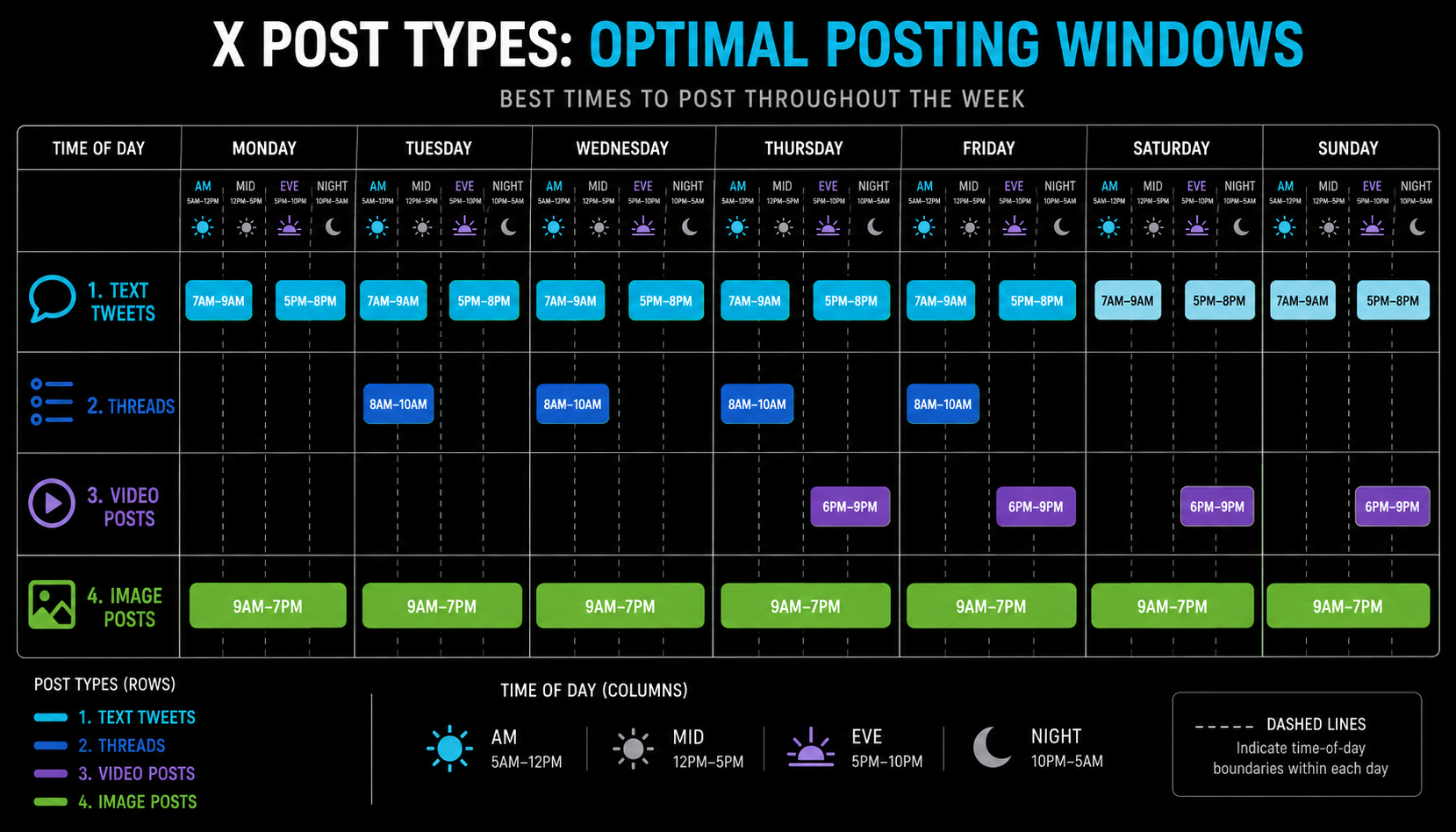
Text posts benefit from peak audience activity windows because they compete against high volume of similar content and rely on rapid scanning to capture attention. Morning windows (7-10 AM) and evening windows (5-9 PM) produce strongest text post engagement. Midday windows work but produce moderately weaker outcomes because midday browsing tends toward more casual attention.
Short punchy text posts perform particularly well during commute windows (7-9 AM, 5-7 PM) matching fragmented commute attention. Longer thoughtful text posts perform better during morning coffee windows (7-9 AM) and evening reflection windows (8-10 PM) when audiences have sustained attention capacity for deeper content consumption.
Threads and Long-Form X Content
Threads benefit from timing that captures sustained attention long enough for viewers to invest in reading 5-15 connected posts. Morning windows (7-9 AM) capture morning coffee reading time. Weekend morning windows (Saturday-Sunday 10 AM to 12 PM) capture leisure reading time. Both windows produce meaningfully better thread completion rates than casual midday browsing windows.
Threads posted during peak evening windows (7-9 PM) sometimes underperform expectations because evening audiences are in scroll mode rather than sustained-reading mode. This is counterintuitive because evening is peak activity time overall. But sustained-attention formats like threads benefit from morning coffee mental mode more than evening scroll mode.
My tracked accounts show morning threads consistently outperforming evening threads by 40-60 percent for engagement rate metrics. But is this pattern universal? Not entirely. Entertainment and pop culture threads sometimes perform better evenings when audiences engage with lighter reading during leisure time. Test your specific thread performance patterns rather than assuming morning universality.
Image and Video Posts
Image and video posts benefit from broader posting windows than text-only posts because visual content captures attention faster during scroll. Video posts particularly benefit from evening leisure windows (7-10 PM) when audiences have sustained attention available for video consumption. Complement organic video posts with quality X likes services during first-hour publishing to strengthen engagement signals that support For You Page distribution eligibility.
Image posts perform strongly across all daily peak windows because static visual content requires minimal viewer commitment. Morning, midday, and evening windows all produce solid image post engagement, making images the most timing-flexible content type on X.
Image post advantage matters for creators managing multiple daily posting slots because image content provides reliable performance regardless of specific window timing. Building a content mix that includes image posts across less-optimal windows while reserving text and thread content for peak windows produces sustainable daily posting cadence without sacrificing per-post performance.
Reply-Chain and Quote Engagement Windows
X differs from other platforms because reply-chain engagement produces meaningful account growth beyond original post distribution. Understanding when to focus reply attention versus original post attention shapes overall X strategy substantially.
Peak Reply Windows for Growth
Reply engagement peaks during weekday morning windows (7-10 AM) when audiences check X for cultural conversation before starting workday tasks. Substantive replies to large accounts during these windows produce disproportionate account discovery because replies appear in the follower notification streams of the accounts you reply to plus the reply feeds of anyone browsing those accounts' content.
My tracked accounts using strategic reply engagement during peak windows consistently produce 40-60 percent higher follower growth compared to accounts focused purely on original posting. The reply strategy captures cross-account audience discovery that pure original-content strategies cannot access. Cross-reference this reply-chain strategy with our X shadowban recovery guide which documents how reply patterns affect account-level distribution health.
Quote Post Timing Strategy
Quote posts (retweets with your commentary) produce hybrid distribution across your followers and the quoted account's audience segment. Peak quote post timing aligns with peak original post timing (Tuesday-Thursday 7-10 AM and 5-7 PM) because quote posts compete with original content for attention across identical distribution surfaces.
Quote posts responding to trending topics or breaking news benefit from immediate posting rather than waiting for peak windows. Trending topic quote posts riding cultural momentum receive algorithmic boost that generic peak-window optimization cannot replicate. But the trending topic must genuinely align with your content niche to convert boost into sustained engagement.
The trending topic timing exception is important because it overrides most general timing advice. When breaking news matches your niche expertise, post immediately regardless of hour. The momentum window closes within 2-4 hours for most trending topics, meaning delayed posting to hit generic peak windows misses the cultural conversation entirely.
Peak Windows on X Are Sharper Than Other Platforms
The compressed 30-90 minute For You evaluation window means X's peak posting slots produce 4-6x impression differences compared to dead-hour posting. Timing discipline is not optional for creators pursuing algorithmic growth on X in 2026.
How to Find Your Personal Best Times Through X Analytics
Generic advice suggests starting windows but X Analytics data reveals what actually works for your specific audience. Building the discipline of checking Analytics and adjusting timing based on data separates accounts that outperform benchmarks from accounts stuck at average performance.
Reading X Analytics Engagement Reports
X Analytics under the Content dashboard shows post performance by publishing time enabling correlation between timing and engagement outcomes. Sorting posts by engagement rate and reviewing publishing timestamps reveals your specific optimal windows that generic advice cannot predict.
Some accounts find weekday morning peaks (business audiences). Others find weekend afternoon peaks (entertainment audiences). Others find highly clustered evening peaks (broad audience). Aligning posting time with your specific analytics patterns produces meaningfully better first-hour engagement than posting at generic recommended times.
Update your timing strategy monthly based on evolving patterns because X audience behavior shifts as accounts grow. Accounts crossing 10k, 50k, and 100k follower thresholds typically develop meaningfully different audience patterns requiring timing adjustment to capture emerging demographic segments.
Correlating Post Timing with Follower Growth
Beyond generic engagement data, tracking specific post timing correlated with follower growth attributable to individual posts reveals empirical patterns for your specific content. Spreadsheet tracking of publishing day, publishing hour, and follower delta reveals patterns Analytics aggregate reports may not surface.
Look for outliers in both directions. Posts with unexpectedly high follower attribution at seemingly suboptimal times reveal timing patterns worth testing more. Posts with unexpectedly low follower attribution at generic peak times may reveal that generic patterns do not apply to your specific niche or audience segment.
Data-driven personal timing beats generic advice consistently once you accumulate 30+ posts of measurement. Before that sample size, distinguishing signal from noise is unreliable. But after crossing 30-40 posts of tracked timing data, patterns emerge with statistical clarity that transforms posting strategy from guesswork into optimization.
Common X Timing Mistakes That Kill Distribution
Understanding what NOT to do prevents wasted posts on timing decisions that guarantee weak algorithmic outcomes. These mistakes appear consistently across accounts stuck at low impression counts despite reasonable content quality.
Posting During Algorithm Dead Zones
Late night posts (11 PM to 4 AM local audience time) consistently underperform because X's For You algorithm evaluates them during platform activity lull. First-hour impression volumes are minimal, initial signals are weak, and the algorithm's initial assessment sets a low distribution ceiling that persists through the post's lifetime.
The exception involves creators targeting specifically nocturnal audiences or international audiences whose peak is your late night. For those specific cases, late night posting aligns with target audience peak. But most creators do not have genuinely nocturnal target audiences and late night posts reflect production scheduling constraints rather than strategic decisions.
Recognizing this distinction lets creators either restructure production for earlier posting capacity or use X's native scheduler to publish overnight-written content during morning peak windows. The scheduling approach captures full timing advantage without requiring creator lifestyle disruption to match audience peak hours across every daily slot.
Batch Posting Multiple Tweets Simultaneously
Publishing 5-10 tweets in the same 30-minute window produces cannibalization where the For You algorithm splits audience attention across all posts simultaneously. Each post receives weaker signals than any single post would have received alone. This batch approach reduces per-post performance dramatically compared to distributed posting across multiple daily windows.
The scheduling fix is straightforward. Batch-produce content during convenient writing sessions then schedule uploads across morning, midday, evening, and late evening windows using X's native scheduling feature or third-party tools like TweetDeck and Buffer. Content production timing separates from publishing timing enabling optimal distribution.
But does the algorithm treat scheduled posts differently than manually published posts? No. X's For You algorithm evaluates the post at publish time regardless of whether the publish action was triggered manually or via scheduler. The distribution outcome depends purely on audience response to the post at its actual publication moment.
Ignoring Timezone for International Audiences
Posts timed for creator's local time rather than audience peak consistently underperform. A US creator posting 6 PM Eastern for a majority-European audience hits their target audience at 11 PM to midnight when X activity is winding down. The upload time matches creator convenience but misses audience peak entirely.
X Analytics geography reports reveal audience concentration by country. Aligning posting timing with audience primary timezone peak activity produces materially better outcomes than posting for creator timezone. Data-driven creators execute timezone alignment consistently while intuitive creators default to their own timezone convenience.
Global creators with distributed audience across US and European timezones face harder decisions than single-timezone creators. The pragmatic approach involves identifying primary segment (typically 40-60 percent of audience) and optimizing for that primary segment while accepting imperfect timing for secondary segments who still engage through delayed browse discovery.
Case Study: X Timing Optimization Producing 3.6x Impression Growth
Concrete numbers illustrate how timing optimization compounds. This case tracks a business commentary X account through 5 weeks of systematic timing testing and adjustment.
Starting Position and Initial Timing Audit
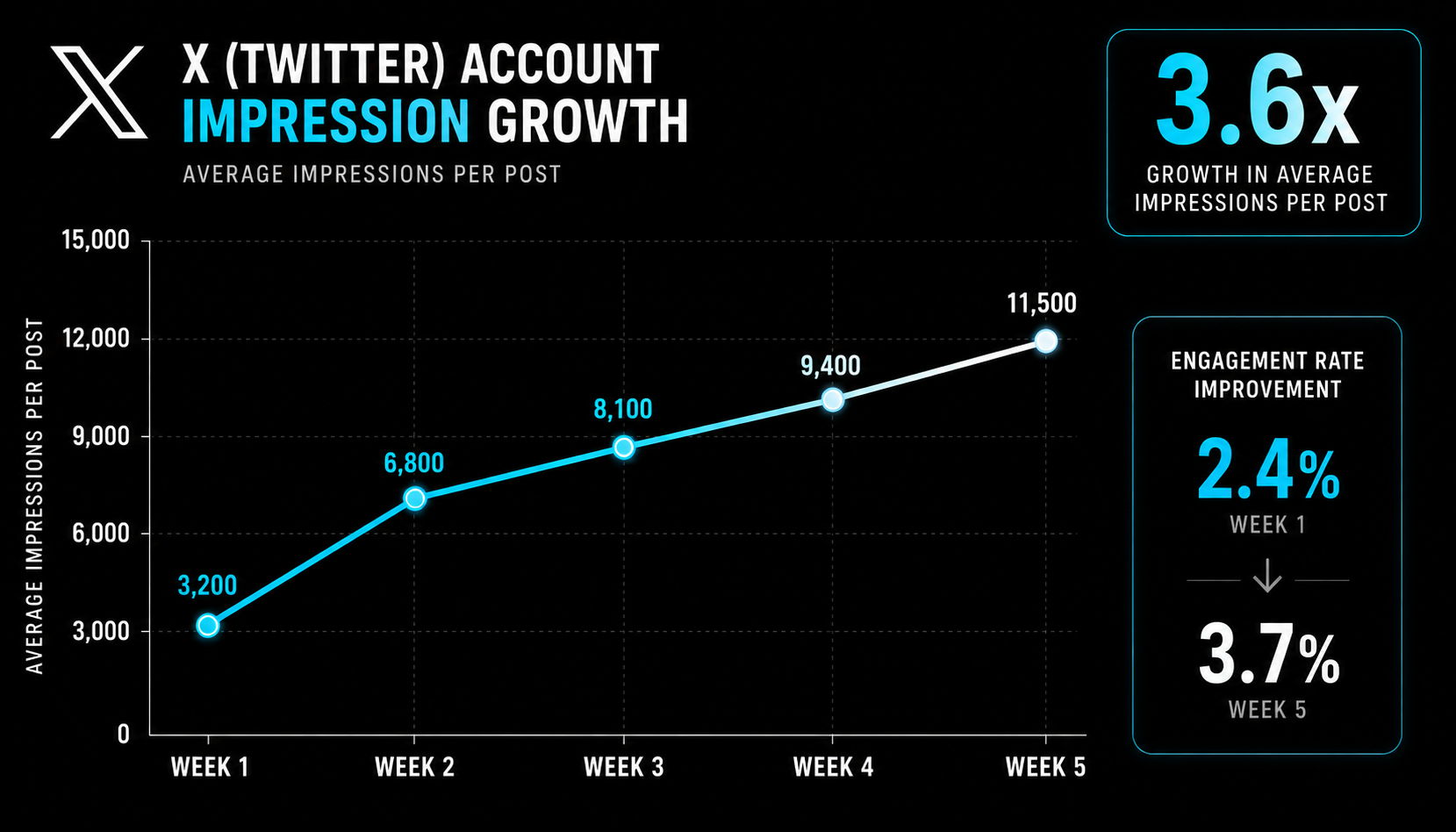
Starting position: 18,500 followers, posting 8-12 tweets weekly at scattered times based on creator availability (mostly late evening after work plus occasional midday batches). Average impressions per post 3,200. Average engagement rate 2.4 percent producing modest growth of 200-350 new followers monthly despite consistent posting effort. X Analytics revealed 68 percent US audience concentrated in Eastern and Central timezones.
Initial timing audit of last 40 posts revealed clear pattern. Tuesday and Wednesday morning posts averaged 6,800 impressions versus 1,900 impressions for late night posts. Hour patterns showed 7-9 AM ET posts averaging 9,400 impressions versus 2,100 impressions for 11 PM to 2 AM posts. The data made timing shift clearly strategically valuable.
The identified optimization involved restructuring posting calendar to consistent 3-4 daily posts distributed across morning (8 AM ET), midday (12 PM ET), evening (6 PM ET), and evening secondary (8 PM ET) windows Monday through Thursday. Weekend posting shifted to Saturday morning and Sunday midday focused windows with reduced frequency.
5-Week Implementation, Results, and ROI
Week 1: Shift to consistent 8 AM, 12 PM, 6 PM ET posting distributed across peak windows. Average impressions per post increased from 3,200 baseline to 6,800 within first week. Engagement rate improved from 2.4 percent to 3.7 percent because peak-window audiences engaged more fully with same content.
Week 2-3: Added strategic reply engagement to large accounts during 7-9 AM ET peak window. This produced cross-account follower discovery that pure original-post strategy could not access. Follower growth accelerated from 350 monthly to 1,200 monthly across weeks 2-3. Average impressions reached 9,400 by week 3.
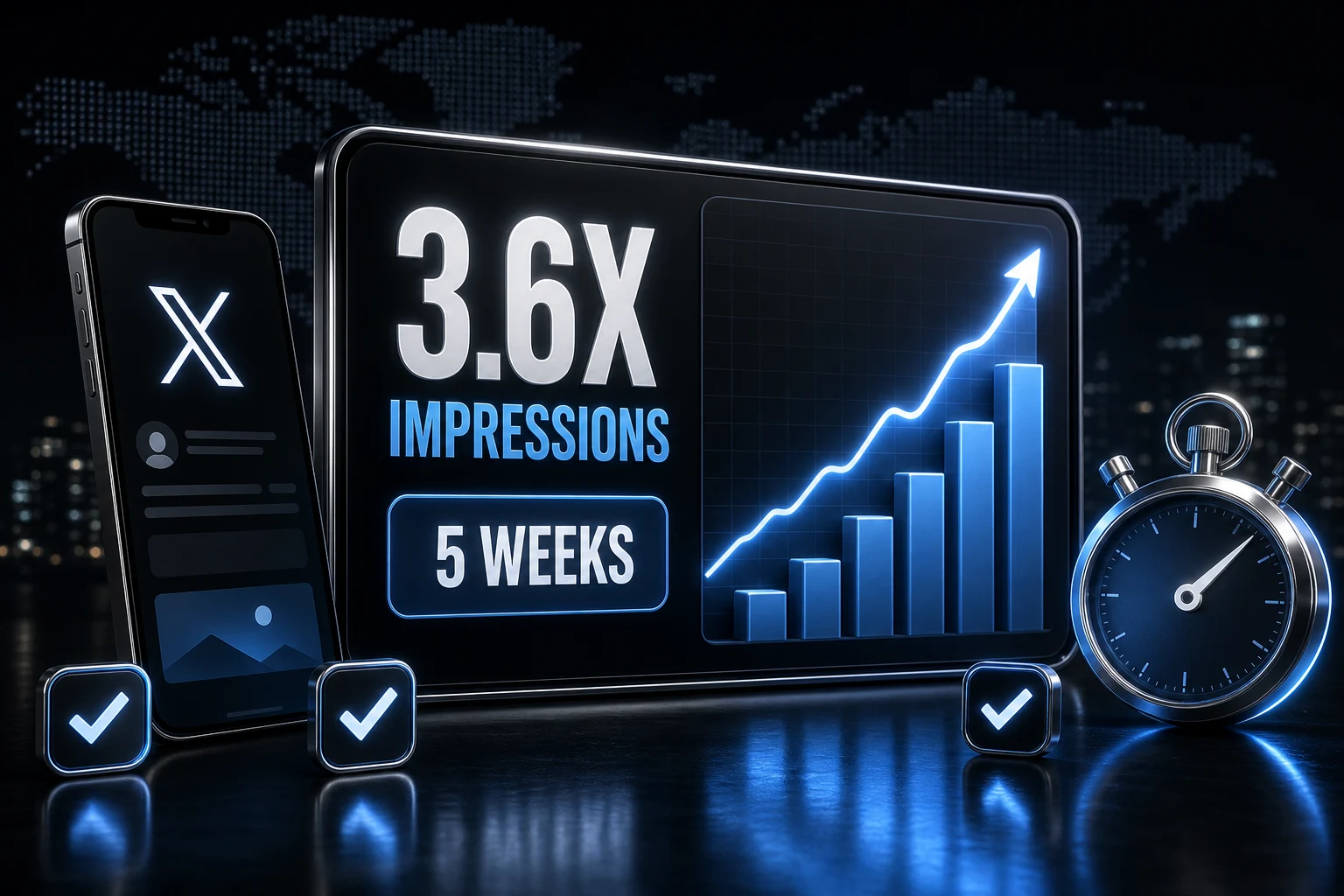
Week 4-5: Continued refinement based on Analytics analysis. Discovered this specific audience had unusually strong 6-7 AM ET early morning peak plus secondary 8-9 PM ET evening peak. Added early morning posts capturing pre-work commute browse. Average impressions reached 11,500 by week 5 representing 3.6x baseline impression growth through timing optimization plus reply strategy combined.
Investment: approximately 5 hours of Analytics analysis time across 5 weeks plus initial 2-hour production calendar restructuring. Additional $95 spent on quality X likes amplification during weeks 2-3 for signal support on critical launches. Zero content quality changes beyond timing shifts and reply strategy. Return: impression growth translated to 3,400 new followers across the 5-week period (from baseline 200-350 monthly to over 1,500 monthly by week 5), plus first sponsored tweet inquiry from a fintech company at 22,000 follower threshold.
Timing Plus Reply Strategy Compounds Faster
X's unique reply-chain distribution means timing optimization compounds with strategic reply engagement to produce faster growth than either strategy alone. Peak-window replies to established accounts drive cross-account audience discovery that original posts cannot match.
Frequently Asked Questions About X Posting Times in 2026
What is the absolute best time to post on X in 2026?
Tuesday, Wednesday, or Thursday between 7-10 AM local audience Eastern Time produces highest average engagement across most content categories, particularly business, tech, and professional content. Adjust based on your specific niche and audience geography visible in X Analytics.
Does day of week matter for X posts?
Yes, significantly. Tuesday-Thursday posts average 30-50 percent higher 7-day impressions than Sunday-Monday posts of comparable content quality across tracked accounts. Wednesday consistently ranks as top day for professional content. Sunday late evening is X's weakest window.
How many times should I post on X per day?
3-5 original posts daily plus 5-15 replies to established accounts produces best sustained growth. Original posts distributed across morning, midday, evening peak windows. Reply engagement concentrated during morning windows when target accounts receive most attention. Consistency matters more than aspirational volume.
Is it bad to post multiple tweets at the same time?
Yes. Batch posting multiple original tweets in the same 30-minute window produces cannibalization where the For You algorithm splits audience attention. Each post receives weaker signals than distributed posting across separate daily windows would produce. Space original posts 3-4 hours apart minimum.
What is the worst time to post on X?
Late night (11 PM to 4 AM local audience time) and Sunday late evening consistently underperform because For You algorithm evaluation windows fall during low platform activity. First-hour impression volumes are minimal producing weak initial signals that cap distribution across the post's entire lifetime.
How do I find my personal best X posting time?
X Analytics under Content dashboard shows post performance by publishing time enabling correlation between timing and engagement outcomes. Sort posts by engagement rate and review timestamps to identify your specific optimal windows that generic advice cannot predict.
Does X posting time affect For You Page distribution?
Yes, indirectly but powerfully. Posting timing affects first-hour engagement rate which the For You algorithm uses to decide distribution expansion. Timing that maximizes early engagement produces better algorithmic outcomes even for identical content quality.
When is the best time to post threads on X?
Morning windows (7-9 AM) capture morning coffee reading time. Weekend morning windows (Saturday-Sunday 10 AM to 12 PM) capture leisure reading time. Both produce better thread completion rates than casual midday or evening scroll-mode browsing windows.
Should I reply to tweets at specific times for growth?
Yes. Reply engagement peaks during weekday morning windows (7-10 AM) when audiences check X for cultural conversation. Substantive replies to large accounts during these windows produce disproportionate cross-account discovery that pure original-post strategy cannot access.
Should I schedule X posts or publish live?
Scheduling to peak windows outperforms publishing at creator convenience. Recording during convenient hours then scheduling for audience peak captures full timing advantage. X provides native scheduling through the web interface plus X Premium subscribers get advanced scheduling features.
How do timezones affect X posting timing?
Posts should target audience primary timezone not creator timezone. Analytics geography reveals audience concentration by country. US-focused creators typically optimize for Eastern time capturing all US timezones. Global creators must choose primary timezone or produce region-specific content windows.
Final Thoughts
Best time to post on X in 2026 combines universal patterns (Tuesday-Thursday morning peaks, midday and evening secondary windows, dead late-night hours) with niche-specific and audience-specific adjustments based on Analytics data from your specific account. Generic advice provides starting points that let creators avoid the worst timing mistakes. Data-driven personal optimization compounds those starting points into materially better sustained performance.
The creators who master X timing consistently execute the same pattern. Understanding X's compressed 30-90 minute For You evaluation window shapes strategic posting decisions. Tuesday-Thursday morning windows capture professional content peak. Weekend morning threads capture leisure reading time. Reply engagement during peak morning windows produces cross-account discovery that original posts cannot access. Analytics data drives ongoing personal timing refinement beyond generic advice. Scheduling tools separate content creation timing from publishing timing enabling optimal audience-facing timing.
Understanding the specific timing mechanics documented throughout this guide gives creators the framework to make deliberate posting decisions rather than treating timing as afterthought to content production. And here is the honest truth about X timing in 2026. Timing optimization plus reply-chain strategy is the highest-ROI combination available to X creators because the improvements apply to every future post the account produces while reply engagement drives compounding cross-account discovery... something no other platform offers at this scale.
The NLO SMM X services stack supports both timing-optimized launches for critical posts requiring strong first-hour signal building and sustained amplification during viral push phases. Combined with the timing discipline covered throughout this guide, posting strategy becomes an operational system producing sustained results across every post published. Ready to accelerate your X performance through both timing optimization and strategic amplification? Register your NLO SMM account for immediate access to the follower, likes, and views services that support X growth across every phase.