How the LinkedIn Algorithm Works in 2026 (Deep Dive)
Ready to Grow Your Social Media?
Join thousands of creators and businesses using NLO SMM Panel
LinkedIn's distribution algorithm evolved substantially through 2024 and 2025 into its current 2026 form, and creators applying pre-2024 tactics consistently underperform because the ranking mechanics changed fundamentally in ways most guides still fail to capture. LinkedIn now operates the highest-reach organic distribution among major social platforms, with average post reach ranging 10 to 40 percent of follower base compared to 2 to 5 percent typical on Instagram or Facebook. Yet most creators either apply Twitter-era tactics that stopped working when LinkedIn overhauled its ranking model, or approach LinkedIn as a resume-hosting site rather than a content distribution engine capable of producing consulting inquiries, speaking invitations, and business partnerships worth thousands or tens of thousands of dollars per breakout post. In this complete LinkedIn algorithm breakdown from the NLO SMM team, we cover exactly how LinkedIn's 2026 algorithm actually decides distribution, why dwell time matters more than any other single engagement metric on the platform, the golden hour test window that determines whether posts expand into broad distribution, the specific engagement hierarchy weighting comments above likes and reshares above both, how LinkedIn Newsletters produce audience-owned distribution that bypasses feed algorithm entirely, the Creator Mode features that unlock algorithmic advantages for creators focused on content publishing, the external link suppression mechanics that reduce distribution 40-60 percent, and the amplification path that helps new accounts break past cold-start credibility ceilings that trap most new professional creators.
Our team has analyzed LinkedIn distribution data across dozens of tracked accounts spanning professional categories including B2B SaaS, consulting, executive coaching, marketing, technology, finance, and career development. Every mechanic explained here is grounded in what actually moved metrics on tracked accounts, cross-referenced against LinkedIn's engineering blog communications and published creator interviews. Not recycled Twitter tactics. Not corporate marketing playbook. The specific mechanics operating in 2026, plus a complementary LinkedIn organic growth playbook covering the content tactics that convert algorithmic understanding into sustainable follower and business development outcomes.
Why LinkedIn's Algorithm Requires Different Understanding Than Other Platforms
LinkedIn operates on fundamentally different mechanics than Instagram, TikTok, or X despite the surface similarity of feed-based content distribution. Understanding these differences matters because strategies producing meaningful growth on those platforms often fail on LinkedIn, and creators applying identical playbooks across platforms consistently underperform on LinkedIn specifically.
The Professional Context Filter
LinkedIn users approach the platform during work-related mental modes, looking for professional insights, career development context, industry news, and business relevance rather than pure entertainment. This professional context filter changes what content resonates and what content gets scrolled past. Content that would perform on Instagram (lifestyle imagery, entertainment humor, personal drama) typically underperforms on LinkedIn because it fails to match the professional intent viewers bring to the platform.
Content genuinely useful for professional development (career insights, industry analysis, leadership frameworks, business tactics, technical explanations) outperforms because it matches viewer intent and produces the dwell time signals the algorithm rewards. The professional context match is not restrictive, it just requires calibrating content to what viewers actually want from the platform.
In my experience across tracked accounts, creators who accept LinkedIn's professional context and lean into content that genuinely helps viewers with their work perform materially better than creators who force personal brand styles from Instagram onto LinkedIn. The context alignment produces both stronger engagement signals and stronger business development outcomes because the audience actually converts to real inquiries.
Extended Session Consumption Patterns
LinkedIn users consume content in longer sessions than Instagram or TikTok users typical. Average session times on LinkedIn are 8 to 15 minutes compared to 3 to 6 minutes typical on TikTok or Instagram. This longer consumption window supports longer-form content that would fail on shorter-session platforms. LinkedIn posts routinely stretch to 1,500-3,000 character limits and successfully generate engagement.
The extended consumption window supports content depth that shorter platforms cannot sustain. Multi-part frameworks, detailed case studies, extended personal narratives, and analytical breakdowns all work on LinkedIn because viewers have the mental bandwidth and time budget to read them. Creators comfortable with longer-form written content have structural advantages on LinkedIn that they might not have on visual platforms.
Understanding this consumption pattern changes what content creators should optimize for. Instead of chasing viral 15-second video hooks that work on TikTok, LinkedIn creators can build sustained engagement through 1,500-character text posts that reward reading investment. This structural difference makes LinkedIn uniquely suited to creators with strong written communication skills, similar patterns to what our analysis of the X algorithm mechanics revealed about text-first platform advantages.
The Golden Hour Distribution Test
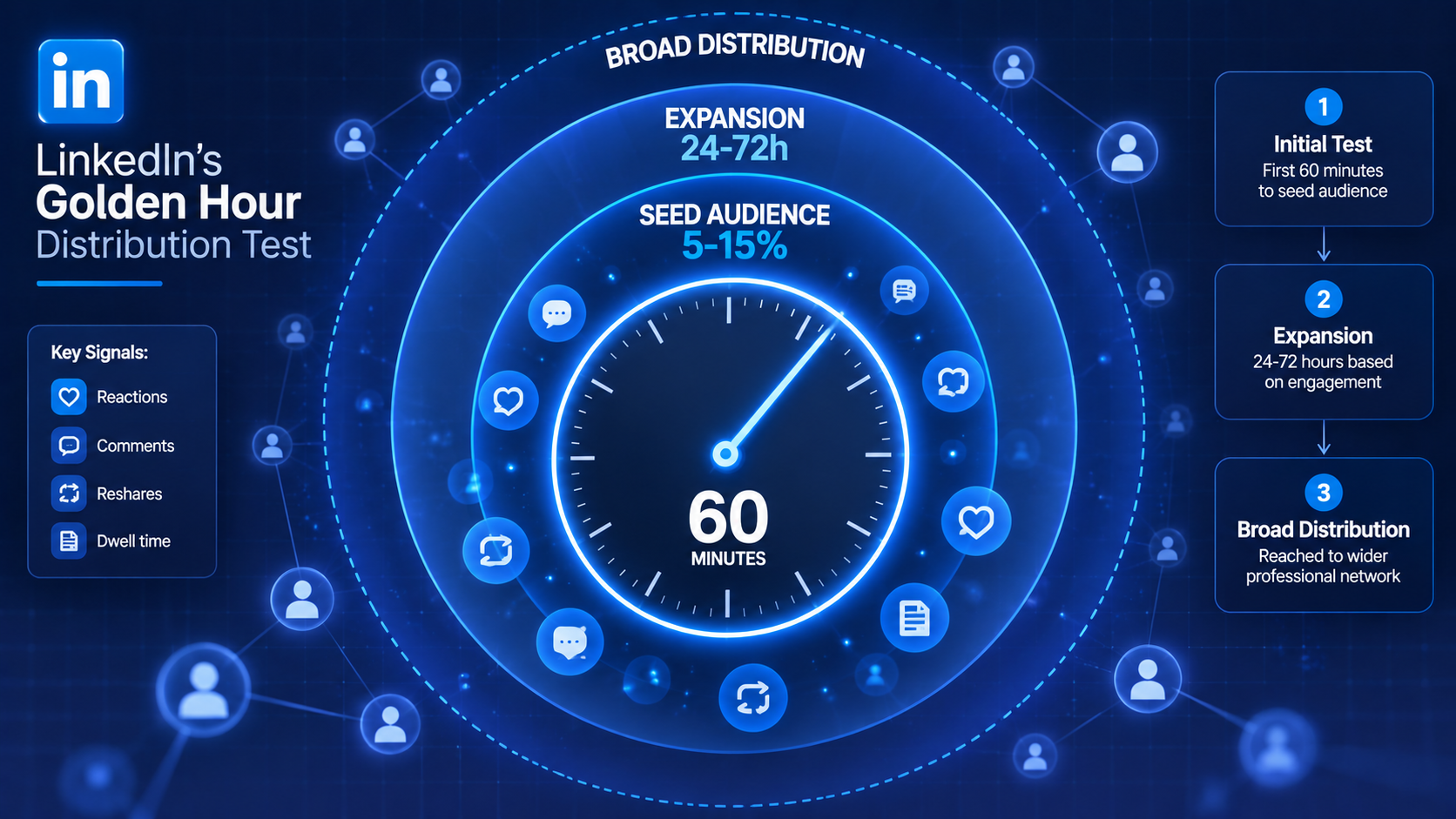
LinkedIn's algorithm uses a specific test window during the first hour after posting to evaluate whether posts deserve expanded distribution. Understanding this golden hour mechanic explains why some posts explode into 100,000+ view viral distribution while other posts from the same account stall at follower baseline.
What the Golden Hour Actually Tests
When you post on LinkedIn, the algorithm distributes it to a small initial audience during the first hour after publish. This golden hour test window shows the post to roughly 5 to 15 percent of your followers plus a small out-of-network exploratory audience. The specific composition varies by account history but the mechanism remains consistent across account tiers.
The golden hour test evaluates specific metrics that determine downstream distribution decisions. Engagement rate (interactions per impression) provides the primary signal. Dwell time (how long viewers spend reading the post before scrolling past) provides the strongest single signal. Comment quality (particularly substantive comments over 10 words) provides secondary confirmation. Share activity provides amplification signal. Save behavior indicates reference-worthy content.
Posts producing strong signals across these metrics during the golden hour expand into broader distribution across the following 24 to 72 hours. Posts producing weak signals stall at the initial distribution ceiling regardless of underlying content quality. Understanding this test window changes strategic posting decisions significantly.
Optimizing for the Golden Hour Window
Posting during peak audience active hours produces stronger golden hour signals because more of your audience is actively browsing when the post enters distribution. Peak hours typically fall in the 7-9 AM and 5-7 PM local time windows for most professional audiences. Tuesday through Thursday typically outperform Monday and Friday for most content categories.
Timing coordination also affects engagement quality during the golden hour. Actively responding to comments within the first 30 minutes of publish produces two effects. First, it demonstrates author engagement that encourages more commenting activity. Second, LinkedIn's algorithm treats author-commenter interaction chains as strong quality signal that expands downstream distribution.
Our team's data suggests dedicating 20-30 minutes to actively responding to comments on posts within the first hour after posting often lifts final post reach by 40-70 percent compared to posting and abandoning. The comment cascade signals during the critical golden hour to Phase 2 transition window produce disproportionate impact on eventual distribution ceiling.
Dwell Time as the Meta-Signal
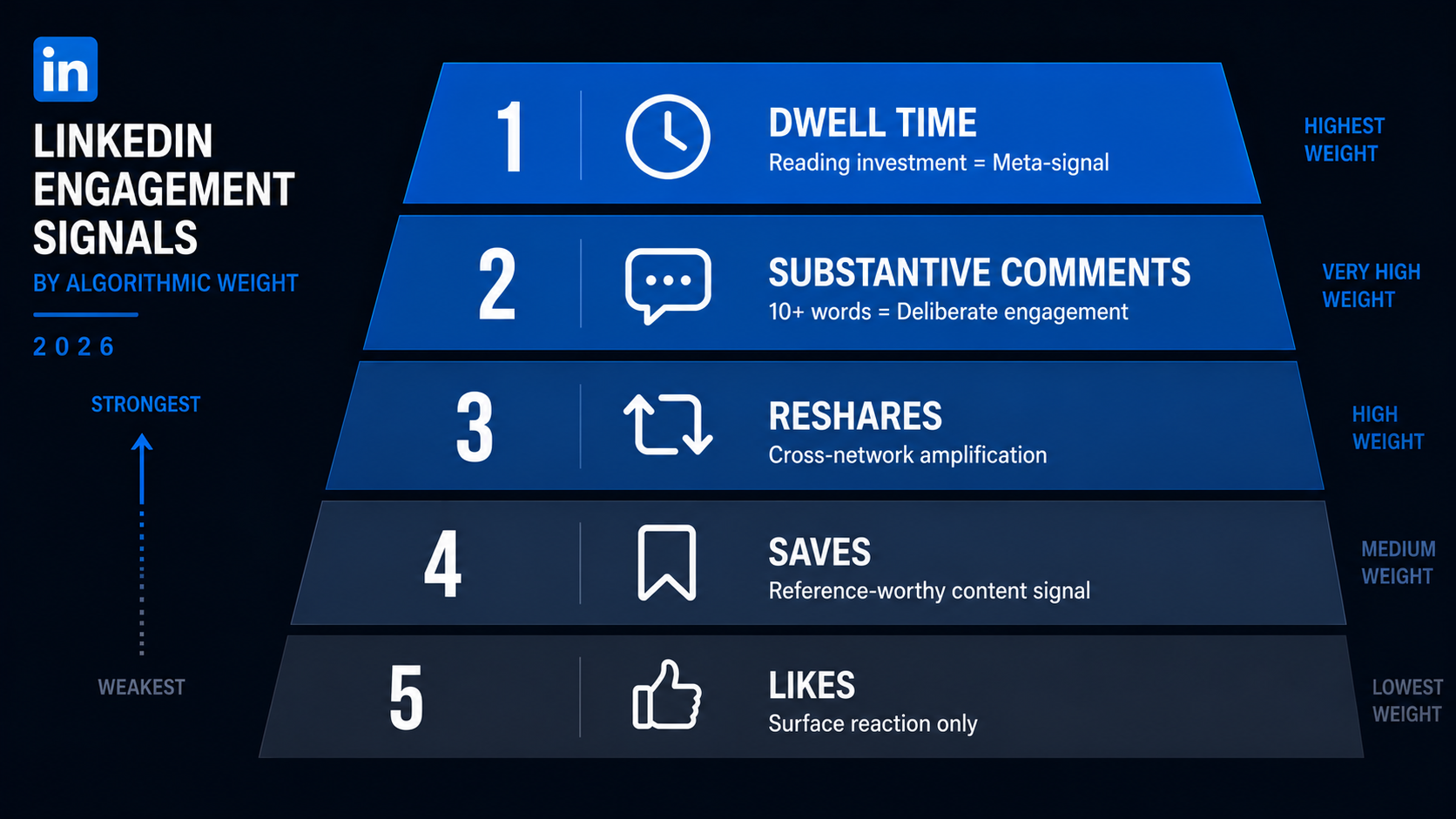
Dwell time emerged as one of the strongest algorithmic signals in the current LinkedIn ranking model, exceeding engagement volume in ranking weight. Understanding this meta-signal changes what content structures produce best distribution.
Why Dwell Time Trumps Engagement Volume
Dwell time (how long viewers spend looking at your post before scrolling past) provides higher-quality signal than raw engagement counts because it measures actual content consumption rather than surface reaction. Longer dwell time signals higher content value than pure engagement volume. A post generating 30-second average dwell time with 20 likes often outperforms a post generating 5-second dwell time with 100 likes in the algorithm's distribution decisions.
The dwell time signal explains why longer, substantive posts often outperform shorter posts even when total engagement seems similar. Readers actually reading a 1,500-character post spend meaningfully more time on it than they spend on a 3-line post they scroll past quickly. This longer time contribution feeds directly into the algorithm's quality assessment for distribution decisions.
Understanding this mechanic changes optimization priorities materially. Creators optimizing for like counts often produce shorter surface-friendly content that generates likes but weak dwell time. Creators optimizing for dwell time produce longer substantive content that generates modest like counts but strong dwell time. The dwell-optimized approach consistently produces stronger algorithmic distribution.
Content Structures That Maximize Dwell Time
Content structures optimized for dwell time share specific characteristics. Narrative openings that create curiosity forcing readers to continue reading. Hook-and-hold structures where the value promise pulls readers through the full post. Multi-step frameworks that require reading through to understand fully. Personal narrative anchors that create emotional investment in the outcome.
Format choices affect dwell time directly. Text posts with generous whitespace between paragraphs produce longer dwell time than dense uninterrupted blocks because readers actually finish them. Carousel PDFs produce very high dwell time because swiping through slides requires sustained visual attention. Native video with strong opening hooks produces high dwell time when the content earns continued viewing.
Testing content variants systematically across your posting cadence reveals which structures produce strongest dwell time for your specific audience. Some audiences respond to narrative openings, others to data-heavy analytical structures, others to framework-driven content. Data-driven format testing outperforms following generic content advice because it accounts for your specific audience preferences.
Engagement Signal Hierarchy on LinkedIn
Not all engagement is weighted equally on LinkedIn. The algorithm has clear preferences that determine which signals trigger distribution expansion and which get filtered out. Understanding this hierarchy changes what content creators optimize for.
Comments Beat Likes by Order of Magnitude
Comments carry substantially more algorithmic weight than likes in the current LinkedIn model. A comment requires meaningfully more effort than a like (writing something thoughtful takes 30-90 seconds versus 1 second for a like), which produces stronger signal about content resonance. Posts generating high comment counts typically get distribution expansion regardless of like counts because comment activity signals deliberate engagement.
The weight differential between comments and likes exceeds most creators' intuitions. A post with 30 substantive comments and 200 likes signals stronger content quality than a post with 5 comments and 3,000 likes in LinkedIn's algorithm evaluation. This is not intuitive because likes are the visible metric that appears prominently on posts, but understanding it produces materially better content strategy.
Content structures optimized for comment generation include open-ended questions inviting responses, contrarian frameworks that invite debate, personal narrative openings that make readers want to share similar experiences, and industry commentary that produces professional discussion. Each of these structures produces disproportionately more comments per impression than agreement-friendly content that everyone approves but nobody responds to.
Reshares as Cross-Network Amplifiers
Reshares produce disproportionate distribution amplification because they expose your content to entirely new audience networks beyond your direct followers. A single reshare from a well-followed professional can produce more impressions than 50 likes from your existing audience. The compounding effect explains why some posts break out to viral distribution levels that pure like accumulation cannot achieve.
Content structures designed to invite reshares include actionable frameworks that professionals want to save and share with their teams, industry insights that people want to distribute to their networks, and contrarian analyses that generate discussion beyond the original post. Each of these structures produces more reshares per impression than agreement-friendly content that gets liked but not shared.
Reshares also carry different weight depending on the resharer's authority. Reshares from creators with meaningful follower counts and professional credibility carry more algorithmic weight than reshares from low-engagement accounts. Building relationships with other LinkedIn creators produces compounding benefits because their reshares of your content elevate your algorithmic signal in ways low-authority accounts cannot match.
Substantive Comment Weighting
Substantive comments (10 or more words with actual content) carry more weight than minimal comments ("great post" type). LinkedIn's algorithm evaluates comment depth as part of engagement quality assessment. Creators optimizing for substantive comment generation through open-ended questions, contrarian takes inviting responses, or frameworks readers want to add to consistently outperform creators optimizing for surface engagement metrics.
Author response to comments also affects algorithmic weight. When authors respond substantively to reader comments, and readers reply to those responses, the algorithm treats the resulting comment thread as extremely valuable signal. Multi-turn comment conversations demonstrate content quality worth sustained discussion, which triggers strong distribution expansion.
Actively curating comment sections through substantive author responses transforms modest engagement into strong algorithmic signal. Comments that would otherwise be surface acknowledgment become entry points to conversation threads that produce dramatically better distribution outcomes than passive comment sections where authors ignore reader engagement.
Newsletters and Audience-Owned Distribution
LinkedIn Newsletters represent one of the most underrated distribution mechanisms on the platform because they bypass feed algorithm entirely. Understanding Newsletter mechanics clarifies why they should be strategic priority for professional creators.
How Newsletter Distribution Bypasses Feed Algorithm
LinkedIn Newsletters function as recurring publications that subscribers actively opt in to receive. Every new Newsletter issue automatically notifies all subscribers through LinkedIn notifications and email, producing guaranteed reach independent of algorithmic distribution decisions. This audience-owned distribution mechanism is dramatically more reliable than pure post distribution that depends on algorithm favorable treatment.
The distribution advantage matters especially during algorithm changes that reduce organic reach for regular posts. Newsletter distribution remains stable while post reach fluctuates. Creators who build meaningful Newsletter subscriber bases develop resilient audience assets that continue producing engagement even when broader LinkedIn distribution shifts under them.
Newsletter open rates typically fall in the 15-35 percent range for engaged subscriber lists, which produces substantially higher effective reach than typical LinkedIn post reach relative to follower count. Investment in Newsletter subscriber growth compounds across every future Newsletter issue, unlike post-based reach that depends on algorithm treatment of each individual post.
Newsletter Subscriber Compounding
Newsletter subscriber growth compounds through multiple mechanisms. New followers automatically appear as prompts to subscribe to your Newsletter. Existing followers see Newsletter subscribe prompts in your profile. Reader shares of Newsletter issues expose the Newsletter to new potential subscribers. Search discovery of Newsletter archives produces sustained subscriber growth from evergreen content.
The compounding effect produces Newsletter subscriber bases that grow steadily even during periods when regular post reach stagnates. Creators reporting Newsletter subscriber counts of 5,000-50,000 typically achieved this through 6-12 months of consistent Newsletter publishing rather than through viral moments. Steady compounding beats viral spikes for Newsletter growth economics.
Newsletter economics also compound in monetization potential. Sponsored Newsletter sections, embedded product mentions, and subscriber list value all scale with subscriber count. A 20,000-subscriber Newsletter produces meaningful sponsorship inquiries even for creators whose regular post reach would not command sponsor attention. This monetization asymmetry makes Newsletters strategic priority even during periods when subscriber growth feels slow.
Content Format Algorithm Weighting
Content format matters enormously on LinkedIn because different formats produce dramatically different average engagement rates. Understanding which formats currently dominate helps allocate content production effort toward the highest-return formats.
Text-Only Posts as Baseline
Despite LinkedIn's investment in video and image content, text-only posts continue producing the highest average engagement rates on the platform in 2026. This is because text-only posts optimize for the professional context viewers bring to the platform, where quick information consumption often beats visual production values. Text posts also travel better through reshares because they render consistently across mobile and desktop views.
Text post structure follows specific patterns for high engagement. Opening hook line that creates curiosity or promises specific value in 8-15 words. Whitespace between short paragraphs (2-4 lines maximum per paragraph). Bulleted or numbered lists breaking up dense content. Personal narrative anchors giving credibility to advice. Call-to-action closing inviting comment engagement rather than external links.
The 1,300-2,000 character sweet spot produces the strongest average performance for most niches. Below 500 characters, posts fail to build dwell time. Above 2,500 characters, engagement drops as readers give up before reaching the value. Testing character length in your specific niche reveals the exact optimum for your audience.
Native Video Distribution Advantages
Native video content grew substantially through 2024-2025 as LinkedIn invested in creator video tools and pushed video distribution priority. Well-produced native videos (1-3 minutes typical) generate strong engagement when they deliver clear professional value. Talking-head format directly to camera outperforms produced video content for most professional topics because it feels authentic and personal rather than promotional.
Video length matters. Under 45 seconds is typically too short for meaningful professional content. Over 3 minutes typically loses viewers before reaching the value payoff. The 60-120 second range produces the best average performance for most B2B and professional development content. Captions are essential because most LinkedIn video plays with sound muted during work environments.
Native video also produces cross-format algorithmic benefits. Posting occasional native videos alongside text posts creates content variety signals that LinkedIn's algorithm interprets positively for account-level assessment. Purely text-only accounts sometimes plateau because format variety signals contribute to sustained account authority development. Understanding how vertical video mechanics differ across platforms (LinkedIn horizontal versus TikTok and Instagram vertical) is covered in detail in our Instagram Reels algorithm analysis for creators managing multi-platform video strategy.
Carousel PDFs and Document Posts
Carousel PDF documents produce exceptional engagement for educational and framework content. Users swipe through slides at their own pace, dramatically increasing dwell time compared to text posts covering equivalent content. Framework carousels, step-by-step guides, and industry data breakdowns all perform strongly in carousel format.
Effective carousels follow specific structure. Cover slide with hook and promise. 5-10 content slides each covering one distinct point. Closing slide with call-to-action inviting comment or save. Consistent visual design across slides. Clean typography readable on mobile. Each slide should stand alone as a complete thought while contributing to the carousel narrative.
Carousel dwell time advantages produce disproportionate algorithmic distribution boosts because dwell time is such a heavily weighted signal. A carousel producing 45-second average dwell time triggers substantially stronger distribution than a text post producing 15-second average dwell time even at similar engagement counts.
Dwell Time Beats Every Other Signal
LinkedIn's algorithm weights dwell time above likes, comments, and reshares in current 2026 ranking. Content structures optimized for long dwell time (carousels, substantive text posts, native video) consistently outperform surface-optimized content across every tracked account category. Optimize for reading investment, not surface reactions.
Creator Mode and Its Algorithmic Advantages
LinkedIn Creator Mode is a specific profile setting that unlocks algorithmic advantages and additional features for creators focused on content publication. Understanding what Creator Mode actually provides clarifies whether activating it makes strategic sense for specific accounts.
What Creator Mode Actually Unlocks
Creator Mode changes the profile call-to-action button from "Connect" to "Follow" (making followers the primary connection type rather than mutual connections), unlocks LinkedIn Live streaming capabilities, provides access to advanced analytics on post and profile performance, enables LinkedIn Newsletter publishing, and adds the "creator" designation that appears in search results and profile displays.
The follow-versus-connect change is the most algorithmically impactful for growing creators because it lets audiences follow content without requiring mutual acceptance of connection requests. This produces materially faster follower growth for creators with content-following-worthy profiles compared to standard Connect mode that gates growth behind acceptance friction.
Creator Mode also produces algorithmic weighting adjustments where content from Creator Mode accounts receives slight preferential treatment for broad distribution consideration. The magnitude of this preferential treatment is modest but meaningful for accounts approaching the borderline between standard and expanded distribution outcomes.
When Creator Mode Makes Strategic Sense
Creator Mode benefits creators actively publishing content and building audiences beyond their immediate professional network. It does not benefit accounts using LinkedIn primarily for job search, sales outreach requiring mutual connections, or purely personal networking. Activating Creator Mode when your primary LinkedIn use is not content publishing can actually hurt outcomes by defaulting connections to follows that lack the mutual accept relationship building sales outreach requires.
For creators committed to content publishing as their primary LinkedIn strategy, Creator Mode should be activated as early as possible. The follower-first framing lets audiences build without requiring the mutual accept friction that limits standard profiles. Combined with strong content strategy, Creator Mode accelerates follower accumulation meaningfully compared to identical content on standard profiles.
Creator Mode activation should coincide with commitment to consistent content publishing schedule. Activating without following through on content commitment produces mismatched profile signals where the account appears to be a creator but produces no creator content, which confuses both audiences and algorithm. Match Creator Mode activation to actual content publishing commitment.
External Link Suppression Mechanics
LinkedIn's algorithm reduces distribution on posts containing external links because links drive traffic off platform. Understanding the specific mechanics of link suppression and the workarounds that experienced creators use is essential for accounts that need to share off-platform content.
How LinkedIn Suppresses External Links
Posts containing external links in the main post body receive reduced distribution due to a specific feature penalty applied to link-containing posts. The magnitude of the penalty varies but typically reduces final distribution by 40 to 60 percent compared to identical posts without links. This is why so many LinkedIn creators put external links in the first comment on their own post rather than in the main body.
The suppression applies to all external links, not just competitor platform links. Even benign links to industry articles, personal blogs, or portfolio pages trigger the reduction. The algorithm does not distinguish between valuable and low-quality link destinations at this level. The penalty is applied uniformly to link-containing posts regardless of destination quality.
The suppression mechanism reflects LinkedIn's business incentive to keep users on platform rather than driving traffic to external destinations. Understanding this incentive alignment helps creators plan around the suppression rather than fighting against it. LinkedIn will not remove link suppression because it exists specifically to preserve platform session time.
The First-Comment Workaround Strategy
The workaround that experienced LinkedIn creators use is posting main content in the initial post and dropping external links in a reply to that post. The initial post reaches full distribution because it contains no links. Interested viewers who want the linked content scroll through the comments to find it. This tactic distributes the algorithmic penalty away from the main content while still providing link access for interested viewers.
The first-comment workaround has become widely understood among LinkedIn users. Most professional audiences now automatically check comments for links when creators reference external content, making this tactic effective. Direct link inclusion in post body remains one of the most common self-inflicted distribution wounds new LinkedIn creators make.
Timing the first comment matters. Posting the first-comment link within 30-60 seconds after the main post prevents the algorithm from evaluating your first comment as the primary content. Comments posted 30+ minutes after the main post appear as afterthoughts and produce weaker link visibility even though they still work around the suppression.
Common Mistakes That Kill LinkedIn Distribution
Everything above focuses on what to do. Equally important is what to stop doing. The mistakes below suppress reach across observed accounts, and each one alone can be enough to explain stagnant growth despite consistent posting effort.
Sporadic Posting Patterns
LinkedIn's algorithm interprets erratic posting as unpredictable content value. Accounts posting 5 times one week then going silent for 3 weeks train the algorithm to distrust posting reliability, which affects distribution ceilings even when posts eventually return. Consistent posting cadence produces materially better sustained distribution than burst-and-silence patterns even at identical total post volume.
Sustainable posting cadence typically ranges 3-5 posts weekly for professional creators. Consistency across weeks matters more than any single week's volume. Sustainable posting patterns that continue across months produce compounding algorithmic trust that expands distribution ceilings for every subsequent post.
Cross-platform creators sometimes struggle with LinkedIn cadence because they optimize for platforms with different posting rhythms. Our TikTok algorithm analysis covers the different posting frequency dynamics on short-form platforms, which differ substantially from professional network cadence expectations that LinkedIn rewards.
Engagement Pod Detection
Engagement pods (coordinated groups where creators agree to like and comment on each other's posts) have become increasingly detectable and often produce shadow suppression rather than intended distribution boost. LinkedIn's algorithm identifies coordinated engagement patterns that do not match organic behavior and reduces distribution on posts using them.
The specific detection mechanisms include pattern-matching for repeated commenter groups across posts, timing patterns that suggest coordinated activity, comment content patterns that seem templated rather than natural, and engagement account clusters that lack broader engagement history. Detection often produces silent suppression rather than explicit penalties, which means creators may not realize their pod use is damaging distribution.
Building genuine reciprocity networks through consistent authentic engagement over months produces sustainable results without the detection risks of pod arrangements. The distinction matters. Reciprocal engagement between two creators who genuinely follow each other's work produces algorithmic benefit. Coordinated engagement between 20-30 pod members mechanically triggering each other's engagement produces detection risk without corresponding lift.
Format Mismatch to Content
Using wrong content format for your specific content type produces weaker distribution than matching format to content nature. Data-heavy insights work better as carousel PDFs than text posts. Personal narratives work better as text posts than native video. Framework content works well in both carousel and text formats but requires different structural approach for each.
Testing format variants for similar content across multiple posts reveals which formats produce strongest performance for your specific content style. Some creators consistently perform best with text posts. Others peak with carousel PDFs. A few genuinely benefit from native video. Data-driven format selection outperforms defaulting to single format because it accounts for your specific content style and audience preferences.
Case Study: B2B Consultant From Zero to 22,000 Followers in 6 Months
Real numbers make the abstract concrete. This case walks through the actual 6-month timeline of a specific B2B consultant account we tracked from unknown to established LinkedIn presence with material business development impact.
Foundation Phase (Months 1-2)
The account started as a new B2B SaaS pricing consultant with zero LinkedIn presence beyond a basic profile. Content plan was 4 posts weekly (Monday, Wednesday, Friday text posts plus 1 carousel document weekly) with 30 minutes daily dedicated to strategic commenting on established SaaS pricing and B2B marketing accounts.
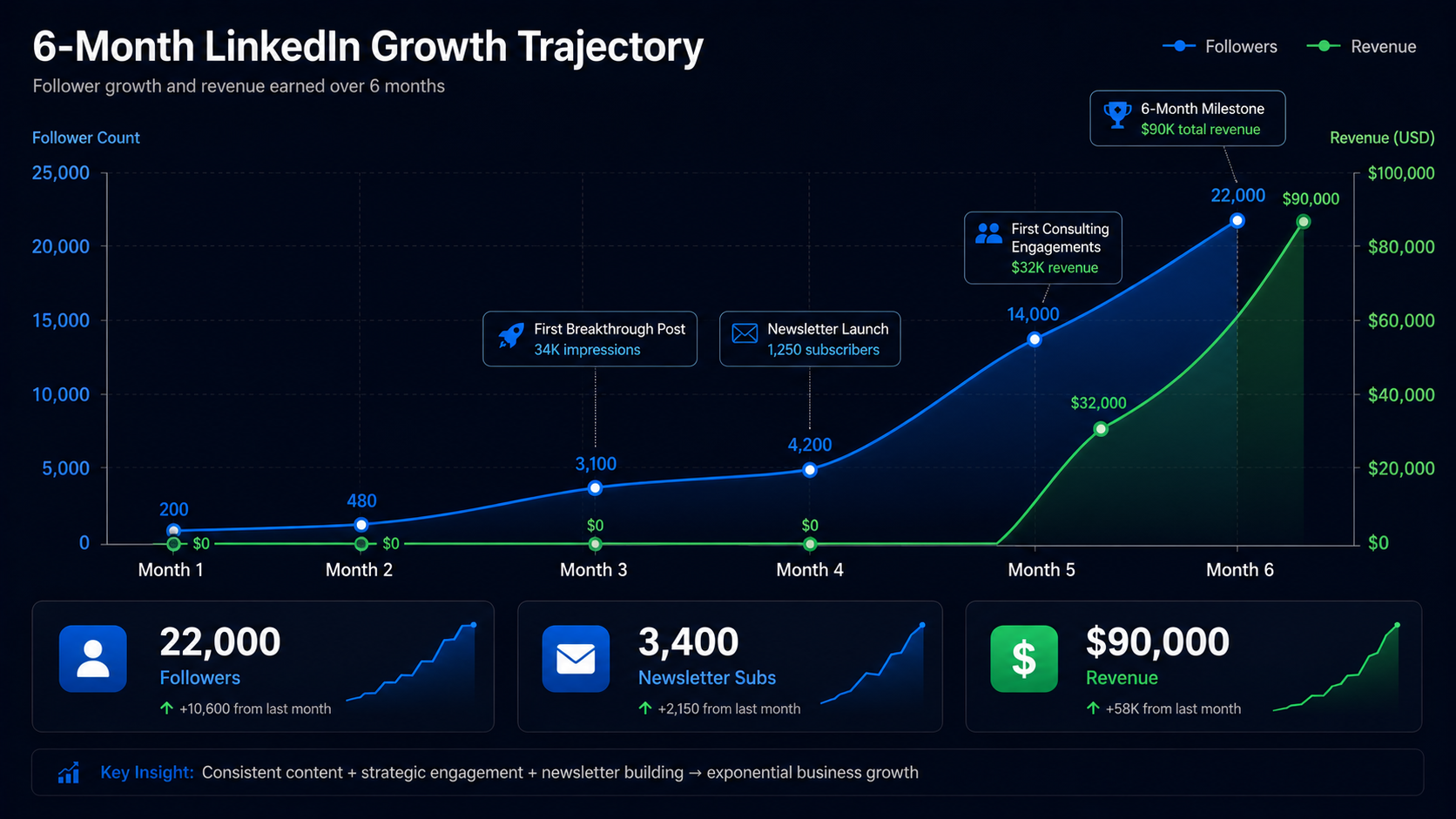
Months 1 and 2 produced typical cold-start results. Average post impressions hovered around 800. Follower count reached 480 by end of month 2. Two posts broke into the 5,000-impression range providing early evidence content was working when it reached matching audience. Commenting strategy started building relationships with 12 established accounts in the B2B pricing niche.
The foundational phase demonstrated content-audience match potential without triggering algorithmic breakthrough. The 5,000-impression breakout posts confirmed content had viral capacity when it matched audience taste correctly. This pattern suggested strategic amplification during subsequent posts could accelerate the trust-building phase.
Growth Phase (Months 3-4)
Month 3 saw the first major breakout post reaching 34,000 impressions and generating 210 followers in 72 hours. This post was a specific framework about SaaS pricing tier design that generated strong reshares from other B2B professionals. The reshare-driven amplification demonstrated the platform's growth mechanics working when content matched audience needs precisely.
Month 4 saw 2 additional posts break into the 20,000+ impression range. Follower count reached 4,200. Commenting strategy expanded to 25 accounts daily with focus on adding specific data points and frameworks to conversations. LinkedIn Newsletter launched Month 4 with initial 340 subscribers converting from existing followers.
The Newsletter launch produced compounding effects beyond the immediate subscriber count. Newsletter issues generated additional post engagement as subscribers shared and discussed issues. Newsletter subscribers converted to higher rates of profile visits, connection requests, and business development inquiries compared to non-subscriber followers.
Scale Phase (Months 5-6)
By month 5, average post impressions climbed to 8,500. Follower count crossed 14,000. Newsletter subscribers reached 1,800. First consulting inquiries arrived through profile messages from LinkedIn readers who had followed the content for 2-3 months. Two consulting engagements signed in month 5 worth $32,000 total, demonstrating the business development impact of established LinkedIn presence.
Month 6 saw sustained growth acceleration. Follower count crossed 22,000. Newsletter subscribers reached 3,400. 4 consulting engagements signed worth combined $58,000. Speaking invitations arrived from 2 industry events. Ambassador partnership discussions started with 2 SaaS tools that align with the pricing consultancy positioning.
Total 6-month journey. Approximately 10-14 hours weekly invested in content production, commenting engagement, and analytics review. Roughly $500 invested in targeted amplification during month 3 to accelerate the cold-start breakthrough. Total followers: 22,000. Total Newsletter subscribers: 3,400. Total consulting revenue attributable to LinkedIn: approximately $90,000. Cross-referencing these outcomes with our complete LinkedIn organic growth playbook clarifies how algorithmic understanding converts to sustainable business development outcomes across the full growth trajectory.
LinkedIn Growth Produces Business Impact, Not Just Follower Counts
Unlike other platforms where growth primarily produces follower counts, LinkedIn growth directly translates to consulting inquiries, speaking invitations, and business partnerships. A 22,000-follower LinkedIn presence in the right niche can produce $75,000-$500,000 in annual business development impact beyond just audience metrics.
Frequently Asked Questions About LinkedIn Algorithm in 2026
How does LinkedIn's algorithm work in 2026?
LinkedIn's algorithm uses golden hour test window during first hour after posting to evaluate whether posts deserve expanded distribution. Signals include dwell time (strongest), comment quality, reshares, and save behavior. Posts producing strong golden hour signals expand to broader distribution over 24-72 hours.
What is the most important ranking signal on LinkedIn?
Dwell time (how long viewers spend reading the post) emerged as the strongest signal. Comments carry substantial weight, particularly substantive comments over 10 words. Reshares produce disproportionate distribution amplification. Optimize for these signals rather than pure like accumulation.
How long is the LinkedIn golden hour window?
First 60 minutes after posting. Algorithm distributes post to 5-15 percent of followers plus small exploratory audience. Strong engagement during this window triggers expansion to broader distribution. Weak engagement stalls the post at initial follower baseline permanently.
Does LinkedIn suppress posts with external links?
Yes. LinkedIn reduces distribution 40-60 percent on posts with external links in main body. Workaround: post links as first comment on your own post. Most viewers know to check comments for links when creators reference external content.
Should I use LinkedIn Creator Mode?
Yes if content publishing is primary LinkedIn strategy. Creator Mode changes profile button from Connect to Follow, enabling faster follower growth without mutual acceptance friction. Not helpful if using LinkedIn primarily for sales outreach or job search requiring mutual connections.
What content format performs best on LinkedIn?
Text-only posts continue producing highest average engagement because they optimize for professional context. Native video (60-120 seconds) and carousel PDFs also perform strongly. Testing format variants in your specific niche reveals what your audience prefers most.
How does LinkedIn Newsletter algorithm work?
Newsletters bypass feed algorithm entirely. Every new Newsletter issue automatically notifies all subscribers via LinkedIn notifications and email, producing guaranteed reach independent of algorithmic distribution. Newsletter subscriber growth compounds through multiple discovery mechanisms.
How many posts should I make per week on LinkedIn?
3-5 quality posts weekly produces best balance of consistency and content quality. Under 3 weekly loses momentum with algorithm's frequency preferences. Over 7 weekly typically dilutes quality unless creator has substantial content production support. Consistency matters more than raw volume.
What are the best posting times on LinkedIn?
Peak audience active hours are typically 7-9 AM and 5-7 PM local time in your target timezone. Posting during these windows produces stronger golden hour signals because more audience is actively browsing. Tuesday through Thursday typically outperform Monday and Friday.
Do engagement pods still work on LinkedIn?
Rarely. LinkedIn's algorithm increasingly detects coordinated engagement patterns and produces shadow suppression rather than intended distribution boost. Building genuine reciprocity networks over months produces sustainable results without detection risks that pods create.
Does buying followers help LinkedIn account growth?
Quality follower services combined with proportional engagement help by breaking cold-start barriers and signaling credibility to algorithm. Cheap services delivering bulk followers without engagement coherence typically hurt more than help. Service quality determines outcome.
Final Thoughts
Understanding the LinkedIn algorithm in 2026 requires accepting that LinkedIn operates as a fundamentally different platform than other social networks despite the surface similarity of feed-based distribution. The professional context filter, extended session consumption, dwell time weighting, and Newsletter mechanics all differ meaningfully from what creators experience on Instagram, TikTok, or X. Yet most creators still apply cross-platform playbooks to LinkedIn and wonder why performance stays flat.
The creators who consistently produce breakout LinkedIn posts follow specific patterns. Content structures optimized for dwell time rather than surface reactions. Comment cultivation through substantive author responses. Newsletter subscriber building as audience-owned distribution asset. Text-first content with strategic video and carousel supplements. Golden hour timing coordination for optimal distribution signals. Each optimization compounds into account-level algorithmic trust that expands distribution ceilings for every subsequent post. Cross-referencing this playbook with the mechanics we documented for the X organic growth guide reveals how professional network dynamics differ from social platform dynamics in ways that shape optimal content strategy.
The NLO SMM services stack supports LinkedIn amplification aligned with the golden hour timing dynamics that decide LinkedIn distribution outcomes. Combined with content strategy informed by understanding dwell time, comment weighting, and Newsletter mechanics covered throughout this article, deliberate LinkedIn account growth becomes engineering rather than lottery. The B2B professionals generating meaningful business outcomes from LinkedIn in 2026 are executing specific playbooks, and this article documented the mechanics those playbooks operate on. Ready to accelerate LinkedIn growth strategy with quality amplification? Register your NLO SMM account for immediate access to the follower and engagement services that support LinkedIn cold-start breakthrough on new professional accounts.