How the YouTube Shorts Algorithm Works in 2026 (Deep Dive)
Ready to Grow Your Social Media?
Join thousands of creators and businesses using NLO SMM Panel
YouTube Shorts operates on a fundamentally different algorithmic system than long-form YouTube, and creators who apply long-form optimization tactics to Shorts consistently underperform because the ranking mechanics diverge dramatically at every level. YouTube Shorts serves over 70 billion daily views globally in 2026, competes directly with TikTok and Instagram Reels for short-form attention, and generates its own separate creator economy through the YouTube Partner Program's Shorts revenue sharing pool. Yet most creator guides still treat Shorts as a subset of the main YouTube algorithm, missing the specific mechanics that separate Shorts breakouts producing 10 million views from Shorts stalling at 500. The confusion is understandable because YouTube publicly frames Shorts as one product surface within their broader ecosystem, but the algorithmic infrastructure supporting Shorts distribution differs from long-form video ranking in almost every ranking signal, evaluation window, and distribution pipeline mechanic. In this detailed YouTube Shorts algorithm breakdown from the NLO SMM engineering team, we cover exactly how Shorts distribution actually works in 2026, why the ranking signals differ from long-form YouTube video ranking, the three-phase distribution model that determines whether Shorts break out or stall, the specific watch time and loop rate mechanics that separate viral Shorts from ignored ones, how cross-format recommendation between Shorts and long-form affects channel growth strategy, and how targeted amplification during launch windows produces the early engagement signals the algorithm evaluates when deciding Phase 2 distribution expansion.
Our team has analyzed YouTube Shorts distribution data across dozens of tracked channels spanning multiple content categories including comedy, education, gaming clips, lifestyle, cooking, tech reviews, and news commentary. Every mechanic explained here is grounded in what actually happened when tracked Shorts hit different engagement thresholds, cross-referenced against YouTube Creator Insider communications and documented policy updates. Not speculation. The specific mechanics operating in 2026, plus a complementary long-form YouTube algorithm deep dive for creators who want to understand how Shorts and long-form ranking systems interact for channels producing both formats.
Why YouTube Shorts Requires Different Understanding Than Long-Form YouTube
YouTube Shorts is not a smaller version of long-form YouTube. The distribution surfaces, viewer behavior patterns, ranking signals, and monetization mechanics all differ meaningfully. Understanding these differences produces materially better content strategy than applying identical playbooks across both formats.
The Vertical Feed Distribution Model
Long-form YouTube distributes through search results, browse recommendations, suggested video sidebar, and end-screen suggestions. YouTube Shorts distributes primarily through the vertical scrolling Shorts feed accessed through the Shorts tab in the mobile app. This distribution surface fundamentally changes viewer behavior because viewers actively consuming Shorts are in a rapid-swipe evaluation mode rather than the click-and-commit mode of long-form video selection.
The vertical feed dynamic means creators cannot rely on thumbnail curiosity or title interest to earn the click. The video autoplays immediately when the viewer scrolls to it. Success depends entirely on hooking viewers within the first 1 to 3 seconds before they swipe away. This behavioral pattern converts to specific algorithm signal weighting where early view time carries disproportionate ranking weight compared to long-form video.
In my experience across tracked channels, creators who understand the vertical feed dynamic and structure their Shorts openings for immediate visual and audio hook consistently outperform creators applying long-form intro patterns to Shorts content. The behavioral pattern difference is fundamental and drives every downstream ranking mechanic.
Attention Economics Differ From Long-Form
Long-form YouTube rewards sustained watch time across 10 to 30 minute videos. YouTube Shorts rewards concentrated engagement across 15 to 60 second videos. The mathematical relationship between attention and algorithmic reward differs substantially. A long-form video with 5-minute average view duration signals strong content. A Shorts video with 5-second average view duration signals total failure because 5 seconds is barely past the swipe-away threshold.
Understanding these different attention economics changes production philosophy fundamentally. Long-form succeeds through depth and narrative development. Shorts succeeds through immediate payoff and dense information delivery. Same production techniques that produce strong long-form performance often produce weak Shorts performance because the attention economics are inverse.
Established long-form creators transitioning to Shorts frequently experience frustration because their production instincts betray them on the new format. Slower reveals, complex narrative arcs, and multi-beat comedy structures that work in 15-minute videos produce swipe-away rate disasters when compressed to 30-second Shorts. Successful format transition requires accepting that Shorts is a different craft rather than a shorter version of the craft you already mastered.
The Three-Phase Distribution Model on YouTube Shorts
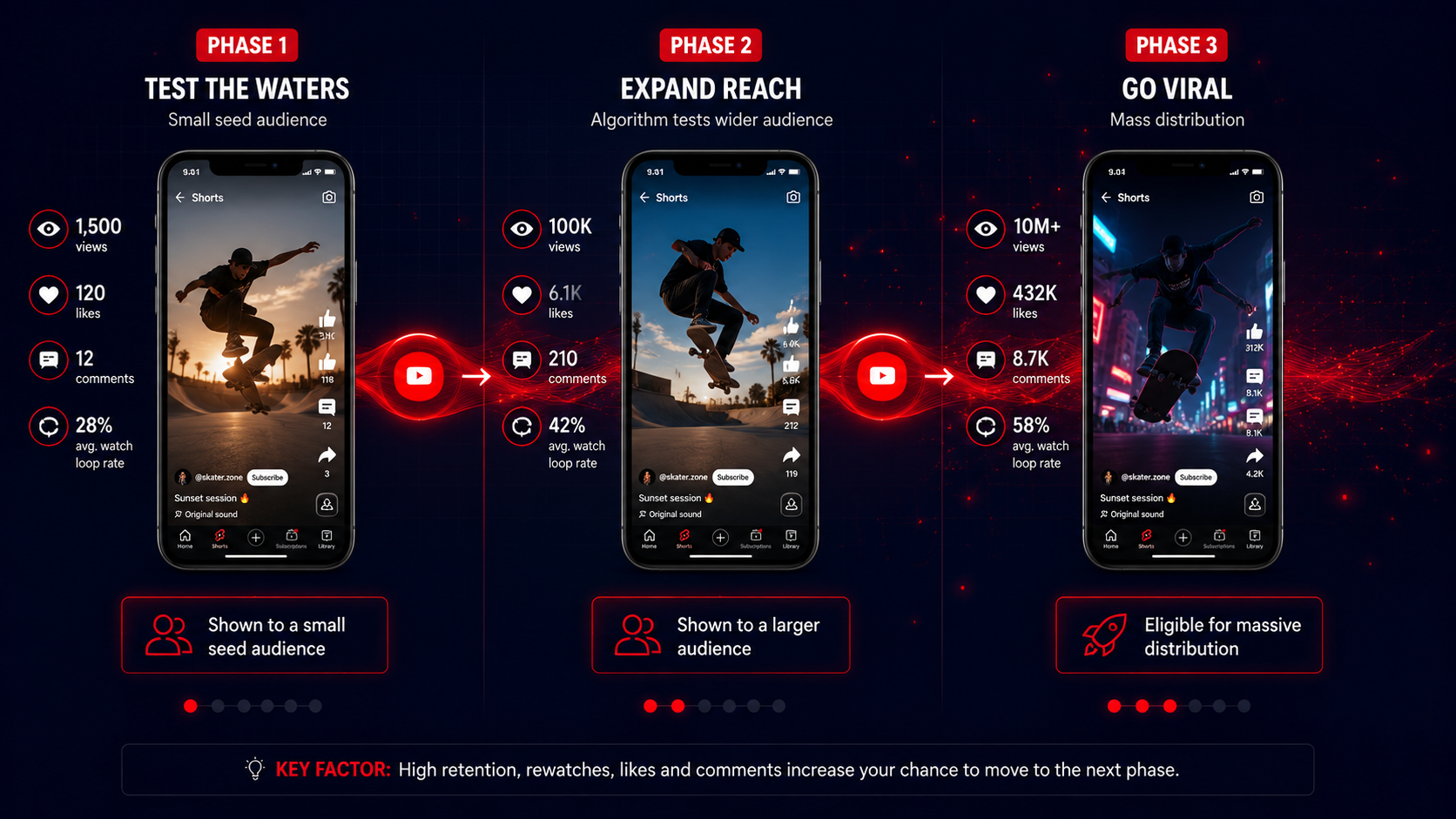
YouTube Shorts move through sequential distribution phases similar to other short-form platforms but with mechanics specific to YouTube's implementation. Understanding this phase structure clarifies why some Shorts explode and others stall.
Phase 1: Initial Seed Distribution
When you upload a Short, YouTube distributes it to a small initial audience during the first 30 to 90 minutes after publish. This seed audience typically ranges from 100 to 1,500 impressions for new channels and 3,000 to 30,000 for established channels with strong subscriber engagement history. The seed audience selection combines viewer history similarity to your content style plus exploratory distribution to broader Shorts feed viewers.
Phase 1 seed audience engagement determines whether the Short expands into Phase 2. The critical signals evaluated during Phase 1 include swipe-away rate (percentage of viewers who swipe away within 3 seconds), average view duration percentage (percent of video length watched on average), loop rate (percentage of viewers who watch the video multiple times), and engagement rate (likes, comments, shares as percentage of views).
Tracks producing strong signals across these metrics expand into Phase 2 rapidly. Tracks producing weak signals stall at the initial seed audience and never reach broader distribution. Understanding this phase gate mechanic explains why so many Shorts hit approximately the same 400-800 view ceiling regardless of underlying content quality when they fail Phase 1 signal thresholds.
Phase 2: Compounding Expansion
Shorts passing Phase 1 signals expand into Phase 2 distribution across the following 4 to 24 hours. Phase 2 distributes Shorts to substantially larger audiences based on continued engagement performance during expanded distribution. Shorts hitting strong Phase 1 signals typically expand from initial 1,500 impressions to 25,000-100,000 impressions during Phase 2.
The compounding dynamic during Phase 2 depends heavily on maintained engagement rate as audience expands. If swipe-away rate stays below 40 percent through Phase 2 expansion, the algorithm continues expanding distribution. If swipe-away rate climbs above 60 percent as expanded audience proves less responsive to the content, distribution reduction happens rapidly. This engagement rate maintenance during expansion is what separates Shorts that plateau at 100K views from Shorts that continue expanding to 1M+ views.
The Phase 2 expansion mechanic explains why some Shorts appear to "die" at specific view thresholds while others continue climbing. When a Short reaches audiences whose taste profiles do not match the content, engagement rate drops and the algorithm interprets this as content-audience mismatch signaling to stop expansion. Content with broad appeal maintains engagement rate across increasingly diverse audiences and continues Phase 2 growth. Niche content plateaus once the algorithm exhausts its niche audience match.
Phase 3: Sustained Distribution
Shorts passing Phase 2 successfully enter Phase 3 sustained distribution that can persist for weeks or months. Phase 3 distribution produces the long-tail view accumulation that turns viral Shorts into 10M+ view accumulators. Most viral YouTube Shorts spend significant time in Phase 3 building total view counts far beyond their initial viral spike.
Phase 3 distribution requires sustained engagement quality even as audiences continue expanding. Shorts that lose engagement rate during Phase 3 exit sustained distribution and return to standard baseline. Shorts that maintain engagement quality continue receiving algorithmic push through the Shorts feed for weeks after publish, which is why some Shorts continue accumulating views long after the initial upload window.
Phase 3 also produces cross-recommendation effects where other Shorts from the same channel start receiving improved seed audience matching. This channel-level authority spillover is why breakout Shorts often produce cascading benefits for subsequent Shorts uploaded during the Phase 3 window. Complementing quality content with strategic engagement amplification during Phase 3 windows helps maintain the engagement quality that keeps sustained distribution active.
The Ranking Signals That Actually Matter on Shorts
Not all engagement is weighted equally on Shorts. YouTube's algorithm has clear preferences that determine which signals trigger Phase 2 and Phase 3 expansion. Understanding this hierarchy changes what you optimize for and produces materially better results than optimizing for outdated signals.
Swipe-Away Rate as the Meta-Signal
Swipe-away rate (percentage of viewers who leave the Short before it completes) emerged as the strongest single ranking signal in the YouTube Shorts algorithm. Low swipe-away rate signals content quality that hooks viewers effectively. High swipe-away rate signals content that fails to earn continued attention. Every other engagement signal gets weighted through the lens of swipe-away rate.
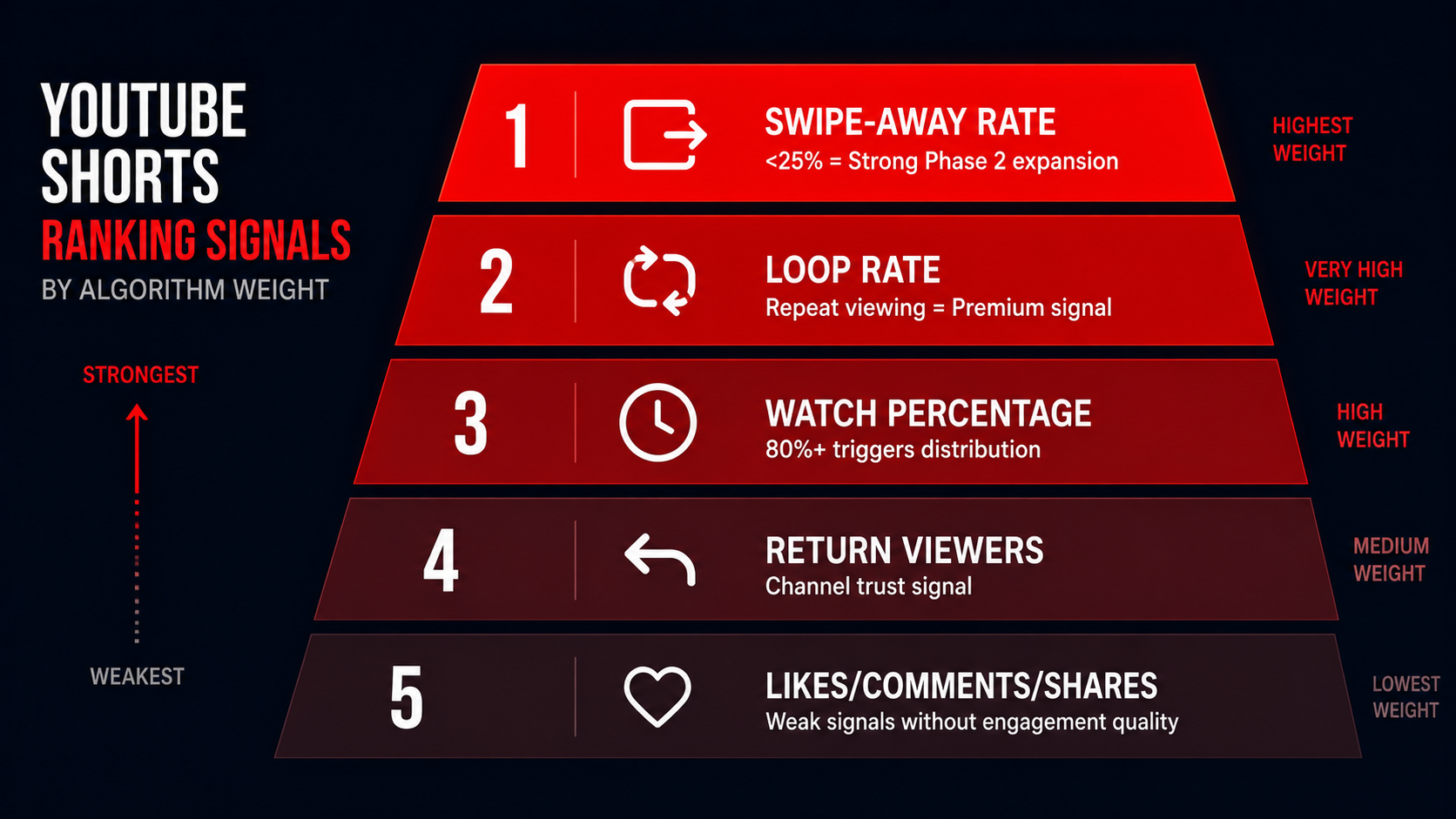
The specific thresholds vary by content category but general patterns hold across tracked data. Shorts with swipe-away rates below 25 percent typically achieve strong Phase 2 expansion. Shorts with swipe-away rates between 25 and 45 percent achieve moderate expansion. Shorts with swipe-away rates above 45 percent typically fail Phase 1 gate and stall at initial seed audience. Optimizing for low swipe-away rate through strong opening hooks materially outperforms optimizing for any other single metric.
In my experience across tracked channels, restructuring Shorts openings to hook viewers within the first 1 to 2 seconds produces 30 to 60 percent reduction in swipe-away rate without any other content change. This single optimization lever has more distribution impact than production quality investment, editing polish, or platform optimization tactics that get more creator attention.
Loop Rate as Quality Signal
Loop rate (percentage of viewers who watch the Short multiple times without swiping away) provides one of the strongest positive signals in the algorithm. Loop behavior indicates content compelling enough that viewers want repeated exposure, which the algorithm treats as exceptional quality indication. Shorts with high loop rates get aggressive Phase 2 and Phase 3 expansion.
The loop mechanic favors specific content structures. Satisfying endings that immediately lead into satisfying beginnings when the video restarts produce natural loop behavior. Punchline reveals that make viewers want to re-experience the setup produce loops. Visual gags where new details become visible on repeat watches produce loops. Sound-only jokes where the audio hook rewards relistening produce loops.
Producing content specifically designed for loop optimization requires deliberate structural choices. The final second of the video should visually or musically connect to the opening second when restart happens. Denouement structure should reward the viewer's brain with the "wait, I want to see that again" reaction. These structural choices produce measurable loop rate improvements that trigger substantially better algorithmic distribution.
Analyzing loop rates in YouTube Studio Analytics reveals which specific Shorts produced strong loop signals and which failed to encourage repeat viewing. Comparing loop-successful Shorts against loop-unsuccessful Shorts across your catalog identifies the structural patterns that produce loops for your specific audience. This data-driven approach to loop optimization outperforms generic loop-design advice because it accounts for what your specific viewers respond to.
Watch Time Percentage Over Absolute Duration
YouTube Shorts algorithm weights watch time percentage of total video length rather than absolute watch duration. A 15-second Short with 12 seconds average view duration (80 percent watch percentage) signals stronger than a 60-second Short with 20 seconds average view duration (33 percent watch percentage) despite the second Short producing more absolute watch time.
This percentage-weighted mechanic favors shorter Shorts that maintain high completion rates over longer Shorts that produce dropoff. The optimization implication is that many creators over-length their Shorts, producing weaker algorithmic performance than shorter versions of the same content would have achieved. Cutting Shorts to the minimum viable duration that still delivers the payoff typically produces better distribution than extending to hit format maximums.
The percentage-weighted signal produces counter-intuitive optimization decisions. When editing raw footage, most creators instinctively include all interesting moments rather than aggressively cutting. But the mathematical reality of the algorithm favors ruthless editing that trims every non-essential second. A 20-second Short with all essential content typically outperforms a 45-second Short containing the same essential content plus additional interesting-but-non-essential material, because the shorter version produces materially higher watch percentage.
Watch Time and Loop Rate Mechanics
Watch time on Shorts operates through mechanics specific to the vertical feed format. Understanding these mechanics clarifies why some optimization tactics that work on long-form video fail on Shorts.
The First 3 Seconds Determine Everything
YouTube's algorithm makes preliminary Phase 1 distribution decisions within the first 3 seconds of average viewer engagement. Shorts that hook viewers past the 3-second threshold get remaining video watch time evaluated for Phase 2 expansion consideration. Shorts that lose viewers before 3 seconds get filtered out of Phase 2 consideration regardless of what happens in the remaining content.
This 3-second gate produces specific content design implications. The visual hook must land before 3 seconds. The audio hook must be established before 3 seconds. The verbal hook (if any) must be introduced before 3 seconds. Content structures that build slowly toward payoff typically fail the 3-second gate regardless of eventual quality because viewers swipe away before reaching the payoff.
Our team's data suggests the 3-second gate operates with slight variance depending on content category. Comedy Shorts need visual or verbal hook by 1.5 seconds because comedic anticipation windows are shorter. Educational Shorts have slightly longer runway to 3.5 seconds because educational viewers pattern-match immediately when they recognize learning content. Understanding your category-specific gate window helps calibrate opening structure precisely.
Playback Speed Behavior
Viewers who slow down playback (rare but present) or replay specific segments produce positive algorithmic signal because their behavior indicates deep engagement with specific content elements. Viewers who scrub through the video (using the timeline to jump around) produce mixed signal that depends on whether they eventually watch through or swipe away.
The scrub-and-watch pattern actually produces particularly positive signal because it indicates the viewer found something compelling enough to non-linearly investigate. This behavior often happens with visual gags where viewers scrub back to catch details or with cooking Shorts where viewers scrub to specific ingredient reveals.
Producing content that rewards scrub behavior means loading visual density into specific moments rather than distributing information evenly across the video. A single second containing 4 or 5 visual details rewards viewers who scrub back to catch what they missed. This density signal produces stronger algorithmic pickup than evenly-distributed content because it correlates with the depth engagement patterns YouTube's algorithm values.
Return Viewer Signal
Viewers who watched previous Shorts from the same channel and return for the new Short signal channel-level algorithmic trust. When multiple existing subscribers or previous viewers show up for a new Short, YouTube's algorithm interprets this as channel quality signal and pushes the new Short more aggressively into Phase 2. This return viewer mechanic explains why established channels often see faster algorithmic pickup than new channels producing identical quality content.
Building return viewer signal accelerates through consistency in content style, posting schedule, and creator identity. When viewers form pattern expectations about your channel, they actively seek out your new Shorts through the Subscriptions tab or search. This deliberate return visitation produces the strongest possible return viewer signal because it demonstrates genuine audience commitment rather than passive Shorts feed encounter.
Swipe-Away Rate Beats Every Other Signal
YouTube Shorts algorithm weights swipe-away rate above likes, comments, shares, and even watch time absolute duration. Cutting swipe-away by 20 percent through stronger opening hooks produces more distribution boost than any other optimization. Design the first 3 seconds for maximum hook density.
Cross-Format Recommendation Between Shorts and Long-Form
YouTube's algorithm handles cross-format recommendation between Shorts and long-form video through specific mechanics that most creators misunderstand. Understanding these mechanics changes strategic content mix decisions.
Shorts to Long-Form Conversion
YouTube's algorithm does not automatically recommend long-form videos from creators viewers discovered through Shorts. The two content surfaces operate as largely separate discovery systems. A viewer who becomes a fan through your Shorts does not automatically get recommended your long-form videos through YouTube's algorithm without explicit action.
Converting Shorts viewers into long-form viewers requires deliberate strategy. End-of-Short calls-to-action pointing to long-form content, channel description highlighting long-form videos, community post promotion, and consistent posting patterns that train subscribers to expect long-form content on specific schedule all contribute to cross-format conversion. Without deliberate strategy, Shorts viewers stay in the Shorts feed and never surface for your long-form content.
The subscriber count conversion rate from Shorts audiences to long-form viewers typically ranges from 5 to 15 percent even with deliberate promotion strategy. This lower conversion rate means creators pursuing dual-format strategies should not expect Shorts subscriber growth to translate 1:1 to long-form view counts. Planning cross-format promotion at the 5-15 percent conversion tier produces more accurate revenue projections and content strategy decisions.
Long-Form Impact on Shorts Distribution
Established long-form YouTube channels experience distinct algorithmic behavior when launching Shorts strategies. The channel-level authority accumulated through long-form success partially transfers to Shorts distribution, producing initial seed audience advantages compared to new Shorts-first channels. However, the transferred authority is partial rather than complete because Shorts algorithm evaluates Shorts-specific engagement patterns rather than long-form watch time signal.
The practical implication for established channels is that Shorts should be evaluated as a distinct algorithmic surface requiring dedicated optimization rather than assumed to inherit long-form success. Channels that treat Shorts as afterthought content typically produce weak Shorts distribution even with strong long-form performance because the Shorts-specific optimization requires dedicated attention. Complementing this with our complete YouTube video SEO guide covers the long-form ranking layer that intersects with Shorts strategy for channels producing both formats.
The reverse direction produces a different but equally important dynamic. Shorts channels transitioning to long-form typically experience significant algorithmic learning curves because long-form ranking signals differ substantially from Shorts signals. Watch time thresholds that seem generous by Shorts standards become baseline requirements in long-form ranking. Understanding this direction of transition helps Shorts creators set realistic expectations about long-form performance in the first months after format expansion.
Content Length and Format Optimization
YouTube Shorts support 15 to 60 second video length. Understanding how length affects algorithmic performance clarifies why some duration choices produce dramatically better distribution than others.
The 15 to 30 Second Sweet Spot
Shorts in the 15 to 30 second duration range typically produce the strongest algorithmic performance because they optimize the watch percentage metric that YouTube weights heavily. Shorter Shorts complete faster, which produces higher watch percentages on average. Higher watch percentages trigger stronger algorithmic distribution.
The counter-intuitive implication is that longer Shorts often underperform shorter versions of the same content because the additional length produces disproportionate dropoff. If your 45-second Short would be 90 percent as complete as content at 25 seconds, cutting to 25 seconds typically produces better distribution because the watch percentage improves substantially while retaining most of the content payoff.
Testing multiple length variants of the same content on separate uploads reveals your specific sweet spot. Some content categories perform best at 15 seconds. Others peak at 25 seconds. A few genuinely benefit from 45-60 second duration. Systematic length testing across 5-10 Shorts per length variant reveals the actual data-driven optimal duration for your specific content style, which often differs from generic advice about ideal Shorts length.
When Longer Shorts Work
Longer Shorts (45 to 60 seconds) can outperform shorter Shorts when the content genuinely requires the additional duration to deliver payoff. Story-based Shorts with narrative arcs, educational Shorts explaining complex concepts, and cooking Shorts showing multi-step processes sometimes benefit from longer duration because the story requires it to work.
The distinction between "content requires longer duration" versus "content padded to fill longer duration" matters enormously for algorithmic performance. Longer Shorts that earn their duration through denser content in every second produce strong watch percentages. Longer Shorts that pad content to fill format maximum produce dropoff that damages algorithmic distribution.
Vertical Format Requirements
Shorts must be filmed or edited in vertical 9:16 aspect ratio for algorithmic distribution eligibility. Horizontally shot content uploaded as Shorts gets penalized in the algorithm because the black bars produce weak visual signal and unprofessional presentation. Vertical native filming produces materially better distribution than horizontal footage cropped to vertical after the fact.
Composing shots specifically for vertical framing requires different visual thinking than horizontal composition. Subjects should be positioned to fill the vertical frame rather than lost in horizontal wide-shots reformatted vertically. Text overlays should account for mobile Shorts feed interface elements (like button, subscribe prompt, comment icon) that overlay the bottom-right area of the video. Composition awareness of these mobile-specific constraints produces cleaner visual presentation that supports the low swipe-away rate the algorithm rewards.
Common Mistakes That Kill Shorts Distribution
Everything above focuses on what to do. Equally important is what to stop doing. The mistakes below suppress Shorts distribution across observed channels, and each one alone explains why many creators plateau at low view ceilings despite consistent posting.
Weak Opening Hooks
The single most common Shorts distribution killer is weak opening hooks that fail the first 3 seconds test. Openings that build slowly toward payoff, generic introductions ("Hey guys, in today's video..."), or ambient establishing shots without immediate visual interest produce high swipe-away rates that kill Phase 2 expansion.
Strong openings load the highest-attention moment into the first frame. Movement, color contrast, unexpected visual, immediate audio hook, or direct verbal claim within the first frame all serve as viable opening strategies. The specific approach matters less than the fact that something compelling happens immediately when the video autoplays in the vertical feed.
Testing opening variants on the same core content reveals your specific audience response patterns. Publishing the same core content with three different openings across three separate Shorts uploads reveals which hook style your specific audience responds to most strongly. This data-driven opening optimization outperforms following generic opening advice because it accounts for your specific content style, audience taste, and category-specific attention patterns.
Recycled Content From Other Platforms
YouTube's algorithm reduces distribution on Shorts that contain visible watermarks from TikTok, Instagram, or Snapchat. Cross-posted content with visible platform branding gets 40 to 70 percent distribution reduction compared to native-uploaded content. This penalty applies even when the content is otherwise excellent because the visible watermark signals second-tier content to the algorithm.
The workaround is filming and editing native for each platform rather than cross-posting with watermarks intact. Removing watermarks before upload through video editing produces distribution comparable to native content. The additional 15 to 30 minutes per Short spent on watermark removal typically produces 2 to 3 times more distribution than the cross-posted version would achieve.
Cross-platform creators can benefit from strategic content differentiation across TikTok, Instagram Reels, and YouTube Shorts rather than uniform cross-posting. Each platform has slightly different audience preferences and algorithmic signals that reward platform-specific optimization. Our TikTok organic growth guide covers the platform-specific mechanics that produce native TikTok performance, which differs from what produces Shorts performance despite similar format constraints.
Community Guidelines Adjacent Content
Content that skirts YouTube Community Guidelines without technically violating them can trigger reduced distribution as risk mitigation. Adult-adjacent content, borderline health claims, political commentary near policy boundaries, and content in categories currently receiving increased scrutiny all produce algorithmic caution that reduces Shorts distribution. Creators experiencing this pattern should reference our YouTube shadowban recovery guide for the specific protocol that rebuilds algorithmic trust after community guidelines adjacent content produces distribution reduction.
The algorithmic caution around borderline content often produces silent distribution suppression that creators misinterpret as random algorithmic bad luck. Multiple borderline Shorts compound the caution signal into channel-level distribution reduction that affects all future uploads regardless of individual content quality. Reviewing recent uploads against current community guidelines with honest self-assessment prevents this pattern from spiraling into channel-wide suppression that requires structured recovery to reverse.
The Amplification Path for New Shorts Channels
The cold-start problem for new YouTube Shorts channels centers on the Phase 1 seed audience being small enough that variance in random viewer engagement patterns can determine whether Shorts pass Phase 1 gate. Understanding this mechanic clarifies why some Shorts channels break through faster than others.
Why New Channels Face Distribution Ceilings
New Shorts channels start with minimal channel-level algorithmic trust because no engagement history exists to inform seed audience selection. Every new Short gets tested against small exploratory audiences whose taste profile may or may not match the content. This produces high variance in Phase 1 outcomes where objectively strong content sometimes fails Phase 1 because the sampled seed audience did not match the content well.
Established channels have better seed audience matching because YouTube knows what audiences historically engaged with their content. This audience matching produces more consistent Phase 1 pass rates for established channels compared to new channels producing similar content quality. Breaking through the cold-start ceiling requires either extensive patience (10 to 30 Shorts before consistent Phase 2 pickup) or targeted amplification during Phase 1 windows.
The variance during cold-start phase produces psychologically discouraging pattern where a creator can produce identical quality Shorts and see wildly different view counts based purely on seed audience luck. Understanding that this variance is algorithmic rather than content-driven helps creators avoid the common mistake of dramatically changing content strategy after a few disappointing early results. Consistency across 15-30 Shorts allows the algorithm to gather enough data to make accurate seed audience matching decisions.
How Amplification Accelerates Phase 1 Success
Targeted amplification during Phase 1 windows produces engagement signals that lift Shorts above the exploratory-Phase-1 threshold into Phase 2 expansion. Once a Short enters Phase 2, matching audience discovery happens naturally because expanded distribution reaches viewers who genuinely resonate with the content. The amplification bridges the gap between content quality and algorithmic willingness to test it broadly.
The critical requirement is that amplification signals must arrive during the Phase 1 window (first 30 to 90 minutes after publish) to affect Phase 2 expansion. Signals arriving later still contribute to raw engagement counts but do not affect the algorithm's expansion decision. Quality amplification services deliver engagement rapidly during the critical window rather than distributing signals across days.
In my experience across tracked channels, new channels combining strategic content decisions with well-timed amplification during Phase 1 reach 10K+ view baselines 4 to 8 times faster than channels relying purely on organic patience. The amplification is not a shortcut around content quality. Poor Shorts still stall after amplification because organic viewers do not sustain engagement on genuinely low-quality content. Amplification simply removes the exploration ceiling that prevents good content from being discovered.
Case Study: From Zero to 10 Million Views in 90 Days
Real numbers make the abstract concrete. This case walks through the actual 90-day timeline of a new YouTube Shorts channel we tracked from launch to sustained viral distribution.
The Setup and Content Plan
The channel launched as a new comedy Shorts creator focused on relatable workplace humor. Zero subscribers, no prior content. Content plan was 2 Shorts daily during the initial 90-day sprint, all filmed native vertical, all under 30 seconds, all designed with immediate opening hooks and satisfying loop structures.
Weeks 1 and 2 produced typical cold-start results. Most Shorts stalled at 300-800 view Phase 1 ceilings. Two Shorts broke into 15K and 22K view ranges providing early evidence content was working when it matched seed audiences correctly. Subscriber count reached 190 by end of week 2.
The early ceiling pattern is diagnostic. Consistent 300-800 view stalls typically indicate content quality is adequate but seed audience matching is failing due to cold-start algorithmic exploration limits. Sudden 15K and 22K breakouts during cold-start phase confirm content has viral potential when audience matches correctly. This pattern suggested strategic amplification could produce breakthrough by lifting more Shorts above the Phase 1 threshold to test whether they matched real audience taste.
The Amplification Strategy (Weeks 3-6)
Starting week 3, the creator applied strategic amplification through targeted engagement during Phase 1 windows on 3 Shorts per week (out of 14 posted weekly). These 3 amplified Shorts served as pilots to test whether content-plus-amplification could break through Phase 1 gates that pure content alone had failed.
Week 3 saw first breakthrough. One amplified Short reached 340K views by end of week. Two other amplified Shorts reached 85K and 120K respectively. Week 4 breakthrough. Amplified Short reached 1.2M views, non-amplified Shorts began breaking through more easily because algorithmic trust started building. Subscribers reached 4,200 by end of week 4. Complementing view amplification with strategic subscriber support during this window compounds the channel authority signal that improves seed audience matching for all subsequent uploads.
Weeks 5 and 6 continued strategic amplification while organic pickup accelerated in parallel. Multiple non-amplified Shorts started breaking through Phase 1 gates because the channel's algorithmic trust had built enough that seed audience matching improved even without amplification. The amplification investment during weeks 3-4 produced compounding organic returns during weeks 5-6, which is the target outcome of amplification strategy for new channels.
The Organic Compounding (Weeks 7-13)
Weeks 7-13 saw sustained growth acceleration. Amplification effort was reduced to occasional strategic pilots because organic Phase 1 gates started opening reliably. Multiple Shorts broke into 500K to 2M view ranges organically. Week 10 breakthrough Short reached 4.5M views. Week 12 breakthrough Short reached 3.8M views.
The transition from amplification-dependent to organic-driven distribution represents the target outcome of strategic amplification investment. By week 7, the channel had accumulated enough algorithmic trust that new Shorts routinely passed Phase 1 gates through natural seed audience matching. This trust compounding is what makes early-stage amplification substantially higher ROI than late-stage amplification, because the trust benefits compound across every subsequent upload for the channel's lifetime.
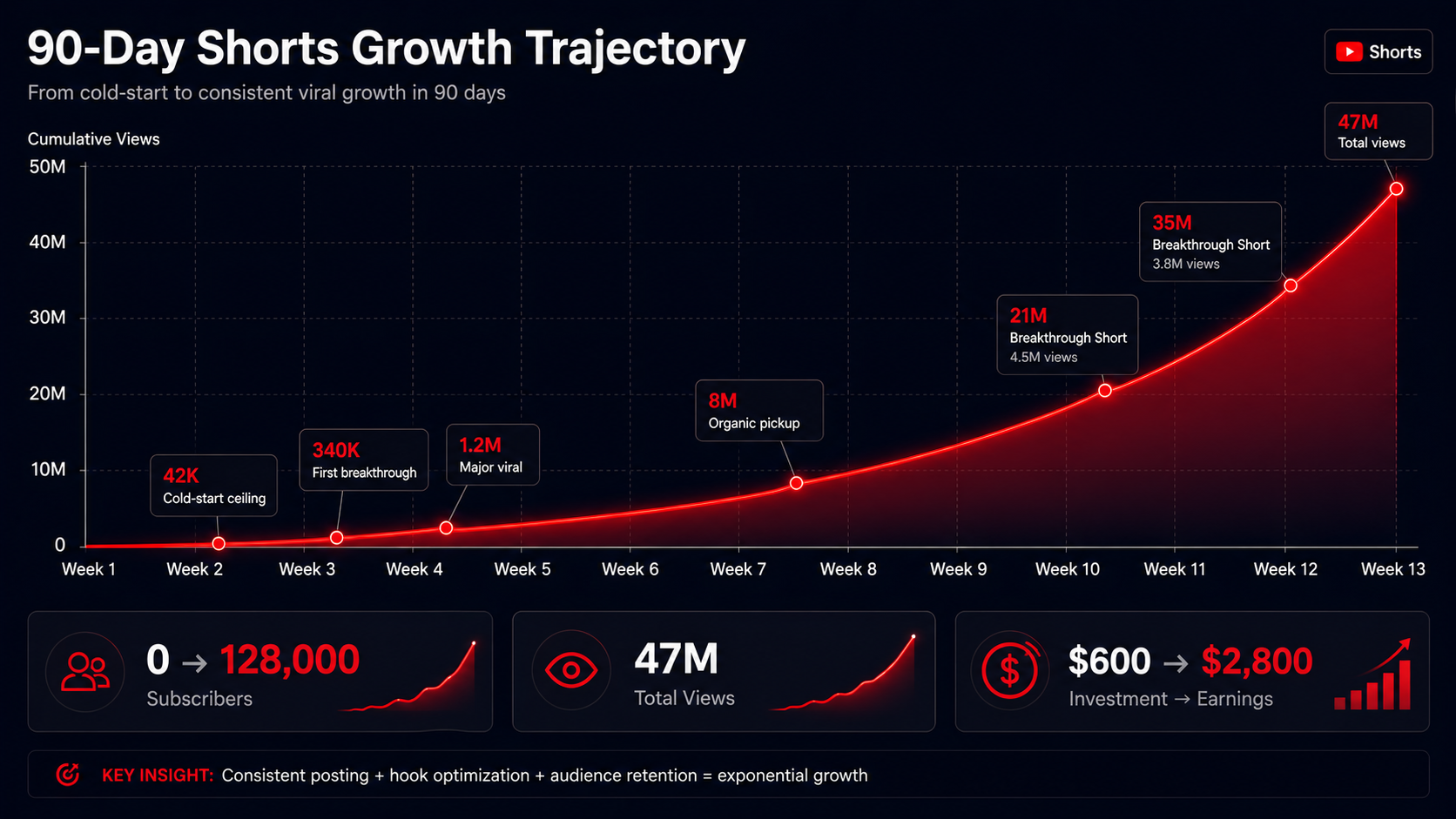
Total 90-day results. 178 Shorts published. Cumulative views: approximately 47 million. Subscribers: 128,000. Approximately $600 invested in amplification services during weeks 3-6. Estimated Partner Program earnings from Shorts revenue sharing pool: approximately $2,800 for the 90-day period based on tracked RPM data. Trajectory suggested continued sustained growth into month 4-6 as channel authority compounds through algorithmic trust accumulation across sustained posting patterns. Cross-referencing these numbers with our complete YouTube creator earnings breakdown clarifies how Shorts view volume translates to sustainable creator income for channels reaching similar scale.
Shorts Growth Compounds Through Trust Building
New Shorts channels face cold-start ceilings that pure content quality often cannot overcome due to algorithmic exploration budget limitations. Strategic amplification during the first 90 days accelerates the trust-building phase and produces channels that reach organic viral distribution ceilings faster than pure organic patience typically achieves.
Frequently Asked Questions About YouTube Shorts Algorithm in 2026
How is YouTube Shorts algorithm different from long-form YouTube?
YouTube Shorts uses vertical feed distribution with rapid swipe-away evaluation rather than click-and-commit long-form video selection. Ranking signals emphasize swipe-away rate, loop rate, and watch percentage rather than absolute watch duration. The two algorithmic systems operate largely independently despite existing on the same platform.
What is the most important ranking signal on Shorts?
Swipe-away rate emerged as the strongest single ranking signal. Shorts with sub-25 percent swipe-away rates achieve strong Phase 2 expansion. Shorts with above 45 percent swipe-away rates typically fail Phase 1 gate. Optimize opening hooks aggressively for the first 3 seconds to minimize swipe-away rate.
How long is the Shorts Phase 1 evaluation window?
Phase 1 runs 30 to 90 minutes after publish. Seed audience of 100-1,500 impressions for new channels evaluates the Short. Strong engagement during this window triggers Phase 2 expansion to 25,000-100,000 impressions. Weak engagement stalls the Short at initial seed ceiling permanently.
What is the ideal length for YouTube Shorts?
Shorts in the 15-30 second range typically produce strongest algorithmic performance because they optimize watch percentage metric YouTube weights heavily. Shorter Shorts complete faster producing higher watch percentages. Cut Shorts to minimum viable duration that still delivers the payoff rather than extending to format maximum.
Do YouTube Shorts pay creators?
Yes, through Shorts revenue sharing pool in YouTube Partner Program. Requires 1,000 subscribers plus 10 million Shorts views over 90 days for eligibility. Payments follow different mechanics than long-form ads. Typical RPM ranges $0.02 to $0.10 per 1,000 views for eligible Shorts content in most niches.
Why do my YouTube Shorts get stuck at low views?
Most stalling happens at Phase 1 gate when Shorts fail to pass swipe-away rate threshold. Common causes include weak opening hooks, watermarks from other platforms, mismatched seed audience for new channels, or duration extending past optimal watch percentage range. Restructure opening hooks first as highest-leverage fix.
Does buying views help YouTube Shorts distribution?
Quality view services delivered during Phase 1 windows help by producing the engagement signals that trigger Phase 2 expansion. Cheap services with obvious bot patterns can trigger algorithm caution that reduces distribution. Timing matters as much as quality since amplification outside the Phase 1 window has minimal algorithmic impact.
Should I post Shorts or long-form for faster channel growth?
Shorts produce faster subscriber growth typically. Long-form produces higher revenue per view. Best strategy depends on monetization goals. Channels prioritizing rapid audience building should focus Shorts first, then introduce long-form once subscriber base builds. Channels prioritizing revenue should balance both formats.
How do watermarks affect Shorts distribution?
Visible TikTok, Instagram, or Snapchat watermarks produce 40-70 percent distribution reduction because YouTube algorithm signals second-tier content. Remove watermarks through video editing before upload. Native-uploaded content substantially outperforms watermarked cross-posted content across all metrics.
How many Shorts should I post daily?
Successful new Shorts channels typically post 1-3 Shorts daily during initial growth phase. Higher volume increases probability of Phase 2 breakthrough because each Short is essentially an algorithmic lottery ticket. Consistency across weeks matters more than any single day's volume. Sustainable posting cadence beats burst posting.
Can YouTube Shorts get shadowbanned?
Yes. Channels producing consistent community guidelines adjacent content, cross-platform watermarked uploads, or engagement anomaly patterns can trigger algorithmic distribution suppression that affects Shorts across the channel. Recovery follows structured protocols involving content audit, quality upload rebuilding, and sustained metric improvement over 4-12 weeks.
Final Thoughts
Understanding the YouTube Shorts algorithm in 2026 requires accepting that Shorts operates as a fundamentally different algorithmic system than long-form YouTube. The distribution phases, ranking signals, and viewer behavior patterns all differ meaningfully from what creators experience on the main YouTube algorithm. Yet most creators still apply long-form optimization tactics to Shorts and wonder why performance stays flat.
The creators who consistently produce viral Shorts follow specific patterns. Opening hooks land within the first 1 to 2 seconds. Watch percentage stays high through 15 to 30 second optimized duration. Loop structures reward repeated viewing. Native vertical filming eliminates watermark penalties. Amplification timing coordinates with Phase 1 evaluation windows. Each optimization compounds into channel-level algorithmic trust that expands distribution ceilings for every subsequent Short. The mechanics are documented, the signals are knowable, and the strategy is executable.
The NLO SMM YouTube services stack aligns amplification delivery with the Phase 1 timing dynamics that decide Shorts distribution outcomes. Combined with content strategy informed by understanding the swipe-away rate, loop rate, and watch percentage mechanics covered throughout this article, deliberate Shorts channel growth becomes engineering rather than lottery. The creators generating meaningful views from YouTube Shorts in 2026 are executing specific playbooks, and this article documented the mechanics those playbooks operate on.